Nanofiltration-based Recovery of Sodium Gluconate from Fermentation Broths of Oil Palm Solid Residue Hydrolysates
Article Sidebar
Main Article Content
Abstract
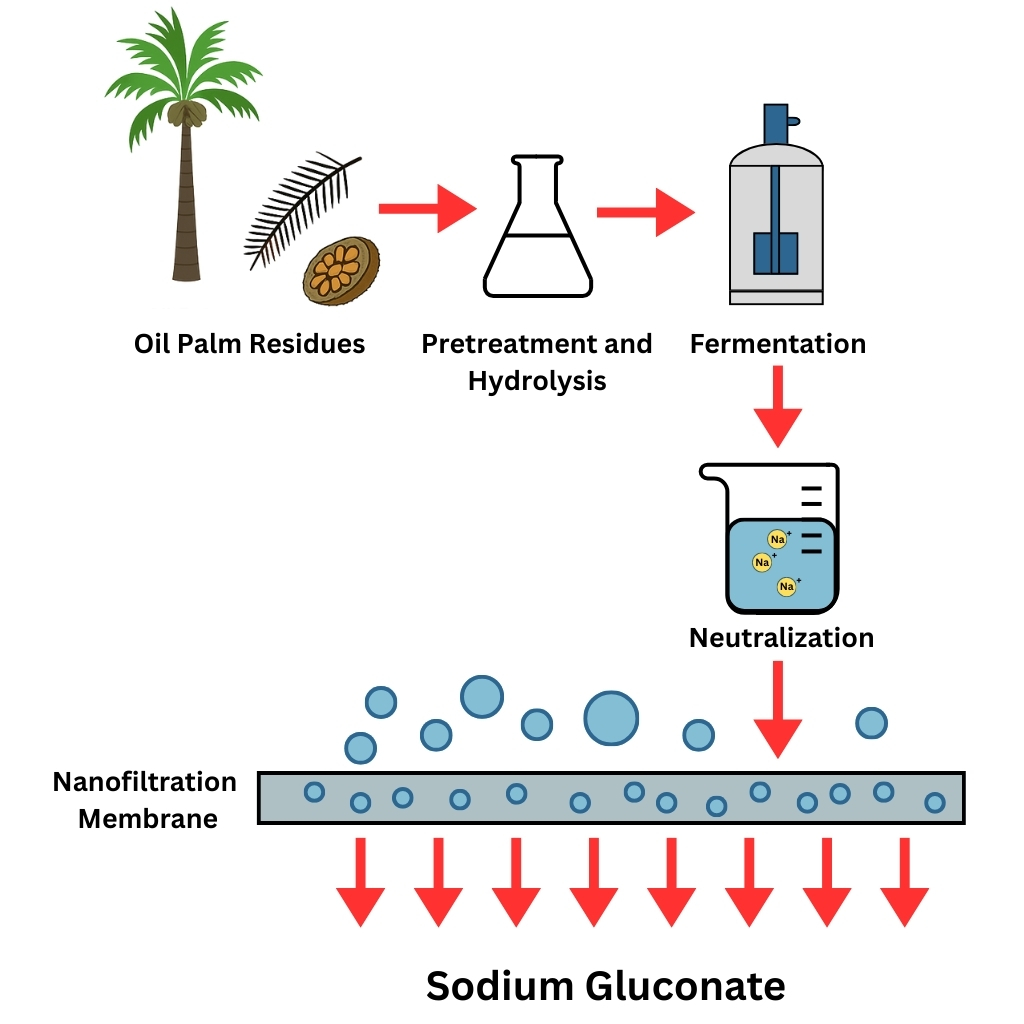
Sodium gluconate (SG), a functional organic salt derived from gluconic acid, is widely utilized in various industrial sectors because of its excellent chelating ability, low toxicity, and biodegradability. SGs can be produced sustainably through the neutralization of gluconic acid, which is obtained from the microbial fermen-tation of lignocellulosic biomass such as oil palm fronds (OPFs) and empty fruit bunches (OPEFBs). To meet commercial demands, SGs must be recovered in concentrated form, and nanofiltration (NF) offers a promising membrane-based approach for this purpose. This study aimed to optimize the SG concentration from the fermentation broths of oil palm residue hydrolysates via a dead-end NF system, with feed pH as a key parameter. The NF270 membrane demonstrated optimal performance when synthetic fermentation broth was used at pH 8.0 and 9 bar, yielding 5.55±0.16 g L-1 SG, a flux of 74.47±0.39 L m⁻² h⁻¹, 28.04±2.13% rejection, and 25.21±1.12% recovery. An increased SG concentration was also achieved in real biomass-derived broths; at pH 8.0, the OPF hydrolysate pro-duced 1.56±0.02 g L-1 SG with 35.72 ± 1.36 L m⁻² h⁻¹ flux, whereas the OPEFB hydrolysate yielded 1.52 ± 0.15 g L-1 SG with 41.29 ± 1.26 L m⁻² h⁻¹ flux. The results demonstrate that feed pH significantly influences nanofiltration performance, particularly in terms of improving the SG concentration and membrane efficiency across different biomass sources. This study provides the first systematic evaluation of SG recovery from oil palm solid residues via nanofiltration, highlighting its potential as a sustainable and efficient alternative to conventional purification methods.
Article Details

This work is licensed under a Creative Commons Attribution-NonCommercial 4.0 International License.
Published articles are under the copyright of the Applied Environmental Research effective when the article is accepted for publication thus granting Applied Environmental Research all rights for the work so that both parties may be protected from the consequences of unauthorized use. Partially or totally publication of an article elsewhere is possible only after the consent from the editors.
