Evaluating Anambra State's Readiness and Willingness for a Subnational Carbon Market for Climate Change Mitigation and Sustainable Development
Article Sidebar
Main Article Content
Abstract
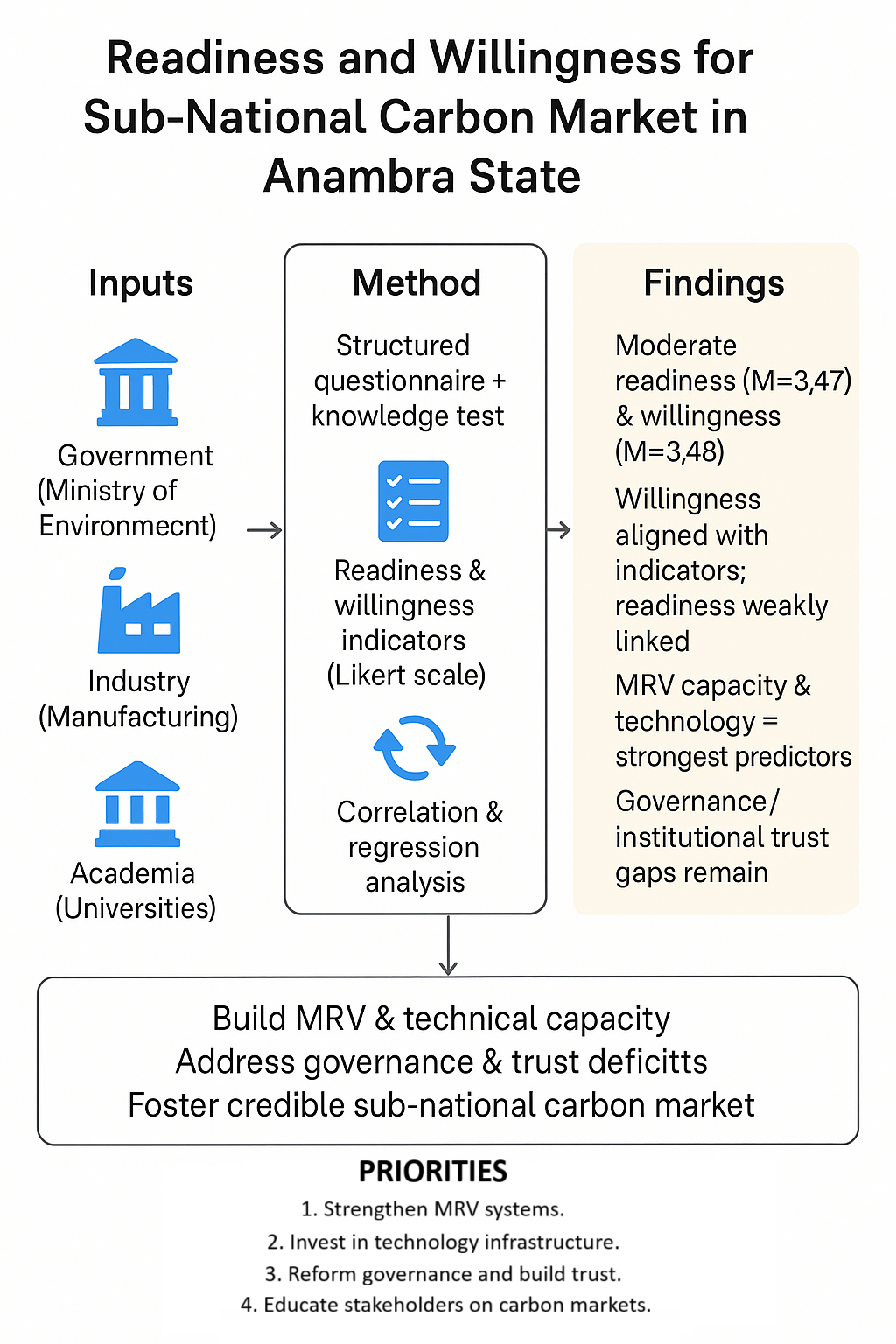
Climate change necessitates innovative strategies, with carbon markets emerging as a key tool for mitigation. This study assesses the readiness and willingness of stakeholders in Anambra State to engage in a subnational carbon market. Using a structured questionnaire distributed across government, industry, and academia, the data were analyzed through descriptive statistics, Pearson correlation, and multiple regression analysis. The findings indicate a moderate level of readiness (M = 3.47) and willingness (M = 3.48) among stakeholders. Correlation analysis revealed a significant alignment between composite willingness indicators and direct willingness to participate (r = 0.406, p = 0.004) but a weak and nonsignificant relationship between composite readiness indicators and direct readiness (r = 0.164, p = 0.261). This finding shows that willingness is partly aligned, but stakeholders doubt actual readiness. Regression analysis revealed that technological capability (B = 0.554, p = 0.002) and monitoring, reporting, and verification (MRV) capacity (B = 0.381, p = 0.006) are the strongest predictors of willingness. In contrast, financial constraints (B = 0.201, p = 0.197), institutional frameworks (B = -0.035, p = 0.858), and coordination between the government and private sectors (B = 0.137, p = 0.554) did not significantly influence willingness. These results indicate that stakeholders prioritize operational and technical readiness over financial and institutional factors, emphasizing the need for robust MRV systems and transparent technological infrastructure to foster confidence in the carbon market. The study recommends targeted investments in MRV infrastructure, governance reforms to address stakeholder skepticism, and enhanced stakeholder education on carbon market mechanisms.
Article Details

This work is licensed under a Creative Commons Attribution-NonCommercial 4.0 International License.
Published articles are under the copyright of the Applied Environmental Research effective when the article is accepted for publication thus granting Applied Environmental Research all rights for the work so that both parties may be protected from the consequences of unauthorized use. Partially or totally publication of an article elsewhere is possible only after the consent from the editors.
