Assessment of Metal Contamination and Potential Health Risk of Roadside Vegetables along the Sayre Highway, Province of Bukidnon, Philippines
Article Sidebar
Main Article Content
Abstract
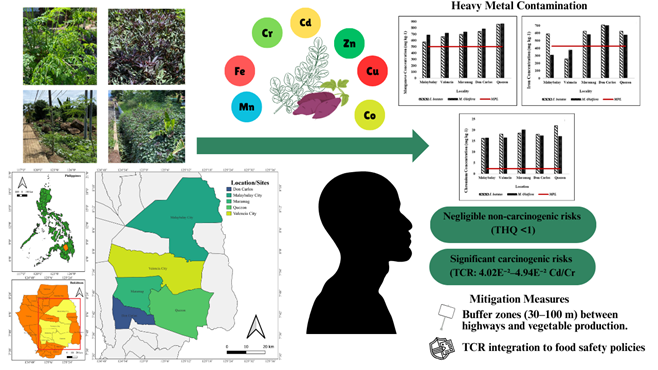
This study assessed heavy metal contamination in roadside vegetables (Ipomoea batatas and Moringa oleifera) across five urbanized localities in Bukidnon, Philippines, and evaluated potential human health risks. Metal concentrations (Cd, Cr, Cu, Co, Fe, Mn, and Zn) were analyzed via atomic absorption spectro-photometry and compared against FAO/WHO maximum permissible limits. The results revealed severe contamination, with Mn (575.27–862.17 mg kg-1) and Fe (256.46–706.68 mg kg-1) dominating natural soil mineralogy (Adtuyon series) and anthropogenic inputs. Toxic Cr (16.20–21.93 mg kg-1) exceeded permissible limits by nine and a half times in Quezon. Health risk assessments revealed negligible noncarcinogenic risks (THQ<1) but significant carcinogenic risks (TCR: 4.02E-2 to 4.94E-2; exceeding the USEPA’s 1E-4 threshold), driven by Cd/Cr ingestion. Correlation analysis revealed synergistic (Zn-Fe: 0.453*) and antago-nistic (Zn-Cr: -0.417*) interactions. Urgent mitigation strategies include buffer zones (≥30 m from roads), *Moringa*-based phytoremediation, and TCR integration into national food safety policies.
Article Details

This work is licensed under a Creative Commons Attribution-NonCommercial 4.0 International License.
Published articles are under the copyright of the Applied Environmental Research effective when the article is accepted for publication thus granting Applied Environmental Research all rights for the work so that both parties may be protected from the consequences of unauthorized use. Partially or totally publication of an article elsewhere is possible only after the consent from the editors.
