Spatial Distribution and Potential Ecological Risk of Microplastics in Surface Sediments of the Inner Gulf of Thailand
Article Sidebar
Main Article Content
Abstract
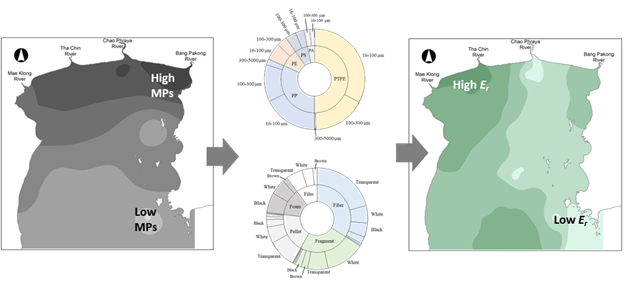
The global surge in plastic usage during the COVID–19 pandemic raised concerns about increased microplastic (MP) contamination in aquatic environments. This study assessed the abundance, characteristics, and ecological risk of MPs in surface sediments of the inner Gulf of Thailand during the post–COVID–19 period (April 2021). The sediment samples were analyzed via density separation, stereomicroscopic examination, and polymer identification via micro–FTIR. The mean MP abundance was 196.07 ± 85.60 pieces kg-1, with concentrations ranging from 73.08 to 351.19 pieces kg-1. PTFE and PP were the dominant polymer types, comprising 50% and 32% of all the MPs, respectively. Fibers (34%) and fragments (24%) were the most common shapes, whereas transparent (42%) and white (32%) were the predominant colors. A significant inverse correlation was observed between MP abundance and seawater depth, as well as between the PTFE and PP fractions, suggesting that the deposition of MPs depends on the horizontal‒vertical distance and the properties of the MPs. The pollution indices indicated moderate contamination (Cf = 2.72±1.19), moderate polymer–specific risk (PRI = 95.35±133.45), and low potential ecological risk (Er = 0.87 ±0.83). Although MPs are present at moderate levels in sediments, the COVID–19 pandemic did not significantly increase MP contamination or ecological risk in the benthic environments of the inner Gulf. However, the potential impacts on the water column remain uncertain and warrant further investigation.
Article Details

This work is licensed under a Creative Commons Attribution-NonCommercial 4.0 International License.
Published articles are under the copyright of the Applied Environmental Research effective when the article is accepted for publication thus granting Applied Environmental Research all rights for the work so that both parties may be protected from the consequences of unauthorized use. Partially or totally publication of an article elsewhere is possible only after the consent from the editors.
