Unveiling Microplastic Removal and Characteristics in Wastewater from Two Municipal Wastewater Treatment Facilities in Indonesia
Article Sidebar
Main Article Content
Abstract
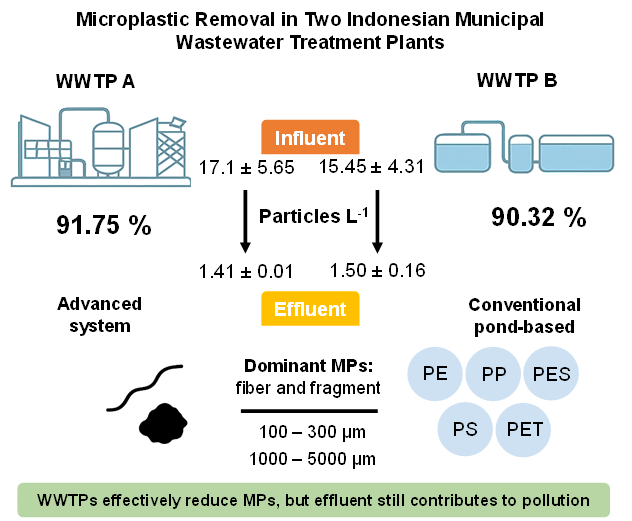
Wastewater treatment plants (WWTPs) are considered an entrance pathways for microplastic (MP) pollution in aquatic environments. This study reveals the removal and characteristics of MPs in wastewater from two municipal WWTPs in Indonesia. The influent contained 17.1 ± 5.65 particles L-1 (WWTP A) and 15.45 ± 4.31 particles L-1 (WWTP B), whereas the effluent contained 1.41 ± 0.01 and 1.5 ± 0.16 particles L-1. The removal efficiency was 91.75% for WWTP A and 90.32% for WWTP B, with no statistically significant difference (p > 0.05). WWTP A employed advanced treatment units, whereas WWTP B used a conventional pond-based system. MPs were characterized via light microscopy, with most particles ranging from 100–300 μm and 1000–5,000 μm. Fibers and fragments were the dominant shapes, with transparent and black being the most common colors. ATR-FTIR analysis identified polymers such as polypropylene (PP), polyethylene (PE), polyethylene terephthalate (PET), polyester, and polystyrene (PS). These findings emphasize the important role of WWTPs in reducing MP pollution and highlight the need to improve treatment technologies to better protect aquatic ecosystems.
Article Details

This work is licensed under a Creative Commons Attribution-NonCommercial 4.0 International License.
Published articles are under the copyright of the Applied Environmental Research effective when the article is accepted for publication thus granting Applied Environmental Research all rights for the work so that both parties may be protected from the consequences of unauthorized use. Partially or totally publication of an article elsewhere is possible only after the consent from the editors.
