Kinetics of Hexavalent Chromium Adsorption and Reduction by Living Cells of the Marine Bacterium Bacillus cereus
Article Sidebar
Main Article Content
Abstract
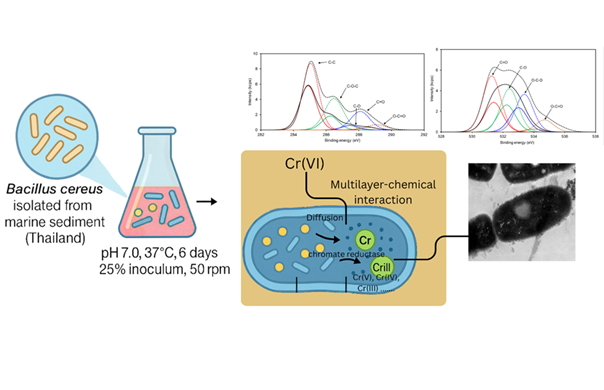
This study identified Bacillus cereus, an efficient Cr(VI) bioreducer, isolated from marine sediment in Thailand. Batch experiments verified the complete removal of 25 mg L-1 Cr(VI) from synthetic wastewater (pH 7.0) after 6 days at 37 °C, 50 rpm, and a biomass concentration of 25% (v/v) culture inoculum. The Freundlich isotherm model demonstrated the best correlation with the Cr(VI) adsorption equilibrium data in the 25–100 mg L-1 concentration range (R2 = 0.9831). Kinetic analyses indicated that the removal of Cr(VI) by living B. cereus followed a pseudo-second-order adsorption model (R2 = 0.9875) and a pseudo-second-order reduction model (R2 = 0.9807). The adsorption rate can be accurately characterized via the intraparticle diffusion model and a Boyd plot. This bacterium can remove Cr(VI) in four steps: (1) migration of Cr(VI) from the fluid into the cell membrane; (2) chemical interaction of Cr(VI) with carbon and oxygen functional groups present on the cell surface; (3) multilayer adsorption and diffusion of chromium ions from the cell surface to the internal pores of the cellular particles; and (4) reduction of chromium ions to other forms. This research highlights the potential application of B. cereus in mitigating Cr(VI) environmental issues.
Article Details

This work is licensed under a Creative Commons Attribution-NonCommercial 4.0 International License.
Published articles are under the copyright of the Applied Environmental Research effective when the article is accepted for publication thus granting Applied Environmental Research all rights for the work so that both parties may be protected from the consequences of unauthorized use. Partially or totally publication of an article elsewhere is possible only after the consent from the editors.
