Health Risk Assessment of Copper Exposure through Hand-to-Mouth Activities in the Lithium-ion Battery Manufacturing Industry
Article Sidebar
Main Article Content
Abstract
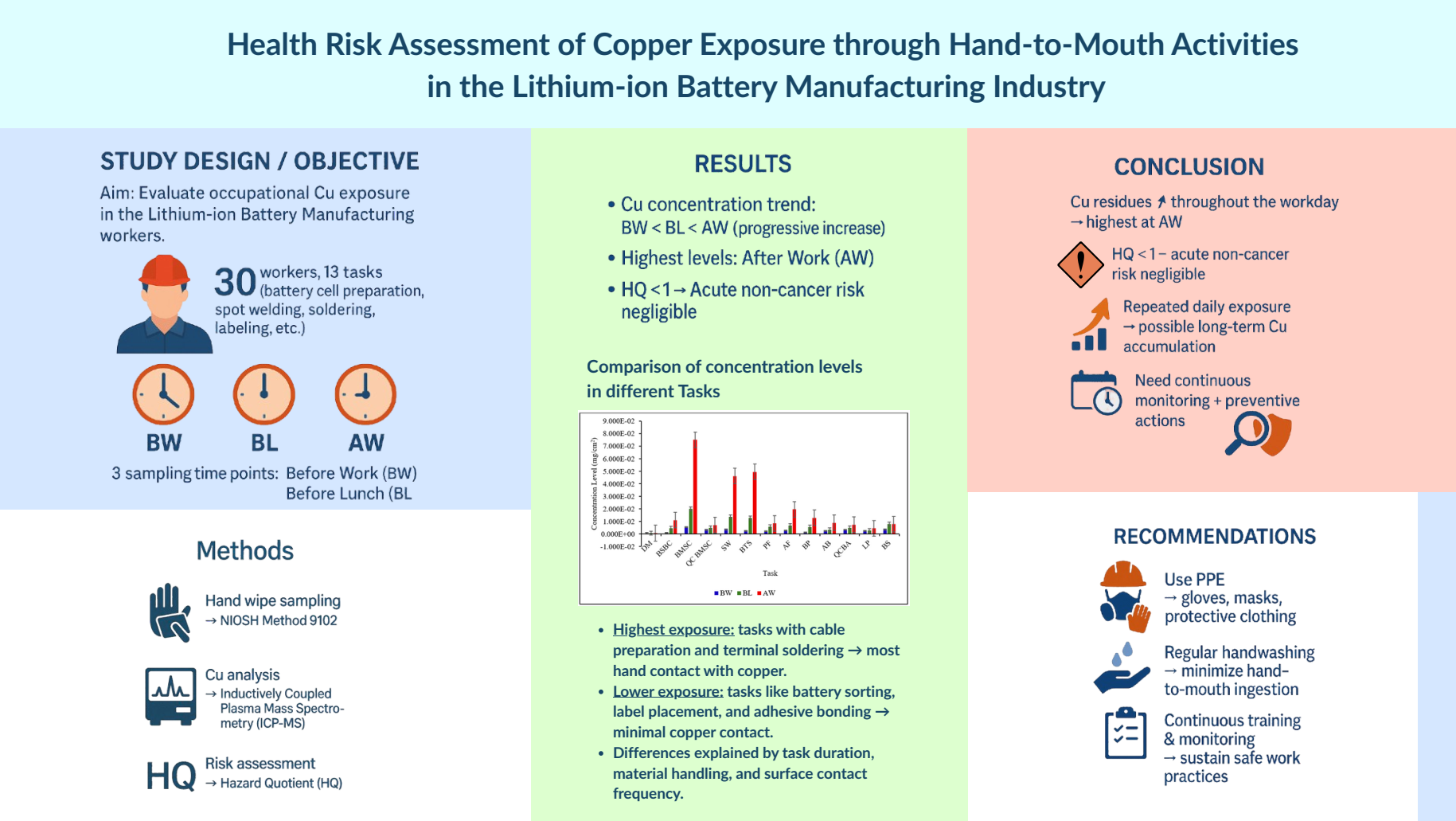
This study aims to evaluate the occupational exposure levels of copper (Cu) among workers in a battery manufacturing facility by analyzing the Cu concentrations on hand surfaces at three distinct time periods: before work (BW), before lunch (BL), and after work (AW). A total of 30 workers involved in 13 different workstations or tasks—such as battery cell preparation, spot welding, soldering, and labeling—were included in the study to reflect diverse exposure scenarios. Surface wipe sampling was conducted according to NIOSH Method 9102, and the Cu concentrations were quantified via inductively coupled plasma‒mass spectrometry (ICP‒MS). Additionally, the hazard quotient (HQ) was calculated to assess potential noncarcinogenic health risks. The results indicate a progressive increase in the Cu concentration throughout the workday, with the highest levels observed during the AW period. However, all HQ values remained below 1, suggesting that acute noncancer health risks are negligible. However, the potential for long-term Cu accumulation warrants continuous monitoring. This study highlights the necessity of preventive measures, such as the use of personal protective equipment (PPE), improved ventilation systems, and regular handwashing, to minimize Cu exposure and reduce unintentional ingestion risks in occupational settings.
Article Details

This work is licensed under a Creative Commons Attribution-NonCommercial 4.0 International License.
Published articles are under the copyright of the Applied Environmental Research effective when the article is accepted for publication thus granting Applied Environmental Research all rights for the work so that both parties may be protected from the consequences of unauthorized use. Partially or totally publication of an article elsewhere is possible only after the consent from the editors.
