Community Perception and Attitudes Toward Plastics and Microplastic Pollution: A Case Study in the Red River Delta, Vietnam
Article Sidebar
Main Article Content
Abstract
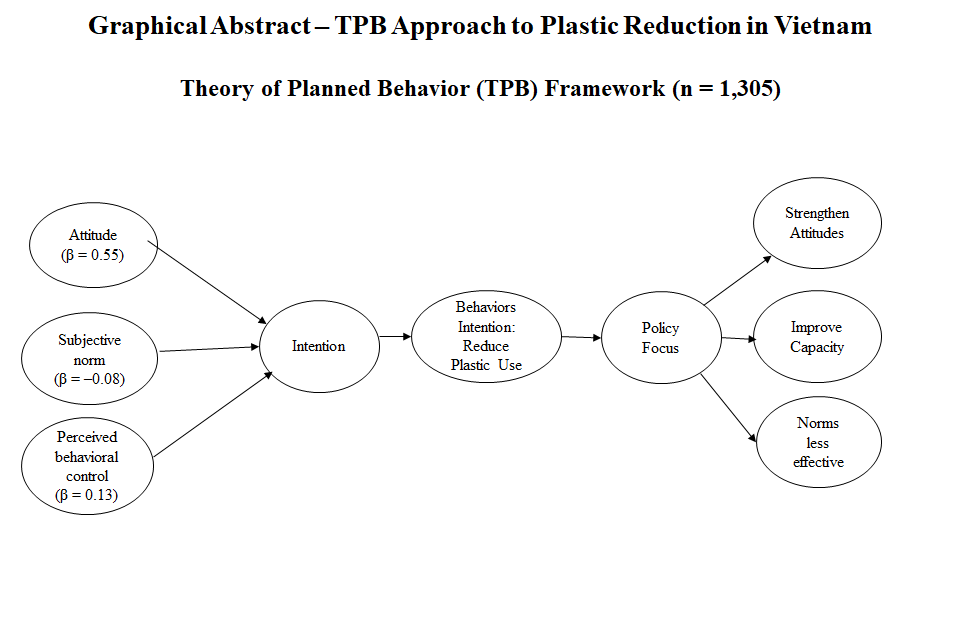
Plastics and microplastic contamination pose increasing threats to human health, food safety, and environmental sustainability. In Vietnam, rapid urbanization, economic growth, and population expansion have contributed to a surge in plastic waste, intensifying pollution across regions such as the Red River Delta. This study adopts the theory of planned behavior (TPB) to explore community perceptions, attitudes, and behavioral intentions regarding plastic and microplastic pollution. A quantitative research design was employed, with data collected through structured questionnaires administered to 1,305 respondents via a stratified multistage sampling strategy across four provinces in the Red River Delta. Descriptive statistics and multiple linear regression analyses were conducted to examine the influence of the TPB constructs on behavioral intention. The results reveal that all three TPB components significantly affect behavioral intention. Among them, attitude has the strongest positive influence, indicating that personal beliefs about the benefits of reducing plastic use are key drivers. Perceived behavioral control also has a positive effect, whereas subjective norms have a small but statistically significant negative influence. This result offers important cultural insights into the social dynamics surrounding plastic use in Vietnam. The novelty of this research lies in its application of the TPB framework to analyze microplastic-related behavioral intentions at the community level in Vietnam, a context that remains understudied in the current literature. This study provides valuable insights for developing targeted interventions and public policies aimed at reducing plastic consumption and promoting sustainable environmental practices in the country.
Article Details

This work is licensed under a Creative Commons Attribution-NonCommercial 4.0 International License.
Published articles are under the copyright of the Applied Environmental Research effective when the article is accepted for publication thus granting Applied Environmental Research all rights for the work so that both parties may be protected from the consequences of unauthorized use. Partially or totally publication of an article elsewhere is possible only after the consent from the editors.
