Land Use and Land Cover Simulation via Integrated Modelling with GIS Techniques for Sustainable Land Utilization Development in the Northeast Khong Subwatershed of Thailand
Article Sidebar
Main Article Content
Abstract
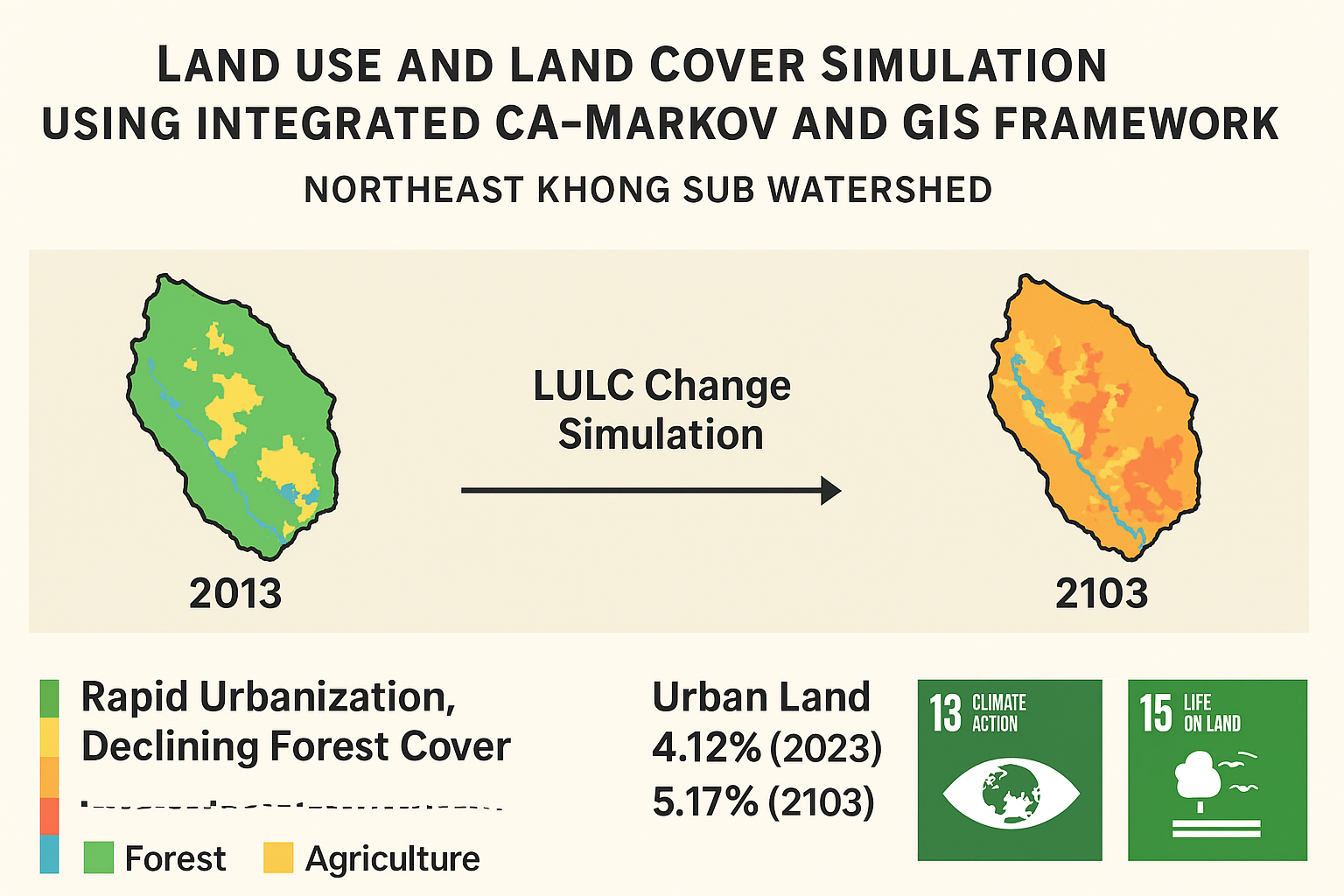
Land utilization is an important indicator of socioeconomic and environmental changes caused by both natural and man-made factors. Land use and land cover (LULC) simulation is a critical tool for monitoring and predicting LULC and is essential for sustainable development, land resource management and planning. The cellular automata (CA) Markov model is the basis for the current study’s prediction of LULC changes in the Northeast Khong Sub Watershed (NKSW). Landsat data from 2013 to 2023 were used to investigate LULC classification and determine the spatiotemporal distributions of LULC. In addition, LULC data from 2013 and 2023 were used to generate simulations via the CA Markov model spanning eight decades (2033 to 2103) to determine how the LULC perspective has changed in the NKSW, which has undergone significant development over the years, including increases in population, settlements, the agriculture sector, and economic and social development. A population increase, according to the model, will cause rapid urbanization, rural expansion and a reduction in forest areas. In 2103, urban and built-up land is expected to account for 5.17% of the total land area, up from 4.12% in 2023. According to the CA Markov model results, the land use and settlement patterns changed significantly in the NKSW. This study urges environmentalists, planners, decision-makers, and those interested in studying LULC change to emphasize sustainable practices and make well-informed decisions for regional well-being. It is an essential tool for directing future planning efforts. Therefore, developing a future master plan for the watershed of Thailand, Lao People's Democratic Republic, and the world should be given top priority.
Article Details

This work is licensed under a Creative Commons Attribution-NonCommercial 4.0 International License.
Published articles are under the copyright of the Applied Environmental Research effective when the article is accepted for publication thus granting Applied Environmental Research all rights for the work so that both parties may be protected from the consequences of unauthorized use. Partially or totally publication of an article elsewhere is possible only after the consent from the editors.
