Halotolerant Biodegradation and Detoxification of Synthetic Dyes by Marine-Derived Penicillium oxalicum M6A: Metabolite Profiling and Ecotoxicity Assessment
Article Sidebar
Main Article Content
Abstract
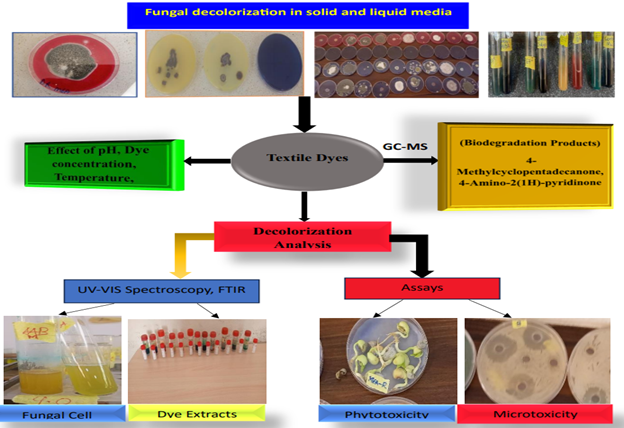
The complex aromatic structures of synthetic dyes in contaminated water bodies make them difficult to degrade, posing a serious environmental challenge and representing a significant emerging pollutant that warrants urgent intervention. This study evaluated the biodegradation and detoxification potential of a halotolerant, marine-derived fungal strain, Penicillium oxalicum M6A, isolated from the Nigerian coastline, against Indigo carmine (IC) and Remazol Brilliant Blue R (RBBR). The effects of pH, temperature, salinity, and dye concentration on degradation efficiency, alongside enzymatic activity, were assessed. FTIR and GC‒MS analyses were employed to identify degradation products and predict metabolic pathways, whereas toxicity was evaluated in three bacterial strains and two crop plant seeds. Penicillium oxalicum M6A effectively degraded the dyes, with maximum growth observed at 1.0 g L-1 for the IC and 0.8 g L-1 for the RBBR. Optimal degradation occurred at pH 5–7, 35 °C for the RBBR, and 45 °C for the IC. The most favorable salinity levels were 1% for the RBBR and 5% for the IC. The RBBR activity significantly increased for laccase (16.14±0.34 U mL-1), lignin peroxidase (10.14±0.12 U mL-1), and alcohol dehydrogenase (8.20±0.46 U mL-1), and the IC activity significantly increased for laccase (15.58 ±0.52 U mL-1), lignin peroxidase (12.54 ± 0.33 U mL-1), and alcohol dehydrogenase (9.31 ± 0.33 U mL-1). FTIR spectra and GC‒MS analysis revealed significant structural changes in the dyes and several potential metabolites, including 4-methylcyclopentadecanone, 9-octadecenamide, and 8-cyclohexadecen-1-one for RBBR and 4-amino-2(1H)-pyridinone, 3,7-dimethyl-1-octene, E-2-octadecen-1-ol, and 7-tetradecenal for IC. Phytotoxicity and microtoxicity tests confirmed that P. oxalicum M6A metabolized these toxic dyes into less toxic compounds. Its halotolerance and enzymatic versatility make it a promising biocatalyst for the treatment of dye-contaminated saline industrial effluents and other recalcitrant pollutants.
Article Details

This work is licensed under a Creative Commons Attribution-NonCommercial 4.0 International License.
Published articles are under the copyright of the Applied Environmental Research effective when the article is accepted for publication thus granting Applied Environmental Research all rights for the work so that both parties may be protected from the consequences of unauthorized use. Partially or totally publication of an article elsewhere is possible only after the consent from the editors.
