The Use of Machine Learning Algorithms for Water Quality Index Prediction in the Sai Gon River, Vietnam
Article Sidebar
Main Article Content
Abstract
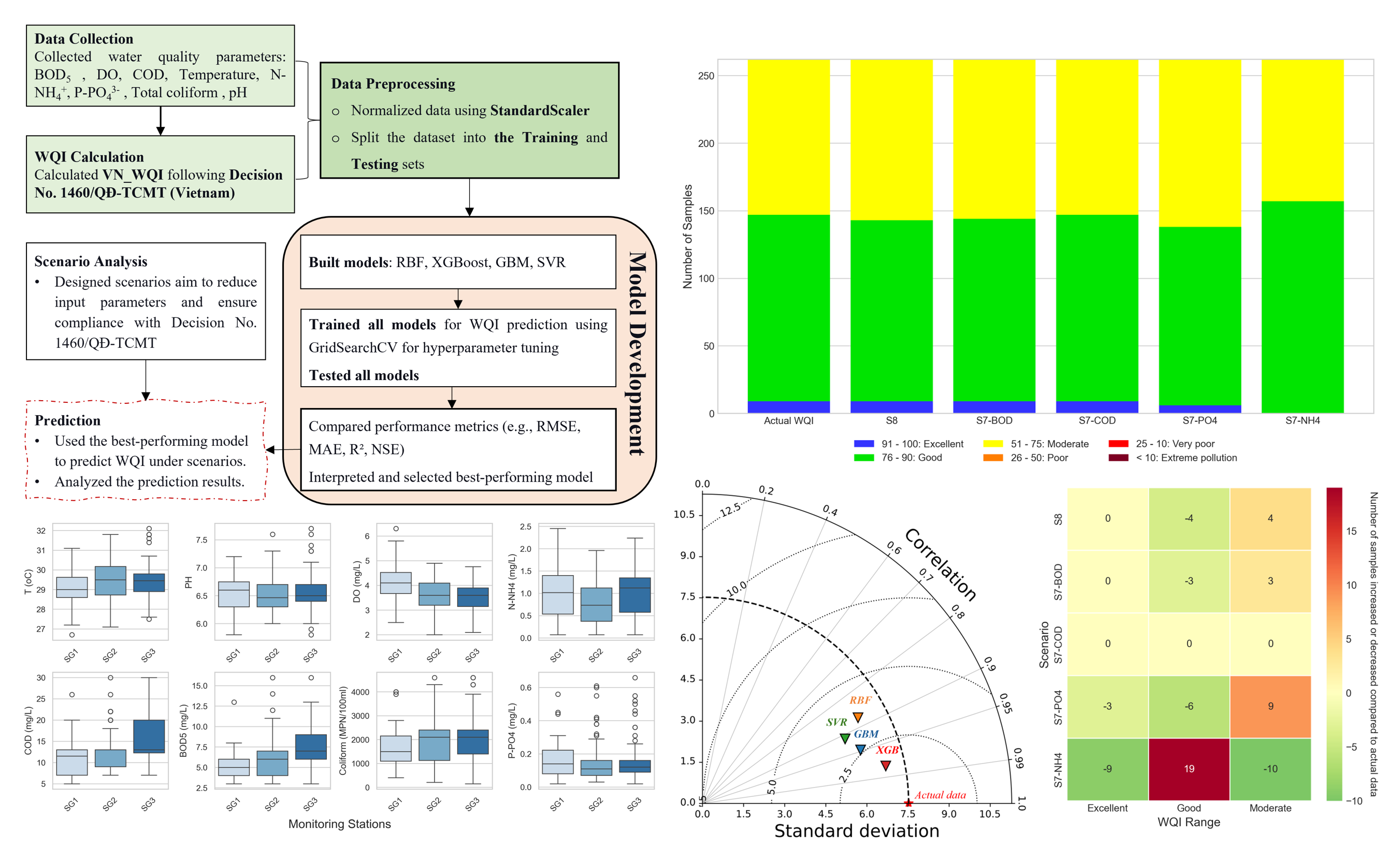
Accurate prediction of the water quality index (WQI) lays the groundwork for integrated river basins and sustainable water resource management. Recent and accelerated advances in machine learning have led to various promising applications in water quality assessment. The present study leverages the predictive performance of several ML algorithms, including extreme gradient boosting (XGB), the gradient boosting model (GBM), support vector regression (SVR), and the radial basic function (RBF), to predict the WQI at three monitoring sites on the Sai Gon River from 2015–2019. In comparison, the results indicate that the XGB model outperforms the other models when eight parameters, including DO, BOD5, COD, N-NH₄⁺, P-PO₄³⁻, pH, temperature, and total coliforms, are input. Specifically, the XGB model exhibited the lowest error rates (RMSE = 1.630 and MAE = 0.782) and highest correlation (R2 = 0.960 and NSE = 0.953), followed by the GBM, SVR, and RBF models. This study also revealed that model performance decreased substantially when N-NH₄⁺ and P-PO₄³⁻ were removed, whereas the exclusion of COD or BOD5 caused marginal declines in predictive capacity. These findings highlight that parsimonious ML models can minimize the parameters required for WQI prediction but still maintain satisfactory simulations and effectively capture potential relationships between input parameters and derive WQI. Generally, this study provides an analytical framework for simulating WQI based on parsimonious and accurate ML algorithms, which are conducive to water quality assessment and monitoring in developing nations.
Article Details

This work is licensed under a Creative Commons Attribution-NonCommercial 4.0 International License.
Published articles are under the copyright of the Applied Environmental Research effective when the article is accepted for publication thus granting Applied Environmental Research all rights for the work so that both parties may be protected from the consequences of unauthorized use. Partially or totally publication of an article elsewhere is possible only after the consent from the editors.
