Assessment of the Carbon Stock of Trees in Selected Urban Green Spaces of Davao City, Philippines
Article Sidebar
Main Article Content
Abstract
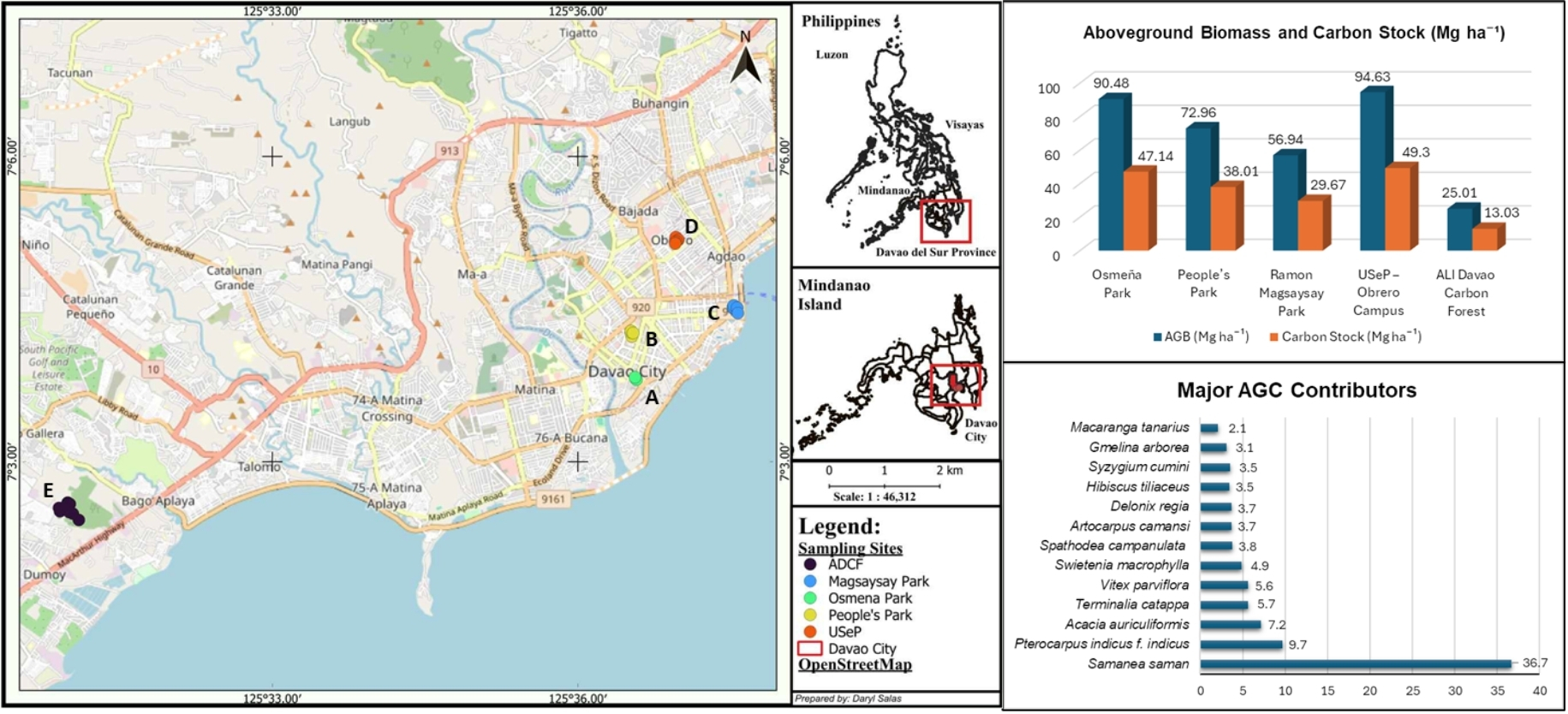
The combined impacts of deforestation, tree cover loss, and urbanization in urban and suburban areas significantly reduce the capacity of natural carbon sinks to sequester and store carbon. Hence, this study assessed the aboveground biomass (AGB) and carbon stock of trees in the selected green spaces of Davao City. A purposive sampling technique was employed in placing quadrats, with data collected from 27 plots categorized by size. AGB was estimated via an allometric equation, and aboveground carbon (AGC) was derived from the AGB values. A total of 358 individual trees from 25 species, 24 genera, and 13 families were documented. Species contributing more than 2% to the total AGC were identified as major carbon stock contributors, with Samanea saman demonstrating the highest carbon stock, followed by Pterocarpus indicus f. indicus and Acacia auriculiformis, despite Hibiscus tiliaceus being the most abundant. Spearman’s correlation was also used to find significant correlations between stem length, canopy area, and AGC, with a weak positive relationship between stem length and AGC (rs = 0.166) and a strong positive relationship between canopy area and AGC (rs = 0.631).
Article Details

This work is licensed under a Creative Commons Attribution-NonCommercial 4.0 International License.
Published articles are under the copyright of the Applied Environmental Research effective when the article is accepted for publication thus granting Applied Environmental Research all rights for the work so that both parties may be protected from the consequences of unauthorized use. Partially or totally publication of an article elsewhere is possible only after the consent from the editors.
References
Beech, E., Rivers, M., Oldfield, S., & Smith, P. P. (2017). GlobalTreeSearch: The first complete global database of tree species and country distributions. Journal of Sustainable Forestry, 36(5), 454–489. https://doi.org/10.1080/10549811.2017.1310049
Polinar, A. & Muuss, U. (2010). Tree Species Diversity in Secondary Forest of Mount Pangasugan, Baybay City, Philippines. Journal of Nature Studies (9), 105-111.
Valle, P. B. (2018). Comparison of Species Composition, Species Diversity, and Structural Distribution of Urban Trees in Three Types of Urban Greenspaces. Ecosystems & Development Journal 8(2): 28–40.
Pansit, N. (2019). Carbon Storage and Sequestration Potential of Urban Trees in Cebu City, Philippines. Mindanao Journal of Science and Technology, 17, 98–111.
Climate Watch. (2022). Climate Watch Historical GHG Emissions. https://www.climatewatchdata.org/countries/PHL?end_year=2021&start_year=1990
World Bank. (2013). Getting a grip on Climate Change in the Philippines. https://documents1.worldbank.org/curated/en/099094102272331986/pdf/P1796370ef3e7a0609310020fd7be7cbb2.pdf
Alvey, A. A. (2006). Promoting and preserving biodiversity in the urban forest. Urban Forestry & Urban Greening, 5(4), 195–201. https://doi.org/10.1016/j.ufug.2006.09.003
Mckinney, M.L. (2008). Effects of urbanization on species richness: A review of plants and animals. Urban Ecosystems, 11, 161-176.
Balmford, A., Moore, J. L., Brooks, T., Burgess, N., Hansen, L. A., Williams, P., & Rahbek, C. (2001). Conservation conflicts across Africa. Science, 291(5513), 2616–2619. https://doi.org/10.1126/science.291.5513.2616
Godefroid, S., & Koedam, N. (2007). Urban plant species patterns are highly driven by density and function of built-up areas. Landscape Ecology, 22(8), 1227–1239. https://doi.org/10.1007/s10980-007-9102-x
Jim, C., & Chen, W. Y. (2009). Diversity and distribution of landscape trees in the compact Asian city of Taipei. Applied Geography, 29(4), 577–587. https://doi.org/10.1016/j.apgeog.2009.01.002
Jim, C., & Liu, H. (2001). Species diversity of three major urban forest types in Guangzhou City, China. Forest Ecology and Management, 146(1–3), 99–114. https://doi.org/10.1016/s0378-1127(00)00449-7
Kühn, I., Brandl, R., & Klotz, S. (2004). The flora of German cities is naturally species rich. Evolutionary Ecology Research, 6(5), 749–764. https://www.researchgate.net/profile/Ingolf_Kuehn/publication/222096009_The_flora_of_German_cities_is_naturally_rich/links/09e41507d0130b08c4000000.pdf
Nero, B.F. (2016). Urban green spaces enhance carbon sequestration and conserve biodiversity in the global south- case of Kumasi, Ghana. https://core.ac.uk/reader/322961740
Cornelis, J., & Hermy, M. (2004). Biodiversity relationships in urban and suburban parks in Flanders. Landscape and Urban Planning, 69(4), 385–401. https://doi.org/10.1016/j.landurbplan.2003.10.038
Colding, J., Elmqvist, T., Lundberg, J., Ahrie, K., Anderson, E., Barthel S., Duit, A., Ernstsson, H., and Tengo, M. (2003). The Stockholm urban Assessment (SUA-Sweden). Millennium Ecosystem Assessment Sub-Global Summary report, Stockholm. http://www.beijer.kva.se/PDF/60278360_Disc182.pdf.
Morgenroth, J., Östberg, J., Van Den Bosch, C. K., Nielsen, A., Hauer, R., Sjöman, H., Chen, W., & Jansson, M. (2015). Urban tree diversity—Taking stock and looking ahead. Urban Forestry & Urban Greening, 15, 1–5. https://doi.org/10.1016/j.ufug.2015.11.003
Grêt-Regamey, A., Altwegg, J., Sirén, E. A., Van Strien, M. J., & Weibel, B. (2016). Integrating ecosystem services into spatial planning—A spatial decision support tool. Landscape and Urban Planning, 165, 206–219. https://doi.org/10.1016/j.landurbplan.2016.05.003
Blood, A., Starr, G., Escobedo, F., Chappelka, A., & Staudhammer, C. (2016). How do urban forests compare? Tree diversity in urban and periurban forests of the southeastern US. Forests, 7(6), 120.
Konijnendijk, C. C., Sadio, S., Randrup, T. B., & Schipperijn, J. (2004). Urban and Peri-Urban Forestry in a Development contextStrategy and Implementation. Arboriculture & Urban Forestry, 30(5), 269–276. https://doi.org/10.48044/jauf.2004.032
Velasco, E., Roth, M., Norford, L., & Molina, L.T. (2016). Does urban vegetation enhance carbon sequestration? Landscape and Urban Planning, 148, 99–107.
Dolan, R. W., Aronson, M. F., & Hipp, A. L. (2017). Floristic response to urbanization: Filtering of the bioregional flora in Indianapolis, Indiana, USA. American Journal of Botany, 104(8), 1179–1187. https://doi.org/10.3732/ajb.1700136
De La Barrera, F., & Henríquez, C. (2017). Vegetation cover change in growing urban agglomerations in Chile. Ecological Indicators, 81, 265–273. https://doi.org/10.1016/j.ecolind.2017.05.067
Oehri, J., Schmid, B., Schaepman-Strub, G., & Niklaus, P. A. (2017). Biodiversity promotes primary productivity and growing season lengthening at the landscape scale. Proceedings of the National Academy of Sciences, 114(38), 10160–10165. https://doi.org/10.1073/pnas.1703928114
Akbari, H. & Konopacki, S. (2005). Calculating energy-saving potentials of heat-island reduction strategies. Energy Policy, 33:721–756
Jo, H. K., Kim, J. Y., & Park, H. M. (2019). Carbon reduction and Planning Strategies for Urban Parks in Seoul. Urban For Urban Green, 41, 48–54.
Nowak, D.J., Greenfield, E.J., Hoehn, R.E., & Lapoint, E. (2013). Carbon storage and sequestration by trees in urban and community areas of the United States. Environmental Pollution, 178, 229–236.
Songcayauon, R. C. (2022). "Characterizing the Urban Green Spaces in Davao City, Philippines: Implications for Design and Management." Banwa A 15: art 073.
Mcclaugherty, B. (2003). Plant litter. Decomposition, humus formation, carbon sequestration. Berlin: Spring-er Verlag.
Lindén, L., Riikonen, A., Setälä, H., & Yli-Pelkonen, V. (2020). Quantifying carbon stocks in urban parks under Cold Climate Conditions. Urban Forestry & Urban Greening, 49, 126633.
Pelser, P. B., Barcelona, J. F. & Nickrent, D. L. (eds.). 2011 onwards. Co's Digital Flora of the Philippines. www.philippineplants.org
eFloras. (2008). Flora of China. http://www.efloras.org
Beets, P. N., Kimberley, M. O., Oliver, G. R., Pearce, S. H., Graham, J. D., & Brandon, A. (2012). Allometric Equations for Estimating Carbon Stocks in Natural Forest in New Zealand. Forests, 3(3):818–839.
Wang, V. & Gao, J. (2020). Estimation of carbon stock in urban parks: Biophysical parameters, thresholds, reliability, and sampling load by plant type. Urban Forestry & Urban Greening, 55. 126852.
Nowak D.J. & Crane, D.E. (2002). Carbon storage and sequestration by urban trees in the USA. Environmental Pollution, 116:381–389
Davies, Z. G., Dallimer, M., Edmondson, J. L., Leake, J. R., & Gaston, K. J. (2013). Identifying potential sources of variability between vegetation carbon storage estimates for urban areas. Environmental Pollution, 183, 133–142. https://doi.org/10.1016/j.envpol.2013.06.005
Khatun, N. (2021) Applications of Normality Test in Statistical Analysis. Open Journal of Statistics, 11, 113-122. https://doi.org/10.4236/ojs.2021.111006
National University. (2024). LibGuides: Statistics Resources: Spearman’s. https://resources.nu.edu/statsresources/Spearmans
Figueroa, J.A., Castro, S.A., Marquet, P.A., & Jaksic, F.M. (2004). Exotic plant invasion to the mediterranean region of Chile: causes, history and impacts. Revista Chilena de Hostoria Natural, 77, 465–483.
Nagendra, H., & Gopal, D. (2010). Tree diversity, distribution, history and change in urban parks: studies in Bangalore, India. Urban Ecosystems, 14(2), 211–223.https://doi.org/10.1007/s11252-010-0148-1
Hernández, H. J., & Villaseñor, N. R. (2017). Twelve-year change in tree diversity and spatial segregation in the Mediterranean city of Santiago, Chile. Urban Forestry & Urban Greening, 29, 10–18. https://doi.org/10.1016/j.ufug.2017.10.017.
Hitchmough, J. (2011). Exotic plants and plantings in the sustainable, designed urban landscape. Landscape and Urban Planning, 100(4), 380–382. https://doi.org/10.1016/j.landurbplan.2011.02.017
Pyšek, P., Křivánek, M., & Jarošík, V. (2009). Planting intensity, residence time, and species traits determine invasion success of alien woody species. Ecology, 90(10), 2734–2744. https://doi.org/10.1890/08-0857.1
Dangulla, M., Manaf, L. A., Ramli, M. F., & Yacob, M. R. (2019). Urban tree composition, diversity and structural characteristics in North-western Nigeria. Urban Forestry & Urban Greening, 48, 126512. https://doi.org/10.1016/j.ufug.2019.126512
Akbar, K. F., Ashraf, I., & Shakoor, S. (2014). Analysis of urban forest structure, distribution and amenity value: a case study. The Journal of Animal and Plant Sciences, 24(6), 1636–1642. http://www.thejaps.org.pk/docs/v-24-6/09.pdf
Tutor, J. A., Palijon, A. M., Visco, R. G., Castillo, A. S. & Militante, E. P. (2017). Floristic Composition, Diversity of Public Green Spaces in Major Urban Cities in Western Visayas, Philippines. WVSU Research Journal, 6(2).
Coracero, E. E., Malabrigo, P. J. L., Bambalan, J. M., Palapal, I. K. S., Guleng, R. V., Gallego, R. J., & Suniega, M. J. A. (2022). Diversity, Species Composition, and Carbon Stock Assessment of Trees in Aurora, Philippines: Variations between Preserved and Developed Ecosystems. Environmental Sciences Proceedings, 22(1), 29. https://doi.org/10.3390/iecf2022-13061
Chen, X., Luo, M., & Larjavaara, M. (2023). Effects of climate and plant functional types on forest above-ground biomass accumulation. Carbon Balance and Management, 18(1). https://doi.org/10.1186/s13021-023-00225-1
Liu, C. & Li, X. (2012). Carbon storage and sequestration by urban forests in Shenyang, China. Urban For Urban Green, 11, 121–128.
Zhao, M., Kong, Z.H., Escobedo, F.J., & Gao, J. (2010). Impacts of urban forests on offsetting carbon emissions from industrial energy use in Hangzhou, China. Journal of Environmental Management, 91(4), 807–813.
Russell, A. E., Raich, J. W., Arrieta, R. B., Valverde-Barrantes, O., & González, E. (2010). Impacts of individual tree species on carbon dynamics in a moist tropical forest environment. Ecological Applications, 20(4), 1087–1100. https://doi.org/10.1890/09-0635.1
Hunter, J. T. (2015). Changes in Allometric Attributes and Biomass of Forests and Woodlands across an Altitudinal and Rainfall Gradient: What Are the Implications of Increasing Seasonality due to Anthropogenic Climate Change? International Journal of Ecology, 2015, 1–10. https://doi.org/10.1155/2015/208975
Stephenson, N. L., Das, A. J., Condit, R., Russo, S. E., Baker, P. J., Beckman, N. G., Coomes, D. A., Lines, E. R., Morris, W. K., Rüger, N., Álvarez, E., Blundo, C., Bunyavejchewin, S., Chuyong, G., Davies, S. J., Duque, Á., Ewango, C. N., Flores, O., Franklin, J. F., . . . Zavala, M. A. (2014). Rate of tree carbon accumulation increases continuously with tree size. Nature, 507(7490), 90–93. https://doi.org/10.1038/nature12914
Woldegerima, T., Yeshitela, K., & Lindley, S. (2017). Ecosystem services assessment of the urban forests of Addis Ababa, Ethiopia. Urban Ecosystems, 20(3), 683–699. https://doi.org/10.1007/s11252-016-0624-3
Mensah, S., Veldtman, R., Du Toit, B., Glèlè Kakaï, R., & Seifert, T. (2016). Aboveground biomass and carbon in a South African mistbelt forest and the relationships with tree species diversity and forest structures. Forests, 7(4), 79.
Clark, D. A., Brown, S., Kicklighter, D. W., Chambers, J. Q., Thomlinson, J. R., Ni, J., & Holland, E. A. (2001). Net primary production in tropical forests: an evaluation and synthesis of existing field data. Ecological Applications, 11: 371–384.
Djomoa, A. N., Ibrahimab, A., Saborowskic, J., & Gravenhorsta, J. (2010). Allometric equations for biomass estimations in Cameroon and pan moist tropical equations including biomass data from Africa. Forest Ecology and Management, 260: 1873–1885.
Ragula, A., & Chandra, K. K. (2017). Tree species suitable for roadside afforestation and carbon sequestration in Bilaspur, India. Carbon Management, 11(4), 369–380. https://doi.org/10.1080/17583004.2020.1790243
Vasagadekar, P. R., Gargate, A. V., Patil, Y. Y., & Raut, P. D. (2023). Carbon sequestration potential of trees from urban green spaces of Kolhapur city, Maharashtra, India. Environmental & Socio-economic Studies, 11(3), 22–32. https://doi.org/10.2478/environ-2023-0014
Luyssaert, S., Schulze, E.-., Börner, A., Knohl, A., Hessenmöller, D., Law, B. E., Ciais, P., & Grace, J. (2008). Old-growth forests as global carbon sinks. Nature, 455(7210), 213–215. https://doi.org/10.1038/nature07276
Stoffberg, G., Van Rooyen, M., Van Der Linde, M., & Groeneveld, H. (2010). Carbon sequestration estimates of indigenous street trees in the City of Tshwane, South Africa. Urban Forestry & Urban Greening, 9(1), 9–14. https://doi.org/10.1016/j.ufug.2009.09.004
Baldwin, V., Peterson, K. D., Clark, A., Ferguson, R. B., Strub, M. R., & Bower, D. R. (2000). The effects of spacing and thinning on stand and tree characteristics of 38-year-old Loblolly Pine. Forest Ecology and Management, 137(1–3), 91–102. https://doi.org/10.1016/s0378-1127(99)00340-0
Hébert, F., Krause, C., Plourde, P., Achim, A., Prégent, G., & Ménétrier, J. (2016). Effect of Tree Spacing on Tree Level Volume Growth, Morphology, and Wood Properties in a 25-Year-Old Pinus banksiana Plantation in the Boreal Forest of Quebec. Forests, 7(11), 276. https://doi.org/10.3390/f7110276
Wright, S. J., Kitajima, K., Kraft, N. J. B., Reich, P. B., Wright, I. J., Bunker, D. E., Condit, R., Dalling, J. W., Davies, S. J., Díaz, S., Engelbrecht, B. M. J., Harms, K. E., Hubbell, S. P., Marks, C. O., Ruiz-Jaen, M. C., Salvador, C. M., & Zanne, A. E. (2010). Functional traits and the growth–mortality trade‐off in tropical trees. Ecology, 91(12), 3664–3674. https://doi.org/10.1890/09-2335.1
King, D. A. (1996). Allometry and life history of tropical trees. Journal of Tropical Ecology, 12(01), 25–44. doi:10.1017/s0266467400009299
Waring, R.H. & Schlesinger, W.H. (1985). Forest Ecosystems: Concepts and Management. Academic Press Inc., Orlando, San Diego.
Ryan, M. G., Binkley, D., & Fownes, J. H. (1997). Age-related decline in forest productivity: pattern and process. Advances in ecological research, 27, 213-262.
Goodman, R. C., Phillips, O. L., & Baker, T. R. (2014). The importance of crown dimensions to improve tropical tree biomass estimates. Ecological Applications, 24(4), 680–698. https://doi.org/10.1890/13-0070.1
