Microplastic Contamination in Commercially Important Bivalves of Sorsogon Bay, Philippines
Article Sidebar
Main Article Content
Abstract
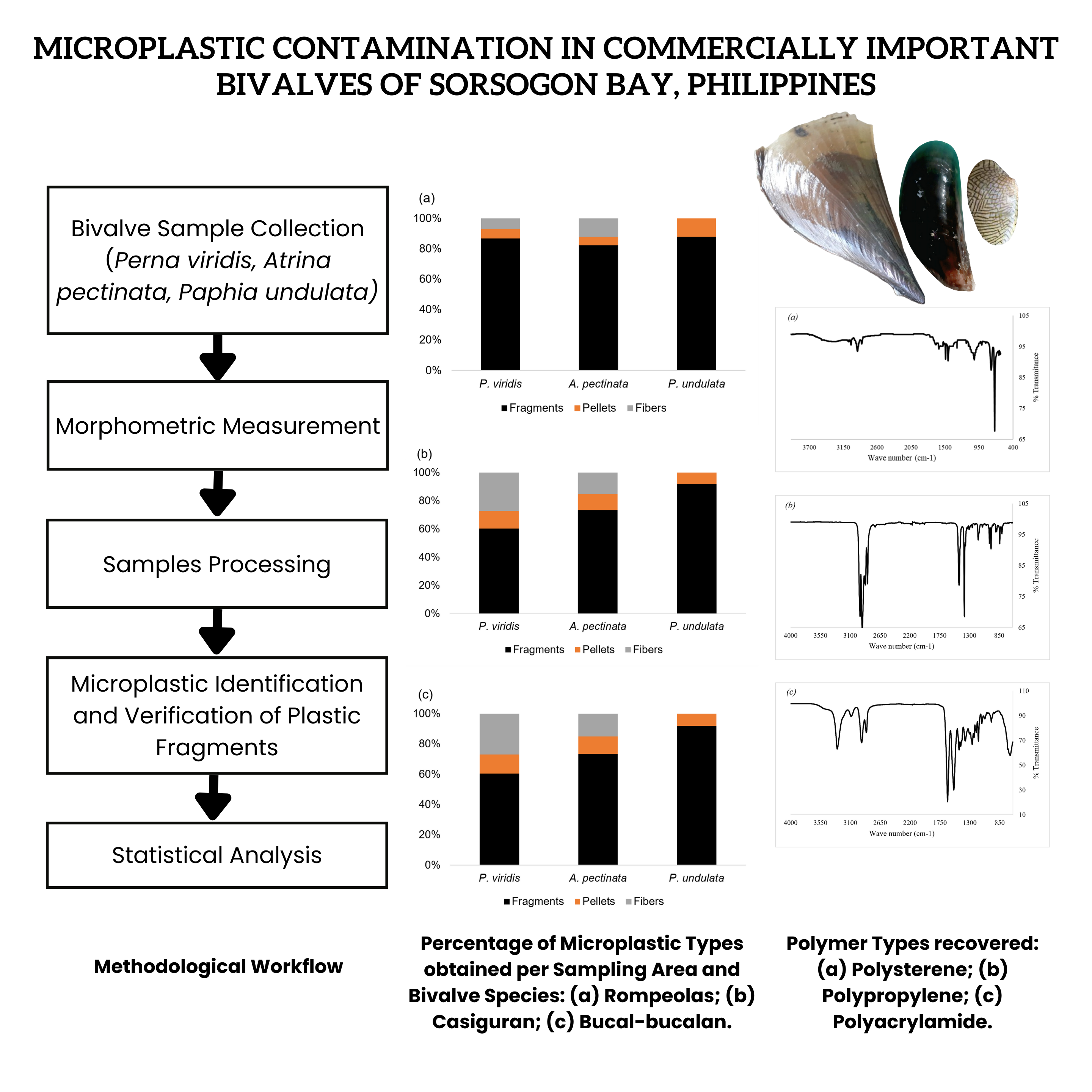
Sorsogon Bay, a key fishing ground in the Philippines, is known for its commercially important bivalve species: Perna viridis, Atrina pectinata, and Paphia undulata. Despite their ecological and economic value, limited research has been conducted on microplastic contamination in bivalves harvested from this area. This study aimed to assess the abundance and types of microplastics in commercially important bivalves (P. viridis, A. pectinata, and P. undulata) from Sorsogon Bay, Philippines. Commercial bivalve samples were randomly collected, digested with 10% w/v potassium hydroxide (KOH) solution, filtered (8 µm), and examined under a compound microscope. Suspected microplastics were confirmed via hot needle tests and Fourier transform infrared (FTIR) spectroscopy and then classified by type. Fragments (70.1%) were most common, followed by fibers (18.4%) and pellets (11.5%), with P. viridis showing the highest mean abundance (0.44 items individual⁻¹). There were 0.07 and 0.06 items individual-1 for P. undulata and A. pectinata, respectively. Polypropylene (53%), polystyrene (38%), and polyacrylamide (9%) were the dominant polymers. These findings highlight significant microplastic contamination in bivalves and the need for better pollution management to ensure seafood safety.
Article Details

This work is licensed under a Creative Commons Attribution-NonCommercial 4.0 International License.
Published articles are under the copyright of the Applied Environmental Research effective when the article is accepted for publication thus granting Applied Environmental Research all rights for the work so that both parties may be protected from the consequences of unauthorized use. Partially or totally publication of an article elsewhere is possible only after the consent from the editors.
