Quantifying Biodiversity in the Absence of Taxonomic Data: A Study of Thailand’s Economic Development Zones
Article Sidebar
Main Article Content
Abstract
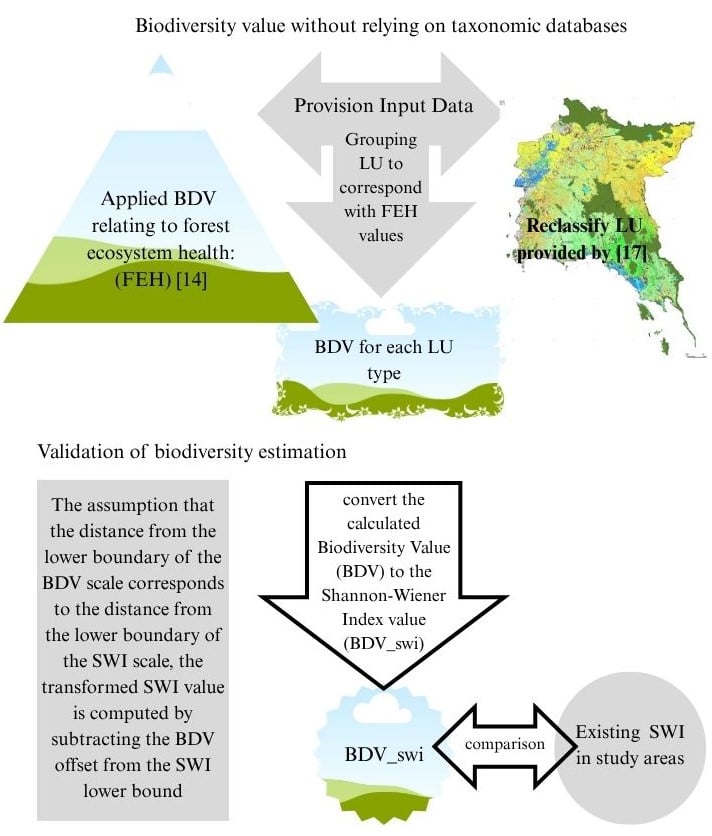
The biodiversity status measures the ecological capacity of a given area. However, biodiversity assessments in developing countries are limited by the absence of taxonomic data on plants and animals. By developing methods to evaluate biodiversity via alternative data, it is now possible to quantify the ecological carrying capacity in areas where taxonomic data are lacking. The relationship between forest ecosystem health and biodiversity values can be used to estimate biodiversity values by considering the proportions of different land use types that are associated with forest ecosystem abundance. The biodiversity value of the area can be assessed by adding the abundance values of forest ecosystems for each land use in the study area, resulting in computed biodiversity values. The accuracy can be confirmed by comparison with the Shannon‒Wiener index values obtained in the research areas. The calculated biodiversity values in the study area, namely, Chonburi, Rayong, and Chachoengsao provinces in Thailand, were 2.08, 1.29, and 2.33, respectively. These values are close to the areas’ average Shannon‒Wiener index values. As a result, it is possible to conclude that the method has the potential to be applied as a substitute for biodiversity assessment in regions where taxonomic data on plants and animals are insufficient to guide future appropriate development.
Article Details

This work is licensed under a Creative Commons Attribution-NonCommercial 4.0 International License.
Published articles are under the copyright of the Applied Environmental Research effective when the article is accepted for publication thus granting Applied Environmental Research all rights for the work so that both parties may be protected from the consequences of unauthorized use. Partially or totally publication of an article elsewhere is possible only after the consent from the editors.
