Nationwide Household Food Waste Generation Rates in Rural and Urban Settings: Evidence in Thailand
Article Sidebar
Main Article Content
Abstract
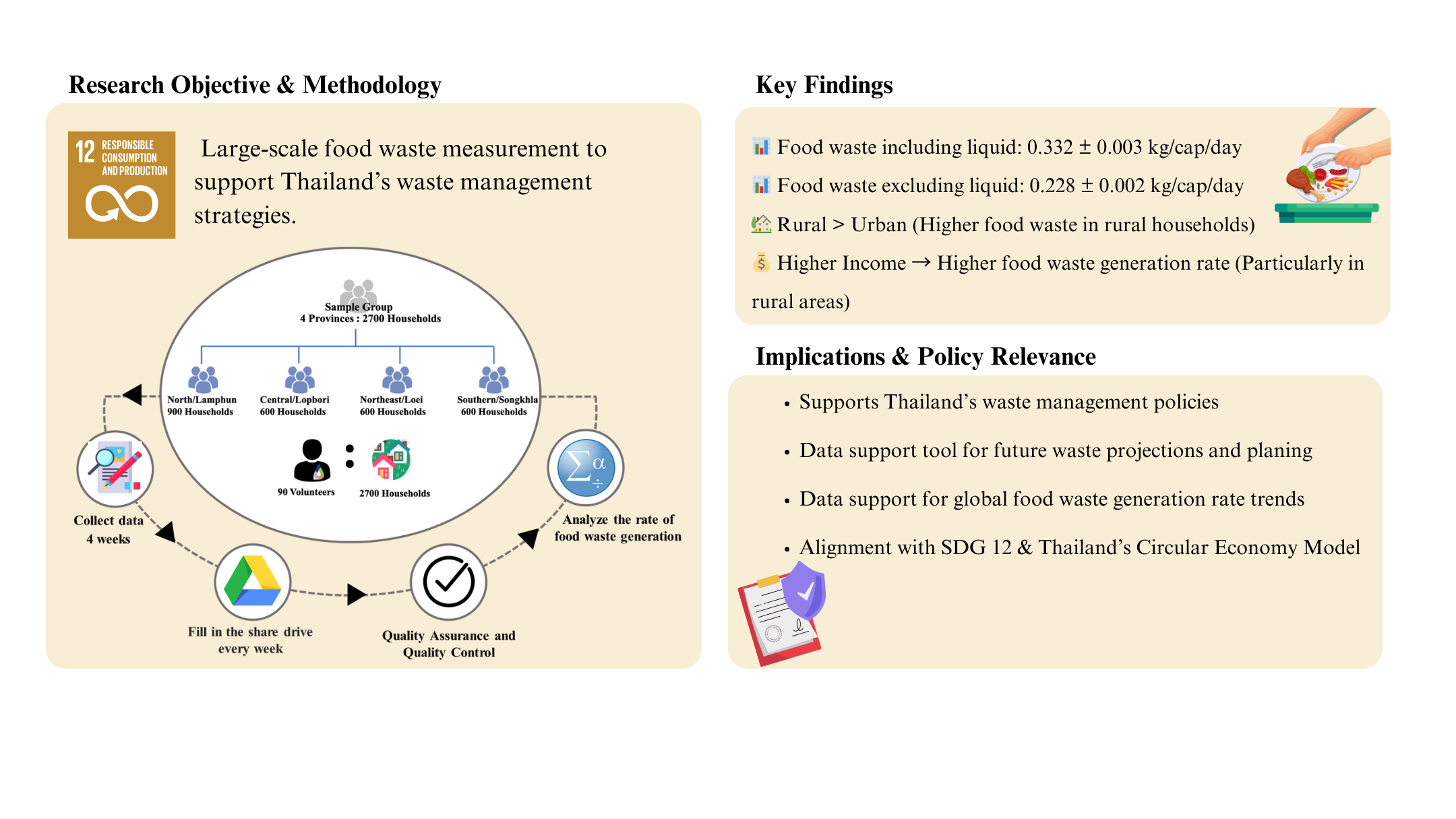
To achieve sustainable development goals, addressing food waste requires evidence-based solutions grounded in a nuanced understanding of waste generation rates and the factors influencing them. This study explores the intricate dynamics of food waste generation in Thai households, encompassing both liquid and solid waste streams. Empirical data were collected from 2,700 diverse households across urban and rural areas over a four-week period. The study revealed an average food waste generation rate of 0.332±0.003 kg per capita per day when liquids were included and 0.228± 0.002 kg per capita per day when liquids were excluded. Surprisingly, rural households generated more food waste than urban households did, likely due to differences in meal preparation and consumption habits. The analysis also revealed a significant negative correlation between household income and food waste in some rural areas, suggesting that income alone does not drive waste behavior. Additionally, a positive correlation between household income and food waste generation rates was observed, underscoring the complex interplay between economic factors and waste generation behaviors. The implications of this research extend beyond Thailand, providing valuable insights into global trends in urban and rural food waste. This study contributes essential knowledge for developing sustainable waste management practices and serves as a benchmark for other regions. Furthermore, the derived food waste generation rates offer predictive tools for estimating future waste volumes, aiding policymakers in targeted interventions and enhancing the efficiency of waste management strategies.
Article Details

This work is licensed under a Creative Commons Attribution-NonCommercial 4.0 International License.
Published articles are under the copyright of the Applied Environmental Research effective when the article is accepted for publication thus granting Applied Environmental Research all rights for the work so that both parties may be protected from the consequences of unauthorized use. Partially or totally publication of an article elsewhere is possible only after the consent from the editors.
