The Role of Remittances in Economic Growth and Environmental Sustainability: A Cross-country Analysis
Article Sidebar
Main Article Content
Abstract
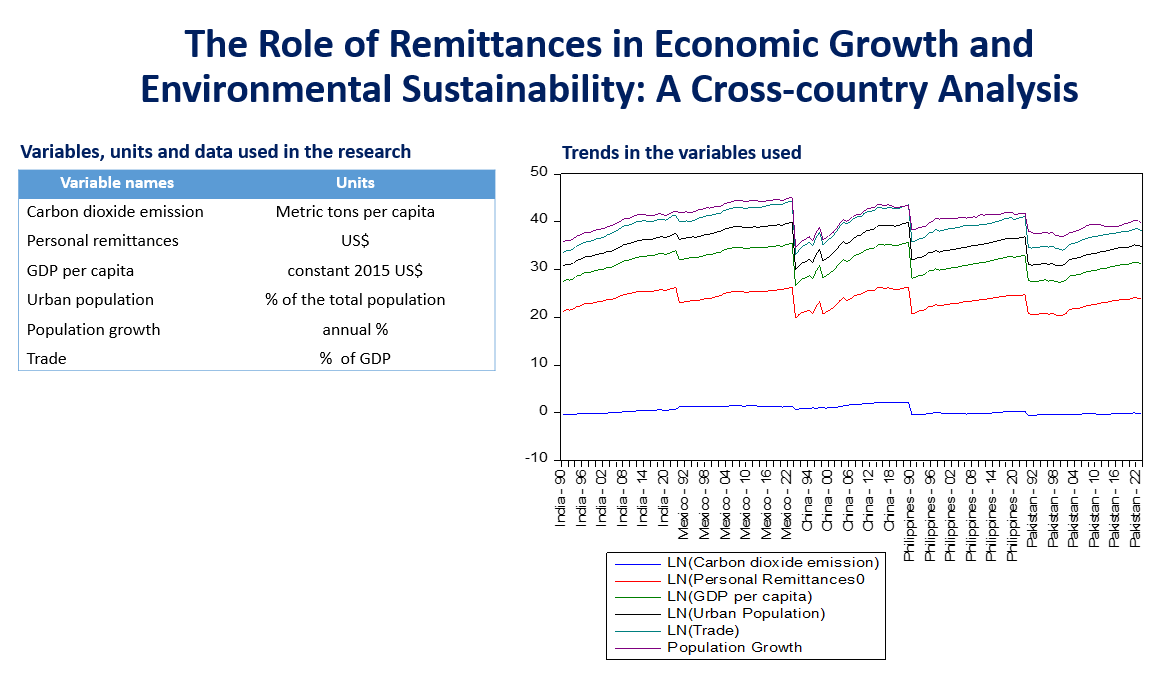
Although remittances significantly influence economic stability, their role in sustainable growth and environmental impact remains uncertain. While these financial inflows enhance household welfare, their effects on gross domestic product (GDP), carbon emissions, and trade openness require further exploration. This study investigates the economic and environmental linkages of remittances in India, Mexico, China, the Philippines, and Pakistan, the top five remittance-receiving countries. Using panel data analysis, this study employs Dumitrescu Hurlin causality tests and dynamic ordinary least squares (DOLS) to assess the long-term and causal relationships between urbanization, trade openness, GDP per capita, carbon emissions, and remittances. Data from the World Bank for the five largest remittance-receiving countries are used to ensure robust empirical analysis. The findings indicate that remittances do not directly drive GDP or emissions but that urbanization and trade openness significantly shape economic and environmental outcomes. This study supports the environmental Kuznets curve (EKC) hypothesis and confirms that carbon emissions influence remittance flows, which aligns with the environmental migration hypothesis. This study highlights the importance of remittance-backed investments in renewable energy, green infrastructure, and financial inclusion programs. Policymakers should create incentives for migrants to channel remittances into productive sectors rather than pure consumption. Trade openness has emerged as a key driver of emissions, necessitating sustainable trade policies that integrate environmental regulations. The study underscores the need for targeted policies that enhance the productive use of remittances while mitigating environmental risk.
Article Details

This work is licensed under a Creative Commons Attribution-NonCommercial 4.0 International License.
Published articles are under the copyright of the Applied Environmental Research effective when the article is accepted for publication thus granting Applied Environmental Research all rights for the work so that both parties may be protected from the consequences of unauthorized use. Partially or totally publication of an article elsewhere is possible only after the consent from the editors.
