
การออกแบบสถาปัตยกรรมบล็อกเชนแบบผสมเพื่อเพิ่มความโปร่งใสในการบันทึกกิจกรรมนักศึกษา
Article Sidebar
Main Article Content
บทคัดย่อ
ในปัจจุบันระบบบันทึกข้อมูลการเข้าร่วมกิจกรรมนักศึกษาในสถาบันอุดมศึกษาส่วนใหญ่ยังใช้ระบบสารสนเทศแบบรวมศูนย์ ซึ่งอาจมีข้อจำกัดด้านความโปร่งใสและความสามารถในการตรวจสอบย้อนหลังของข้อมูล งานวิจัยนี้มีวัตถุประสงค์เพื่อออกแบบและพัฒนาระบบบันทึกกิจกรรมนักศึกษาโดยประยุกต์ใช้เทคโนโลยีบล็อกเชนเพื่อเพิ่ม
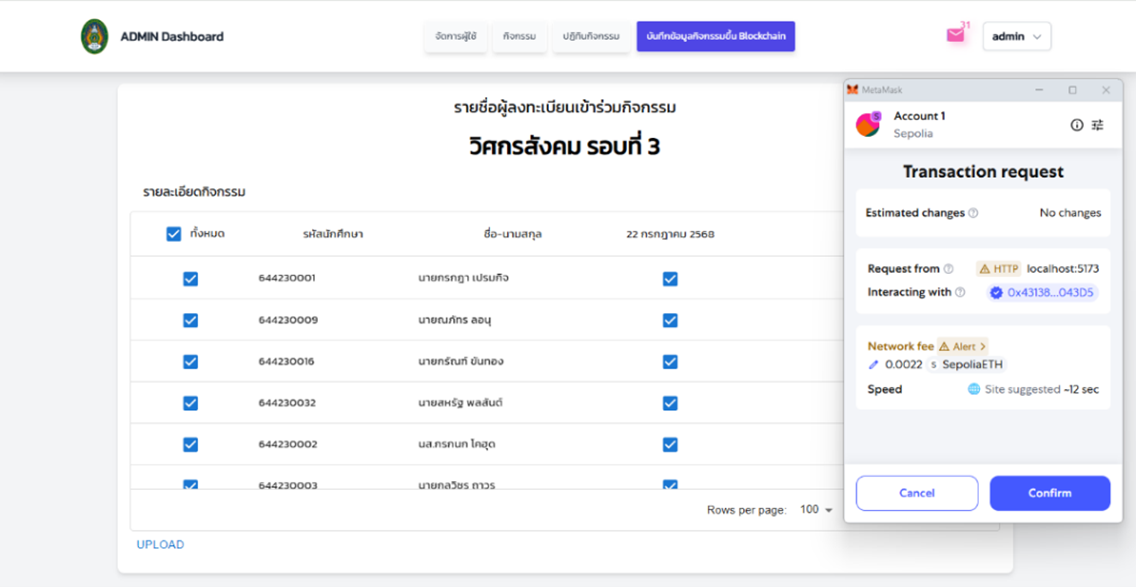
ความโปร่งใสและความน่าเชื่อถือของข้อมูล ระบบถูกออกแบบภายใต้สถาปัตยกรรมแบบผสม (hybrid architecture) ซึ่งจัดเก็บข้อมูลรายละเอียดกิจกรรมในฐานข้อมูลแบบ off-chain และบันทึกค่าพิสูจน์ความถูกต้องของข้อมูล (cryptographic commitment) บนบล็อกเชนผ่านสมาร์ตคอนแทรกต์ที่พัฒนาด้วยภาษา Solidity ระบบต้นแบบถูกพัฒนาเป็นเว็บแอปพลิเคชันและเชื่อมต่อกับเครือข่ายบล็อกเชนที่รองรับ Ethereum Virtual Machine โดยใช้แนวคิด Minimal On-chain ซึ่งบันทึกเฉพาะค่าแฮช (hash) ของข้อมูลกิจกรรมบนเครือข่าย ผลการประเมินพบว่าการ deploy สมาร์ตคอนแทรกต์มีต้นทุนประมาณ 0.0265 ดอลลาร์สหรัฐ (0.82 บาท) ขณะที่การบันทึกข้อมูลกิจกรรมมีต้นทุนเฉลี่ยประมาณ 0.002 ดอลลาร์สหรัฐ (0.06 บาท) ต่อธุรกรรม ค่าการใช้แก๊สของธุรกรรมอยู่ในช่วงประมาณ 119,900 - 119,950 ยูนิต และความหน่วงเวลาในการยืนยันธุรกรรมอยู่ในช่วงประมาณ 4 - 7 วินาที ผลการวิจัยสะท้อนให้เห็นว่าแนวทางสถาปัตยกรรมแบบผสมภายใต้แนวคิด Minimal On-chain สามารถเพิ่มความสามารถในการตรวจสอบความถูกต้องของข้อมูลกิจกรรมได้อย่างมีประสิทธิภาพ โดยยังคงรักษาต้นทุนธุรกรรมในระดับต่ำและลดการเปิดเผยข้อมูลส่วนบุคคลบนบล็อกเชน
Article Details

อนุญาตภายใต้เงื่อนไข Creative Commons Attribution-NonCommercial-NoDerivatives 4.0 International License.
เอกสารอ้างอิง
จักรกริช คำสม, ธรัช อารี ราษฏร์ และอภิชาติ เหล็กดี. (2567). การพัฒนารูปแบบการบริหารจัดการสารสนเทศตามพระราชบัญญัติการคุ้มครองข้อมูลส่วนบุคคลสำหรับมหาวิทยาลัยราชภัฏ. วารสารวิชาการการจัดการเทคโนโลยี มหาวิทยาลัยราชภัฏมหาสารคาม 11(1): 42 - 55.
ธนพล แย้มทุ่ง และอรอุมา พร้าโมต. (2568). การออกแบบและพัฒนาระบบสารสนเทศกิจกรรมนักศึกษาผ่านเว็บแอปพลิเคชัน กรณีศึกษา สาขาวิทยาการคอมพิวเตอร์ มหาวิทยาลัยราชภัฏพิบูลสงคราม. วารสารก้าวทันโลกวิทยาศาสตร์ 25(1): 63 - 84.
Agbo, C.C., Mahmoud, Q.H. and Eklund, J.M. (2019). Blockchain technology in healthcare: A systematic review. Healthcare 7(2): 56. doi: 10.3390/healthcare7020056.
Amnuaysin, O., Areepong, T. and Issaro, S. (2022). Application of Blockchain Technology in Higher education. International Journal of Educational Communications and Technology 2(1): 18 - 27.
Casino, F., Dasaklis, T.K. and Patsakis, C. (2019). A systematic literature review of blockchain-based applications. Telematics and Informatics 36: 55 - 81. doi: 10.1016/j.tele.2018.11.006.
Chen, N.P., Shen, K.Y. and Liang, C.J. (2021). Hybrid decision model for evaluating blockchain business strategy: A bank’s perspective. Sustainability 13(11): 5809. doi: 10.3390/su13115809.
Islam, S. and Apu, K.U. (2024). Decentralized vs. Centralized Database Solutions in Blockchain: Advantages, Challenges, and Use Cases. Global Mainstream Journal of Innovation. Engineering & Emerging Technology 3(04): 58 - 68. doi: 10.62304/jieet.v3i04.195.
Nakamoto, S. (2008). Bitcoin: A peer-to-peer electronic cash system. Bitcoin.org. Source: https://bitcoin. org/bitcoin.pdf. Retrieved date 29 September 2025.
Peffers, K., Tuunanen, T., Rothenberger, M.A. and Chatterjee, S. (2007). A design science research methodology for information systems research. Journal of Management Information Systems 24(3): 45 - 77. doi: 10.2753/MIS0742-1222240302.
Rafdhi, A.A. and Hayati, E.N. (2023). Leveraging Blockchain for Academic Credentialing and Student Data Management in Universities. International Journal of Research and Applied Technology 3(2): 429 - 436.
Regueiro, C., Seco, I., Gutiérrez-Agüero, I., Urquizu, B. and Mansell, J. (2021). A blockchain-based audit trail mechanism: Design and implementation. Algorithms 14(12): 341. doi: 10.3390/a14120341.
Saberi, S., Kouhizadeh, M., Sarkis, J. and Shen, L. (2019). Blockchain technology and its relationships to sustainable supply chain management. International Journal of Production Research 57(7): 2117 - 2135. doi: 10.1080/00207543.2018.1533261.
Shaker, M., Aliee, F.S. and Fotohi, R. (2021). Online rating system development using blockchain-based distributed ledger technology. Wireless Networks 27: 1715 - 1737.
Singh, M. and Srivastava, S. (2025). Immutable transparency: Leveraging blockchain transparency features to foster trust in decentralized systems. In Digital strategy and governance in transformative technologies. Boca Raton, FL: CRC Press. pp. 197 - 215
Tran, V.D., Ata, S., Tran, T.H., Lam, D.K. and Pham, H.L. (2023). Blockchain-Powered Education: A Sustainable Approach for Secured and Connected University Systems. Sustainability 15(21): 15545. doi: 10.3390/su152115545.
Vu, V.H. (2022). A blockchain-based model to support student activities management. World Journal of Advanced Research and Reviews 14(2): 515 - 524. doi: 10.30574/wjarr.2022.14.2.0460.
Xu, X., Weber, I. and Staples, M. (2019). Architecture for blockchain applications. Cham, Switzerland: Springer. pp. 81 - 212.
Zheng, Z., Xie, S., Dai, H., Chen, X. and Wang, H. (2017). An overview of blockchain technology: Architecture, consensus, and future trends. 2017 IEEE International Congress on Big Data (BigData Congress). 557 - 564. doi: 10.1109/BigDataCongress.2017.85
