
การพัฒนาผลิตภัณฑ์ซอสผัดไทยจากสับปะรด
Article Sidebar
Main Article Content
บทคัดย่อ
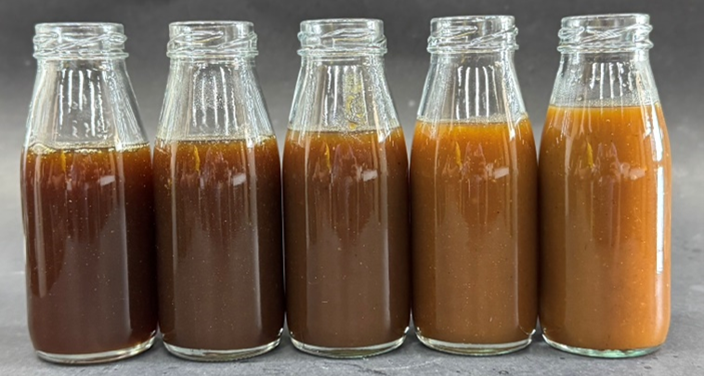
งานวิจัยนี้มีวัตถุประสงค์เพื่อคัดเลือกซอสผัดไทยสูตรพื้นฐานและศึกษาปริมาณน้ำสับปะรดเข้มข้นทดแทนน้ำตาลมะพร้าว จากการศึกษาคุณลักษณะของน้ำสับปะรดคั้นสดและน้ำสับปะรดเข้มข้น พบว่าน้ำสับปะรดเข้มข้นมีปริมาณโปรตีน ใยอาหาร เถ้า คาร์โบไฮเดรต และพลังงานสูงกว่าน้ำสับปะรดคั้นสด การเตรียมซอสผัดไทยที่ทดแทนน้ำตาลมะพร้าวด้วยน้ำสับปะรดเข้มข้นที่ระดับร้อยละ 0 25 50 75 และ 100 ตามลำดับ พบว่าผู้ทดสอบชิมให้การยอมรับซอสผัดไทยจากน้ำสับปะรดเข้มข้นระดับร้อยละ 50 โดยเฉพาะในด้านรสชาติและความชอบโดยรวม การใช้น้ำสับปะรดเข้มข้นส่งผลต่อคุณภาพทางกายภาพเคมี พบว่าซอสผัดไทยที่มีปริมาณน้ำสับปะรดเข้มข้นเพิ่มมากขึ้นมีค่าความสว่าง (L*) ค่าความเป็นสีแดง-เขียว (a*) และค่าความเป็นสีเหลือง-น้ำเงิน (b*) สูงขึ้นตามลำดับ และมีปริมาณของแข็งที่ละลายน้ำ 49.63 องศาบริกซ์ ปริมาณกรดทั้งหมดเป็นร้อยละ 5.34 ค่าความเป็นกรดด่าง 2.70 และค่าความหนืด 510.60 เซนติพอยส์ คุณค่าทางโภชนาการของซอสผัดไทยจากสับปะรดเข้มข้นปริมาณ 100 กรัม ให้พลังงานทั้งหมด 208.93 กิโลแคลอรี โดยมีคาร์โบไฮเดรต 48.02 กรัม ไขมัน 0.89 กรัม โปรตีน 2.21 กรัม และน้ำตาล 47.01 กรัม ตามลำดับ ซอสผัดไทยจากสับปะรดเข้มข้น เก็บรักษาที่อุณหภูมิ 5 ± 3 องศาเซลเซียส มีปริมาณจุลินทรีย์ทั้งหมด ยีสต์ รา และ Escherichia coli เป็นไปตามเกณฑ์มาตรฐานผลิตภัณฑ์ชุมชน “ซอสปรุงรสผัดไทย” (มผช.497/2546)
Article Details

อนุญาตภายใต้เงื่อนไข Creative Commons Attribution-NonCommercial-NoDerivatives 4.0 International License.
เอกสารอ้างอิง
เชาวลิต อุปฐาก. (2552). การศึกษากรรมวิธีการผลิตเครื่องปรุงผงก๋วยเตี๋ยวผัดไทย. วิทยานิพนธ์คหกรรมศาสตร์มหาบัณฑิต,มหาวิทยาลัยเทคโนโลยีราชมงคลพระนคร. กรุงเทพฯ: 125 หน้า.
นักสิทธิ์ ปัญโญใหญ่. (2566). การวิเคราะห์ความหนืดและพฤติกรรมการ ไหลของอาหารแปรรูปไทย. วารสารวิทยาศาสตร์บูรพา 28(3): 1600 - 1619.
เปรมระพี อุยมาวีรหิรัญ, เชาวลิต อุปฐาก, ลัดดาวัลย์ กลิ่นมาลัย และน้อมจิตต์ สุธีบุตร. (2562). การพัฒนาศักยภาพสับปะรดตกเกรดในผลิตภัณฑ์ซอสสำเร็จรูป. รายงานวิจัยฉบับสมบูรณ์, มหาวิทยาลัยเทคโนโลยีราชมงคลพระนคร.
วันดี แก้วสุวรรณ. (2556). การใช้น้ำมะขามเปียกในส่วนผสมน้ำปรุงรสผัดไทยสำเร็จรูป. วารสารวิชาการมหาวิทยาลัยราชภัฏนครศรีธรรมราช 32(1): 55 - 62.
ศรีสมร คงพันธุ์. (2561). อาหารขึ้นทะเบียนมรดกภูมิปัญญาทางวัฒนธรรมของชาติ. กรุงเทพฯ: บริษัท ส.ส.ส. จํากัด.
อรอินทุ์ วงค์ครองศักดิ์. (2566). การพัฒนาผลิตภัณฑ์ผัดไทยกึ่งสำเร็จรูปโดยเทคนิคการวิเคราะห์แบบคอนจ้อยท์. บริหารธุรกิจมหาบัณฑิต. มหาวิทยาลัยศรีนครินทรวิโรฒ.
อัศพงษ์ อุประวรรณา, สังวาลย์ ชมภูจา, จรรยา โท๊ะนาบุตร และอรรถ ขันสี. (2567). การพัฒนาผลิตภัณฑ์น้ำสับปะรดผสม เนื้อว่านหางจระเข้เสริมคอลลาเจน. วารสารคหกรรมศาสตร์และวัฒนธรรมอย่างยั่งยืน 6(2): 18 - 31.
อารี น้อยสำราญ, ศจีมาศ นัตตสุคนธ์, นราธร สัตย์ซื่อ และทศพร ลิ้มดำเนิน. (2566.) การยกระดับอาหารท้องถิ่นเมืองเพชรสู่มาตรฐานสากล. รายงานวิจัยฉบับสมบูรณ์, มหาวิทยาลัยราชภัฏเพชรบุรี.
Abraham, R.A., Joshi, J. and Abdullah, S. (2023). A comprehensive review of pineapple processing and its by-product valorization in India. Food Chemistry Advances 3: 100416. doi: 10.1016/j.focha.2023.100416.
Aguilar-Rosas, S.F., Ballinas-Casarrubias, M.L., Nevarez-Moorillon, G.V., Martin-Belloso, O. and Ortega-Rivas, E. (2007). Thermal and pulsed electric fields pasteurization of apple juice: Effects on physicochemical properties and flavour compounds. Journal of Food Engineering 83(1): 41 - 46.
Ali, M.M., Hashim, N., Abd Aziz, S. and Lasekan, O. (2020). Pineapple (Ananas comosus): A comprehensive review of nutritional values, volatile compounds, health benefits, and potential food products. Food Research International 137: 109675.
AOAC International. (1993). Methods of analysis for nutrition labeling. Arlington, Virginia. p. 8.
AOAC. (2000). Official methods of analysis of AOAC International. 17th edition. Gaithersburg, M.D., USA: Association of Analytical Communities.
AOAC. (2006). Official methods of analysis of AOAC International. 18th edition. Gaithersburg, M.D., USA: The Association of Official Analytical.
AOAC (2007) Official Methods of Analysis. 18th Edition, Association of Official Analytical chemists, Gaithersburg, M.D.
AOAC. (2012). Official Method of Analysis: Association of Analytical Chemists. 19th Edition, Washington D.C. The Association of Official Analytical. pp. 121 - 130.
AOAC. (2016). Official methods of analysis. USA: Washington D.C. The Association of Official Analytical.
AOAC. (2023). Official methods of analysis. 21st ed. Washington D.C. The Association of Official Analytical.
BAM. (2001). Bacteriological Analytical Manual Online. Food and Drug Administration: Silver Spring, MD.
BAM. (2016). Bacteriological Analytical Manual Online. Food and Drug Administration: Silver Spring, MD.
Campos, D.A., Ribeiro, T.B., Teixeira, J.A., Pastrana, L. and Pintado, M.M. (2020). Integral Valorization of Pineapple (Ananas comosus L.) By-Products through a Green Chemistry Approach towards Added Value Ingredients. Foods 9(1): 60. doi: 10.3390/foods9010060.
Cardona, L.M., Cortés-Rodríguez, M., Galeano, F.J.C. and Arango, J.C. (2022). Physicochemical stability of pineapple suspensions: the integrated effects of enzymatic processes and homogenization by shear. Journal of Food Science and Technology 59(4): 1610 - 1618. doi: 10.1007/s13197-021-05172-8.
Cheenkaew, Y., Panpipat, W. and Chaijan, M. (2020). Southern-style Pad Thai sauce: From traditional culinary treat to convenience food in retortable pouches. PLoS One 15(5): e0233391.
Couto, D.S., Cabral, L.M.C., Matta, V.M.D., Deliza, R. and Freitas, D.D.G.C. (2011). Concentration of pineapple juice by reverse osmosis: physicochemical characteristics and consumer acceptance. Food Science and Technology 31: 905 - 910.
García-Casal, M.N., Peña‐Rosas, J.P. and Malavé, H.G. (2016). Sauces, spices, and condiments: definitions, potential benefits, consumption patterns, and global markets. Annals of the New York Academy of Sciences 1379(1): 3 - 16. doi: 10.1111/nyas.13045.
Hariadi, H., Surahman, D.N., Astro, H.M., Anggara, C.E.W., Haryanto, A., Susilo, A., Sulistyowati, E.Y.E., Maruapey, A. and Asbur, Y. (2023). The effect of pineapple juice concentration (Ananas comosus L.) and pectin concentration on pineapple milk powder characteristics. BIO Web of Conferences 69: 03004. doi: 10.1051/bioconf/20236903004.
Horvathová, J., Tobolkova, B., Kopuncová, M., Polovka, M., Durec, J. and Hrouzková, S. (2025). Free amino acid profile of orange and pineapple juices as a marker of geographical origin. Journal of Food Composition and Analysis 148: 108311. doi: 10.1016/j.jfca.2025.108311.
Jinapong, N., Suphantharika, M. and Jamnong, P. (2008). Production of instant soymilk powders by ultrafiltration, spray drying and fluidized bed agglomeration. Journal of food engineering 84(2): 194 - 205.
Kaddumukasa P.P., Imathiu S.M., Mathara J.M. and Nakavuma J.L. (2017). Influence of physicochemical parameters on storage stability: Microbiological quality of fresh unpasteurized fruit juices. Food Science & Nutrition 5(6): 1098 - 1105. doi: 10.1002/fsn3.500.
Mah, E., Kamil, A., Blonquist, T.M., Rehm, C.D., Qu, S., Stern, P. and Wilson, A.R. (2024). Change in liking following reduction in sweetness level of carbonated beverages: a randomized controlled parallel trial. Scientific Reports 14(1): 26742. doi: 10.1038/s41598-024-77529-w.
Maskan, M. (2006). Effect of thermal processing on tristimulus colour changes of fruits. Stewart Postharvest Review 2(5): 1 - 8. doi: 10.2212/spr.2006.5.10.
Munasinghe, M.A.L.S.S. and Dilrukshi, H.N.N. (2018). Development and Physicochemical Quality Assessment of Whey-Based Pineapple (Ananas comosus) Beverage. Journal of Food and Agriculture 11(1): 1 - 13. doi: 10.4038/jfa.v11i1.5198.
Pathare, P.B., Opara, U.L. and Al-Said, F.A.J. (2013). Colour measurement and analysis in fresh and processed foods: A review. Food and Bioprocess Technology 6(1): 36 - 60. doi: 10.1007/s11947-012-0867-9.
Rattanathanalerk, M., Chiewchan, N. and Srichumpoung, W. (2005). Effect of thermal processing on the quality loss of pineapple juice. Journal of Food Engineering 66(2): 259 - 265.
Re, R., Pellegrini, N., Proteggente, A., Pannala, A., Yang, M. and Rice-Evans, C. (1999). Antioxidant activity applying an improved ABTS radical cation decolorization assay. Free Radical Biology and Medicine 26(9-10): 1231 - 1237.
Rodríguez, Ó., Gomes, W., Rodrigues, S. and Fernandes, F.A. (2017). Effect of acoustically assisted treatments on vitamins, antioxidant activity, organic acids and drying kinetics of pineapple. Ultrasonics sonochemistry 35: 92 - 102. doi: 10.1016/j.ultsonch.2016.09.006.
Skąpska, S., Marszałek, K., Woźniak, Ł., Szczepańska, J., Danielczuk, J. and Zawada, K. (2020). The development and consumer acceptance of functional fruit-herbal beverages. Foods 9(12): 1819. doi: 10.3390/foods9121819.
Salunkhe, D.K. and Kadam, S. (Eds.). (1995). Handbook of fruit science and technology: production, composition, storage, and processing. CRC press.
Salleh, M.H., Chen, W.S., Abidin, M.Z., Razak, A.A., Razak, A.F. and Abdullah, M.S. (2023). Physicochemical and minerals analysis of the pineapple juice concentrated by reverse osmosis process. Borneo Journal of Sciences and Technology 5(1): 40 - 46. doi: 10.35370/bjost.2023.5.1-05.
Tanjor, S., Saiwan, T., Puwastien., P. Deeaum., A. and Judprasong., K. (2015). Nutritive Value of Commonly Consumed Eggsand Effects of Cooking Thai. Science and Technology Journal 23(4): 651 - 666.
UNESCO. (2021). Phetchaburi-Creative City of Gastronomy. UNESCO Creative Cities Network. https://www.phetchaburicreativecity.com Retrieved date 20 March 2025
Varilla, C., Marcone, M., Paiva, L. and Baptista, J. (2021). Bromelain, a group of pineapple proteolytic complex enzymes (Ananas comosus) and their possible therapeutic and clinical effects. A summary. Foods 10 (10): 2249. doi: 10.3390/foods10102249.
Wagoner, T.B., Çakır-Fuller, E., Shingleton, R., Drake, M. and Foegeding, E.A. (2020). Viscosity drives texture perception of protein beverages more than hydrocolloid type. Journal of Texture Studies 51(1): 78 - 91. doi: 10.1111/jtxs.12471.
Williams, P.A., Phillips, G.O. and O’Kennedy, B.T. (2021). Gums and stabilisers for the food industry: Texture and rheology. Royal Society of Chemistry. 380 page. doi: 10.1039/9781847551016.
