
การผลิตและคุณลักษณะของแลคเคสจาก Streptomyces salinarius และการตรึงเอนไซม์บนอนุภาคนาโนแม่เหล็ก
Article Sidebar
Main Article Content
บทคัดย่อ
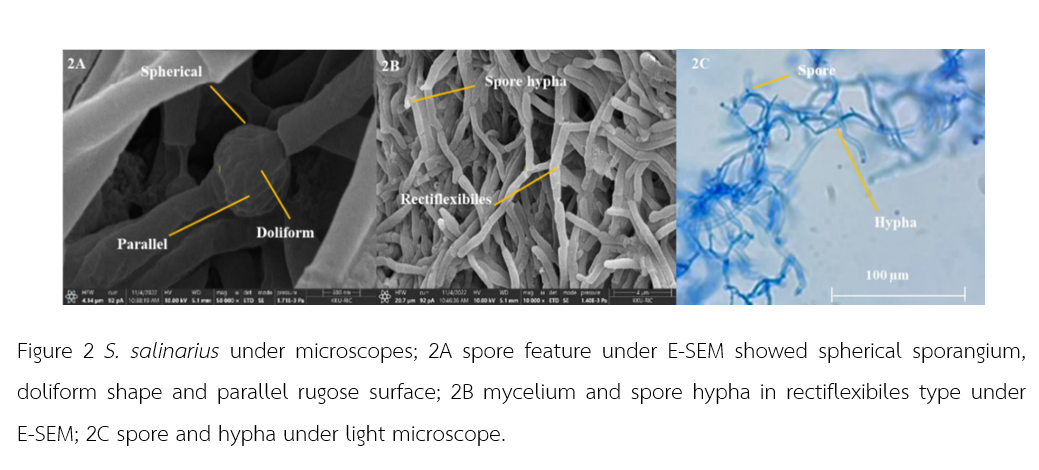
แลคเคสเป็นเอนไซม์ที่มีคุณค่าในการย่อยสลายสารมลพิษทางชีวภาพในสิ่งแวดล้อม จึงศึกษาการผลิตแลคเคสจากเชื้อ Streptomyces salinarius ซึ่งถูกคัดแยกจากดินที่มีการปนเปื้อนสีย้อมมาก่อนหน้านี้ โดยศึกษาลักษณะทางสัณฐานวิทยาภายใต้กล้องจุลทรรศน์แบบใช้แสงและกล้องจุลทรรศน์อิเล็คตรอนแบบส่องกราดด้วยระบบสุญญากาศระดับสภาวะแวดล้อม พบลักษณะเส้นใยเป็น rectiflexibiles มีรูปร่างสปอร์แบบ doliform ขนาดเส้นผ่านศูนย์กลาง 2 ไมโครเมตร พื้นผิวของสปอร์แบบ parallel rugose และสปอร์เป็นแบบ polysporous ในการศึกษาการผลิตเอนไซม์แลคเคส มีการทดสอบชนิดและปริมาณของวัสดุเหลือใช้ทางการเกษตร เพื่อใช้เป็นสับเสตรตในอาหารเลี้ยงเชื้อ และศึกษาคุณสมบัติของเอนไซม์หยาบเพื่อดูความเสถียรและการเก็บรักษา พบว่ากิจกรรมของเอนไซม์แลคเคสสูงที่สุด (0.824 ยูนิตต่อมิลลิลิตร) ในอาหารเหลวที่เติมรำข้าวร้อยละ 1 เมื่อศึกษาการทำงานของเอนไซม์แลคเคส พบว่าแลคเคสจาก S. salinarius มีความคงตัวได้ดีในช่วง pH 4 - 8 โดยพบกิจกรรมคงเหลือร้อยละ 70 หลังจากการบ่ม และมีความคงตัวของเอนไซม์ที่อุณหภูมิ 30 องศาเซลเซียส เป็นเวลา 24 ชั่วโมง เมื่อทดสอบความคงทนต่อสารเคมี พบว่าสารเซทิล-ไตรเมทิลแอมโมเนียมโบรไมด์ (CATB) ช่วยเพิ่มการทำงานของเอนไซม์ ในขณะที่เฟอรัสคลอไรด์ (FeCl2) ยับยั้งการทำงานของเอนไซม์ เมื่อศึกษาการตรึงเอนไซม์หยาบบนวัสดุพาหะที่เป็นวัสดุอนุภาคนาโนแม่เหล็ก (Fe3O4) เพื่อนำเอนไซม์กลับมาใช้ซ้ำได้ พบว่าเอนไซม์คงตัวอยู่ได้ โดยมีกิจกรรมของเอนไซม์ร้อยละ 70 และผลจากการตรึงได้โปรตีนที่ตรึงได้ร้อยละ 20 ซึ่งตรวจสอบการจับของโปรตีนด้วยเครื่อง Fourier-transform infrared spectroscopy (FTIR) จากผลการทดลองแสดงให้เห็นว่า S. salinarius เป็นแหล่งผลิตแลคเคสที่มีศักยภาพสามารถตรึงบนอนุภาคนาโนแม่เหล็กได้ เพื่อนำไปประยุกต์ใช้ในการบำบัดสารมลพิษ
Article Details

อนุญาตภายใต้เงื่อนไข Creative Commons Attribution-NonCommercial-NoDerivatives 4.0 International License.
เอกสารอ้างอิง
Agarwal, N., Solanki, V.S., Gacem, A., Hasan, M.A., Pare, B., Srivastava, A., Singh, A., Yadav, V.K., Yadav, K.K., Lee, C., Chaiprapat, S. and Jeon, B.H. (2022). Bacterial laccases as biocatalysts for the remediation of environmental toxic pollutants: A green and eco-friendly approach-a review. Water 14: 4068.
Araújo, G.S., Ribeiro, G.O., Almeida de Souza, S.M., Paulo da Silva, G., Mafra de Carvalho, G.B., Bispo, J.A.C. and Martínez, E.A. (2022). Rice (Oryza sativa) Bran and Soybean (Glycine max) Meal: Unconventional Supplements in the Mead Production. Food Technology and Biotechnology 60(1): 89 - 98.
Ashraf, F., Irfan, M, Shakir, H.A., Ali, S. and Khan, M. (2020). An overview of production and industrial exploitation of bacterial laccases. Punjab University Journal of Zoology 35(1): 147 - 156.
Coria-Oriundo, L.L., Battaglini, F. and Wirth, S.A. (2021). Efficient decolorization of recalcitrant dyes at neutral/ alkaline pH by a new bacterial laccase-mediator system. Ecotoxicology and Environmental Safety 217: 112237.
Debnath, R. and Saha, T. (2020). An insight into the production strategies and applications of the ligninolytic enzyme laccase from bacteria and fungi. Biocatalysis and Agricultural Biotechnology 26: 101645.
Ezike, T.C., Ezugwu, A.L., Udeh, J.O., Eze, S.O. and Chilaka, F.C. (2020). Purification and characterisation of new laccase from Trametes polyzona WRF03. Biotechnology Reports 28: e00566.
Gogotya, A, Nnolim, N.E., Digban, T.O., Okoh, A.I. and Nwodo, U.U. (2021). Characterization of a thermostable and solvent-tolerant laccase produced by Streptomyces sp. LAO. Biotechnology Letters 43: 1429 - 1442.
Gunne, M. and Urlacher, V.B. (2012). Characterization of the Alkaline Laccase Ssl1 from Streptomyces sviceus with Unusual Properties Discovered by Genome Mining. PLoS One 7: e52360.
He, X., Yang, W., Li, S., Liu, Y., Hu, B., Wang, T. and Hou, X. (2018). An amino-functionalized magnetic framework composite of type Fe3O4-NH2@MIL-101(Cr) for extraction of pyrethroids coupled with GC-ECD. Microchimica Acta 185: 125.
Jing, D. (2010). Improving the simultaneous production of laccase and lignin peroxidase from Streptomyces lavendulae by medium optimization. Bioresource Technology 101(19): 7592 - 7597.
Jing, D. and Wang, J. (2012). Controlling the simultaneous production of laccase and lignin peroxidase from Streptomyces cinnamomensis by medium formulation. Biotechnology for Biofuels 5(15): 1 - 7.
Karuna, D. and Poonam, S. (2020). Production, partial purification and characterization of laccase from rhizospheric bacteria Pseudomonas putida strain LUA15.1. Research Journal of Biotechnology 15(2): 144 – 152.
Klanbut, K., Rattanakavil, T., Duangupama, T., Suriyachadkun, C., Herron, P.R. and Thawai, C. (2023). Streptomyces salinarius sp. nov., an actinomycete isolated from solar saltern soil. International Journal of Systematic and Evolutionary Microbiology 73(4): 005863.
Li, Z., Chen, Z., Zhu, Q., Song, J., Li, S. and Liu, X. (2020). Improved performance of immobilized laccase on Fe3O4@ C-Cu2+ nanoparticles and its application for biodegradation of dyes. Journal of Hazardous Materials 399: 123088.
Li, S., Liu, Q., Liu, J., Sun, K., Yang, W., Si, Y. and Gao, Y. (2022). Inhibition mechanisms of Fe2+/Fe3+ and Mn2+ on fungal laccase-enabled bisphenol a polyreaction. Chemosphere 307: 135685.
Liu, Y., Luo, G., Ngo, H.H., Guo, W. and Zhang, S. (2020). Advances in thermostable laccase and its current application in lignin-first biorefinery: A review. Bioresource Technology 298: 122511.
Liu, Y., Yan, M., Geng, Y. and Huang, J. (2016). Laccase Immobilization on Poly(p-phenylenediamine)/Fe3O4 Nanocomposite for Reactive Blue 19 Dye Removal. Applied Sciences 6: 232.
Mon, W.P., Jantaharn, P., Boonlue, S., McCloskey, S., Kanokmedhakul, S. and Mongkolthanaruk, W. (2022). Enzymatic Degradation of Azo Bonds and Other Functional Groups on Commercial Silk Dyes by Streptomyces coelicoflavus CS-29. Environment and Natural Resources Journal 20(1): 19 - 28.
Muthukumarasamy, N.P., Jackson, B., Joseph, R.A. and Sevanan, M. (2015). Production of Extracellular Laccase from Bacillus subtilis MTCC 2414 Using Agroresidues as a Potential Substrate. Biochemistry Research International 2: 765190.
Niladevi, K.N., Sukumaran, R.K. and Prema, P. (2007). Utilization of rice straw for laccase production by Streptomyces psammoticus in solid-state fermentation. Journal of Industrial Microbiology and Biotechnology 34(10): 665 - 674.
Niladevi, K.N., Sukumaran, R.K., Nicemol, J., Anisha, G.S. and Prema, P. (2009). Optimization of laccase production from a novel strain-Streptomyces psammoticus using response surface methodology. Microbiological Research 164: 105 - 113.
Prakash, D. and Nawani, N.N. (2014). A rapid and improved technique for scanning electron microscopy of actinomycetes. Journal of Microbiological Methods 99: 54 - 57.
Reda, F.M., El-Mekkawy R.M. and Hassan, N.S. (2019). Detoxification and Bioremediation of Sulfa Drugs and Synthetic Dyes by Streptomyces mutabilis A17 Laccase Produced in Solid State Fermentation. Journal of Pure and Applied Microbiology 13(1): 85 - 97.
Sarnthima, R., Mongkolthanaruk, W., Sanachai, K. and Khammuang, S. (2024). Laccase from Streptomyces sp. CS29 and molecular insight of sulfamethoxazole degradation. Biologia 79: 311 - 320.
Scheiblbrandner, S., Breslmayr, E., Csarman, F., Paukner, R., Führer, J., Herzog, PL., Shleev, SV., Osipov, EM., Tikhonova, TV., Popov, VO., Haltrich, D., Ludwig, R. and Kittl, R. (2017). Evolving stability and pH-dependent activity of the high redox potential Botrytis aclada laccase for enzymatic fuel cells. Scientific reports 7: 13688.
Shirling, E.B. and Gottlieb, D. (1966). Methods for characterization of Streptomyces species1. International Journal of Systematic and Evolutionary Microbiology 16(3): 313 - 340.
Shraddha, SR., Sehgal, S., Kamthania, M. and Kumar, A. (2011). Laccase: microbial sources, production, purification, and potential biotechnological applications. Enzyme Research 2011: 217861.
Sondhi, S., Sharma, P., Saini, S., Puri, N. and Gupta, N. (2014) Purification and Characterization of an Extracellular, Thermo-Alkali-Stable, Metal Tolerant Laccase from Bacillus tequilensis SN4. PLoS ONE 9(5): e96951.
Taheran, M., Naghdi, M., Brar, S.K., Knystautas, E.J., Verma, M. and Surampalli, R.Y. (2017). Covalent Immobilization of Laccase onto Nanofibrous Membrane for Degradation of Pharmaceutical Residues in Water. ACS Sustainable Chemistry and Engineering 5(11): 10430 - 10438.
Wang, F., Xu, L., Zhao, L., Ding, Z., Ma, H. and Terry, N. (2019). Fungal Laccase Production from Lignocellulosic Agricultural Wastes by Solid-State Fermentation: A Review. Microorganisms 7(12): 665.
Xu, R., Bi, H., He, G., Zhu, J. and Chen, H. (2014). Synthesis of Cu-Fe3O4@graphene composite: A magnetically separable and efficient catalyst for the reduction of 4-nitrophenol. Materials Research Bulletin 57: 190 - 196.
Zhang, K., Yang, W., Liu, Y., Zhang, K., Chen, Y. and Yin, X. (2020). Laccase immobilized on chitosan-coated Fe3O4 nanoparticles as reusable biocatalyst for degradation of chlorophenol. Journal of Molecular Structure 1220: 128769.
