
การออกแบบแบบแบ่งกลุ่มเป็น 2 คลาสขนาด 1 และ m โดยมี λ_1=5,λ_2=1
Article Sidebar
Main Article Content
บทคัดย่อ
การออกแบบแบบแบ่งกลุ่ม คือ คู่อันดับ
โดยที่
เป็นเซตของสัญลักษณ์ขนาด
และ
เป็นเซตของกลุ่มย่อยขนาด
(เรียกว่า บล็อก) ของ
ที่สอดคล้องกับเงื่อนไขต่อไปนี้ : เซต
ขนาด
ถูกแบ่งออกเป็น
กลุ่มที่มีขนาด
และ
กลุ่มที่แต่ละกลุ่มมีขนาด
โดยที่ สมาชิกในแต่ละคู่ที่อยู่ในกลุ่มเดียวกันจะปรากฏร่วมกันในบล็อกของ
จำนวน
บล็อก และ สมาชิกในแต่ละคู่ที่จากต่างกลุ่มจะปรากฏร่วมกันในบล็อกของ
จำนวน
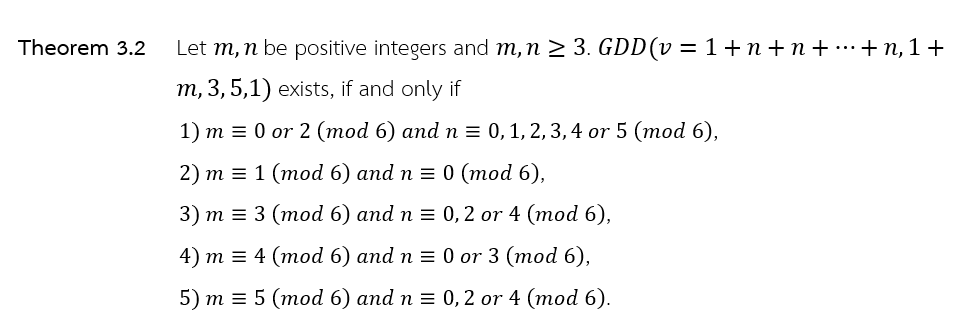
บล็อก ในผลงานวิจัยนี้ เราได้หาหลักเกณฑ์ที่จำเป็นและเพียงพอสำหรับการมีอยู่ของการออกแบบแบบแบ่งกลุ่ม ในรูปแบบ
โดยที่
Article Details

อนุญาตภายใต้เงื่อนไข Creative Commons Attribution-NonCommercial-NoDerivatives 4.0 International License.
เอกสารอ้างอิง
Bose R.C. and Shimamoto T. (1952). Classification and analysis of partially balanced incomplete block designs with two associate classes. Journal of the American statistical Association 47(258): 151 - 184. doi: 10.1080/01621459.1952.10501161.
Colbourn, C.J. and Dinitz, J.H. (2007). Handbook of Combinatorial Designs, 2nd edition. Chapman and Hall. CRC Press, Boca Raton. doi: 10.1201/9781420010541.
Fu, H.L. and Rodger, C.A. (1998). Group divisible designs with two associate classes: n=2 or m=2. Journal of Combinatorial Theory, Series A 83(1): 94 - 117.
Fu, H.L., Rodger, C.A. and Sarvate, D.G. (2000). The existence of group divisible designs with first and second associates, having block size 3. Ars Combinatoria 54: 33 - 50.
Lapchinda, W., Punnim, N. and Pabhapote, N. (2013). GDDs with two associate classes with three groups of sizes 1,n,n and λ_1 < λ_2. In: Akiyama, J., Kano, M. and Sakai, T. Computational Geometry and Graphs. TJJCCGG 2012. Lecture Notes in Computer Science, Springer, Berlin, Heidelberg. 8296: 101 - 109.
Lapchinda, W., Punnim, N. and Pabhapote, N. (2014). GDDs with two associate classes and with three groups of sizes 1,n and n. Australasian Journal of Combinatorics 58(2): 292 - 303.
Lapchinda, W. (2019). GDDs with two associate classes and with one group of size 1 and m groups of size n and λ_1=3 , λ_2=1. Walailak Procedia 2019(3): ST.68.
Lindner, C.C. and Rodger, C.A. (2009). Design Theory. 2nd edition. New York: Chapman and Hall/CRC. 272 pp.
