
Production of Seasoning Powder from Concentrated Crab Boiling Water Using Foam-Mat Drying
Article Sidebar
Main Article Content
Abstract
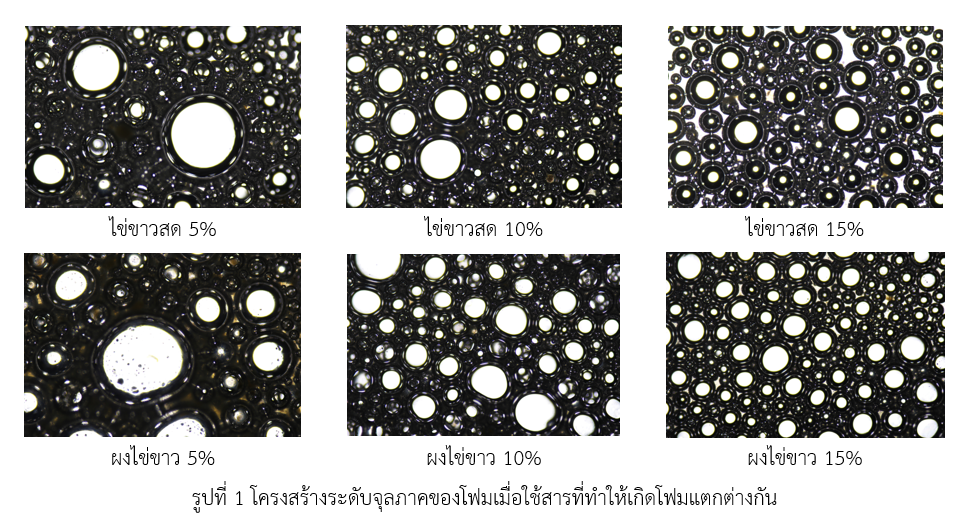
This study investigated the production of seasoning powder from natural ingredients as an alternative to monosodium glutamate (MSG). Concentrated crab cooking water was used as the primary ingredient and supplemented with yeast extract. The proximate compositions and amino acid profiles of both materials were analyzed. A seasoning sauce was initially prepared and subsequently converted into powder by foam-mat drying using either fresh egg white or egg white powder as the foaming agent. The results showed that concentrated crab cooking water was low in energy and protein, whereas yeast extract powder was high in protein and low in salt but relatively high in energy. Hydroxyproline was the most abundant amino acid in the concentrated crab cooking water (6,414.78 mg/100 g), while glutamic acid was predominant in the yeast extract powder (6,475.25 mg/100 g). The high glutamic acid content may have contributed to the greater sensory acceptance of the formulation containing the highest concentration of yeast extract. Among the foaming treatments, 15% egg white powder produced the most favorable foam properties. Of the three drying temperatures tested (60, 70, and 80ºC), 80ºC was the most suitable for producing the seasoning powder. These findings demonstrate the potential commercial application of concentrated crab cooking water and yeast extract in producing a natural umami-enhancing seasoning powder with reduced MSG use.
Article Details

This work is licensed under a Creative Commons Attribution-NonCommercial-NoDerivatives 4.0 International License.
References
กองโภชนาการ. (2544). ตารางแสดงคุณค่าทางโภชนาการของอาหารไทย. พิมพ์ครั้งที่ 1. กรุงเทพฯ: โรงพิมพ์องค์การทหารผ่านศึก. หน้า 6 - 7.
สำนักงานมาตรฐานผลิตภัณฑ์อุตสาหกรรม. (2547). มาตรฐานผลิตภัณฑ์ชุมชนผงปรุงรสอาหาร (มผช. 494/2547) สำนักงานมาตรฐานผลิตภัณฑ์อุตสาหกรรม กระทรวงอุตสาหกรรม.
Affandi, N., Zzaman, W., Yang, T.A. and Easa, A.M. (2017). Production of Nigella sativa Beverage Powder under Foam Mat Drying Using Egg Albumen as a Foaming Agent. Beverages 3(1): 9. doi: 10.3390/beverages3010009.
Ames, J.M. and Elmore, J.S. (1992). Aroma components of yeast extracts. Flavour and Fragrance Journal 7(2): 89 - 103. doi: 10.1002/ffj.2730070208.
Ames, J.M. and Leod, G.M. (2006). Volatile Components of a Yeast Extract Composition. Journal of Food Science 50: 125 - 131. doi: 10.1111/j.1365-2621.1985.tb13292.x.
AOAC. (2000). Official methods of analysis of AOAC International. 17th edition. Gaithersburg, M.D., USA: Association of Analytical Communities.
Ault, A. (2004). The Monosodium Glutamate Story: The Commercial Production of MSG and Other Amino Acids. Journal of Chemical Education 81(3): 347 - 355. doi: 10.1021/ed081p347.
Azizpour, M., Mohebbi, M. and Khodaparast, M.H.H. (2016). Effects of foam-mat drying temperature on physico-chemical and microstructural properties of shrimp powder. Innovative Food Science and Emerging Technologies 34: 122 - 126. doi: 10.1016/j.ifset.2016.01.002.
Chandrasekar, V., Gabriela, J.S., Kannan, K. and Sangamithra, A. (2015). Effect of foaming agent concentration and drying temperature on physicochemical and antimicrobial properties of foam mat dried powder. Asian Journal of Dairy and Food Research 34(1): 39 - 43. doi: 10.5958/0976-0563.2015.00008.1.
Djaeni, M., Kumoro, A.C., Sasongko, S.B. and Utari, F.D. (2018). Drying Rate and Product Quality Evaluation of Roselle (Hibiscus sabdariffa L.) Calyces Extract Dried with Foaming Agent under Different Temperatures. International Journal of Food Science 2018: 9243549. doi: 10.1155/2018/9243549.
Djaeni, M., Prasetyaningrum, A., Sasongko, S.B., Widayat, W. and Hii, C.L. (2013). Application of foam-mat drying with egg white for carrageenan: Drying rate and product quality aspects. Journal of Food Science and Technology 52(2): 1170 - 1175. doi: 10.1007/s13197-013-1081-0.
Eisner, M.D., Jeelani, S.A.K., Bernhard, L. and Windhab, E.J. (2007). Stability of foams containing proteins, fat particles and nonionic surfactants. Chemical Engineering Science 62(7): 1974 - 1987.
Falade, K.O., Adeyanju, K.I. and Uzo-Peters, P.I. (2003). Foam-Mat drying of cowpea (Vigna unguiculata) using glyceryl monostearate and egg albumin as foaming agents. European Food Research and Technology 217: 486 - 491. doi: 10.1007/s00217-003-0775-3.
Franco, T.S., Ellendersen, L.N., Fattori, D., Granato, D. and Masson, M.L. (2015). Influence of the Addition of Ovalbumin and Emulsifier on the Physical Properties and Stability of Yacon (Smallanthus sonchifolius) Juice Foams Prepared for Foam Mat Drying Process. Food and Bioprocess Technology 8: 2012 - 2026. doi: 10.1007/s11947-015-1553-5.
Gharbi, N. and Labbafi, M. (2019). Influence of treatment-induced modification of egg white proteins on foaming properties. Food Hydrocolloids 90: 72 - 81. doi: 10.1016/j.foodhyd.2018.11.060.
Grabowski, J.A., Truong, V. D. and Daubert, C. (2006). Spray-Drying of Amylase Hydrolyzed Sweetpotato Puree and Physicochemical Properties of Powder. Journal of Food Science 71: E209 - E217. doi: 10.1111/j.1750-3841.2006.00036.x.
Hsu, C.L., Chen, W., Weng, Y.M. and Tseng, C.Y. (2003). Chemical composition, physical properties, and antioxidant activities of yams flours as affected by different drying methods. Food Chemistry 83(1): 85 - 92. doi: 10.1016/S0308-8146(03)00053-0.
Ikeda, K. (1908). New seasonings. Journal of Tokyo Chemical Society 30: 820 - 836. doi: 10.1093/chemse/27.9.847.
Indrawati, L., Wang, Z., Narsimhan, G. and Gonzalez, J. (2008). Effect of processing parameters on foam formation using a continuous system with a mechanical whipper. Journal of Food Engineering 88(1): 65 - 74. doi: 10.1016/j.jfoodeng.2008.01.015.
Ji, Y., Dai, Z., Sun, S., Ma, X., Yang, Y., Tso, P., Wu, G. and Wu, Z. (2018). Hydroxyproline Attenuates Dextran Sulfate Sodium-Induced Colitis in Mice: Involvment of the NF-κB Signaling and Oxidative Stress. Molecular Nutrition & Food Research 62(21): e1800494. doi: 10.1002/mnfr.201800494.
Jinap, S. and Hajeb, P. (2010). Glutamate. Its applications in food and contribution to health. Appetite 55(1): 1 - 10. doi: 10.1016/j.appet.2010.05.002.
Kadam, D.M., Wilson, R.A. and Kaur, S. (2010). Determination of biochemical properties of foam-mat dried mango powder. International Journal of Food Science and Technology 45: 1626 - 1632. doi: 10.1111/j.1365-2621.2010.02308.x.
Kampf, N., Martinez, C.G., Corradini, M.G. and Peleg, M. (2003). Effect of two gums on the development, rheological properties and stability of egg albumen foams. Rheologica Acta 42: 259 - 268. doi: 10.1007/s00397-002-0281-8.
Karabulut, I., Topcu, A., Duran, A., Turan, S. and Ozturk, B. (2007). Effect of hot air drying and sun drying on color values and β-carotene content of apricot (Prunus armenica L.). LWT-Food Science and Technology 40: 753 - 758. doi: 10.1016/j.lwt.2006.05.001.
Karim, A.A. and Wai, C.C. (1999). Foam-mat drying of starfruit (Averrhoa carambola L.) puree. Stability and air drying characteristics. Food Chemistry 64: 337 - 343. doi: 10.1016/S0308-8146(98)00119-8.
Kato, A., Takahashi, A. Matsudomi, N. and Kobayashi, K. (1983). Determination of foaming properties of proteins by conductivity measurements. Journal of Food Science 48: 62 - 65. doi: 10.1111/j.1365-2621.1983.tb14788.x.
Kawai, M., Okiyama, A. and Ueda, Y. (2002). Taste Enhancements Between Various Amino Acids and IMP. Taste enhancements between various amino acids and IMP. Chemical Senses 27(8): 739 - 745. doi: 10.1093/chemse/27.8.739.
Kong, Y., Yang, X., Ding, Q., Zhang, Y.Y., Sun, B.G., Chen, H. T. and Sun, Y. (2017). Comparison of non-volatile umami components in chicken soup and chicken enzymatic hydrolysate. Food Research International. 102: 559 - 566. doi: 10.1016/j.foodres.2017.09.038.
Marinova, K.G., Basheva, E.S., Nenova, B., Temelska, M., Mirarefi, A.Y., Campbell, B.and Ivanov, I.B. (2009). Physico-chemical factors controlling the foam ability and foam stability of milk proteins: Sodium caseinate and whey protein concentrates. Food Hydrocolloids 23: 1864 - 1876. doi: 10.1016/j.food hyd.2009.03.003.
Nindo, C.I. and Tang, J. (2007). Refractance window dehydration technology: A novel contact drying method. Drying Technology 25: 37 - 48. doi: 10.1080/07373930601152673.
Palou, E., López-Malo, A., Barbosa-Cánovas, G.V., Welti-Chanes, J. and Swanson, B.G. (1999). Polyphenoloxidase activity and color of blanched and high hydrostatic pressure treated banana puree. Journal of Food science 64: 42 - 45. doi: 10.1111/j.1365-2621.1999.tb09857.
Poonnakasem, N., Pujols, K.D., Chaiwanichsiri, S., Laohasongkram, K. and Prinyawiwatkul, W. (2015). Different oils and health benefit statements affect physicochemical properties, consumer liking, emotion, and purchase intent: A case of sponge cake. Journal of Food Science 81: S165 - S173. doi: 10.1111/1750-3841.13186.
Pua, C.K., Nazimah, H.S.A., Tan, C.P., Mirhosseini, H., Rahman, R.B.A., Rusul, G. (2010). Optimization of drum drying processing parameters for production of jackfruit (Artocarpus heterophyllus) powder using response surface methodology. LWT-Food Science and Technology 43: 343 - 349. doi: 10.1016/j.lwt.2009.08.011.
Qadri, O.S., Srivastava, A.K. and Yousuf, B. (2020). Trends in foam mat drying of foods: Special emphasis on hybrid foam mat drying technology. Critical Reviews in Food Science and Nutrition 60(10): 1667 - 1676. doi: 10.1080/10408398.2019.1588221.
Raghavan, S. (2006). Handbook of Spices, Seasonings, and Flavorings (2nd ed.). Boca Raton: CRC Press. doi: 10.1201/b13597.
Rajkumar, P., Kailappan. R, Vishwanathan, R., Parvathi, K., Raghavan, G and Orsat, V. (2007). Thin layer drying study on foamed mango pulp. Agricultural Engineering International: The CIGR Ejournal Manuscript 9: 1 – 14.
Ratti, C. (2001). Hot air and freeze-drying of high-value foods: A review. Journal of Food Engineering 49(4): 311 - 319. doi: 10.1016/S0260-8774(00)00228-4.
Sangamithra, A., Venkatachalam, S., John, S.G. and Kuppuswamy, K. (2015). Foam mat drying of food materials: A review. Journal of Food Processing and Preservation 39(6): 3165 - 3174. doi: 10.1111/jfpp.12421.
Sarwar, G., Botting, H.G. and Peace, R.W. (1988). Complete amino acid analysis in hydrolysates of foods and feces by liquid chromatography of precolumn phenylisothiocyanate derivatives. Journal Association of Official Analytical Chemistry 71 (6): 1172 - 1175.
Sommer, R. (1998). Yeast extracts: production, properties and components. Food Australia 50(4): 181 - 183.
Tomé, D. (2021). Yeast extracts: Nutritional and flavoring food ingredients. ACS Food Science & Technology 1(4): 487 - 494. doi: 10.1021/acsfoodscitech.0c00131.
Tran, N.Y.T., Duc, N.V., Le, T.D., Huynh, L.B., Van Nguyen, A.V. and Dao, T.P. (2023). Study of seasoning powder processing from gray abalone mushroom. Journal of Food Quality 2023(1): 7991830. doi: 10.1155/2023/7991830.
WHO. (2025). Sodium reduction. World Health Organization. Source: http://www.who.int/mediacentre/ factsheets/fs393/en/. Retrieved date 14 April 2025.
Wilson, R.A., Kadam, D.M., Chadha, S., Grewal, M.K. and Sharma, M. (2014). Evaluation of physical and chemical properties of foam-mat dried mango (Mangifera indica) powder during storage. Journal of Food Processing and Preservation 38: 1866 - 1874. doi: 10.1111/jfpp.12158.
Yamaguchi, S. (1967). The synergistic taste effect of monosodium glutamate and disodium 5’-inosinate. Journal of Food Science 32(4): 473 - 478. doi: 10.1111/j.1365-2621.1967.tb09715.x.
Yamashita, M., Arai, S., Tanimoto, S. and Fujimaki, N. (1973). Condensation Reaction Occurring during Plastein Formation by α-Chymotrypsin. Journal of Agricultural and Biological Chemistry 37(4): 953 - 954. doi: 10.1080/00021369.1973.10860774.
Zhang, Y., Venkitasamy, C., Pan, Z. and Wang, W. (2013). Recent developments on umami ingredients of edible mushrooms: a review. Trends in Food Science & Technology 33(2): 78 - 92.
Zhang, Y., Venkitasamy, C., Pan, Z., Liu, W. and Zhao, L. (2017). Novel umami ingredients: Umami peptides and their taste. Journal of Food Science 82(1): 16 - 23. doi: 10.1111/1750-3841.13576.
