
Khon Kaen University Integrated Generative AI Services System
Article Sidebar
Main Article Content
Abstract
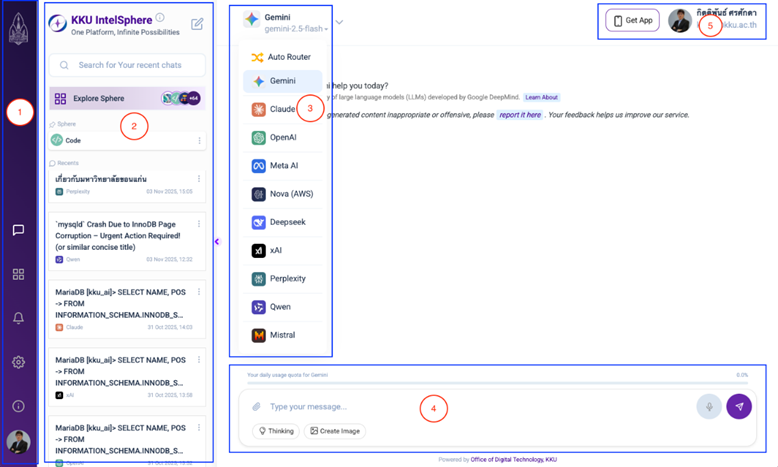
This research aims to develop an “Integrated Generative AI Service System” to serve as a centralized platform for Khon Kaen University (KKU) personnel and students, with the primary objectives of enhancing resource management efficiency, controlling AI utilization expenditures, and establishing a standardized framework for integration with the university's core information systems. The system was developed using a microservices architecture, dividing functionalities into independent services. The User Interface supports access via Web Browsers and Mobile Applications, while the Web Service layer comprises an API Server acting as the central hub for processing commands and managing business logic, interfacing with a diverse database infrastructure including MariaDB (Primary Database), Redis (Cache/Session Data), and Object Storage (File Server). At the core of the system is the Large Language Model (LLM) Integration component, which functions as a centralized gateway managing and interacting with various LLMs. It employs the OpenRouter LLMs Gateway as an intermediary to select and route requests to the most appropriate LLM provider (e.g., OpenAI, Google, Anthropic) to optimize for cost and processing speed. Furthermore, the system integrates authentication through KKU Single Sign On (SSO) and implements rigorous security measures, including HTTPS/TLS encryption, XSS/CSRF protection, Rate Limiting, and API Key management, to ensure secure and effective AI utilization. User satisfaction evaluation showed that user satisfaction with the Integrated Generative AI Service System at Khon Kaen University was at a high level (with an overall mean score of 4.18 and S.D. of 0.83).
Article Details

This work is licensed under a Creative Commons Attribution-NonCommercial-NoDerivatives 4.0 International License.
References
คชาธร ขาวเรือง และเมธี แซ่ตั้ง. (2568). การพัฒนาการให้บริการ Generative AI เพื่อส่งเสริมการเรียนรู้และการวิจัย. PULINET Journal 12(1): 146 - 157.
มานน เซียวประจวบ, ปิญะธิดา อมรภิญโญ และนิษา ศักดิ์ชูวงษ์. (2567). โมเดลการใช้งานเทคโนโลยีปัญญาประดิษฐ์เชิงสร้างสรรค์ของผู้ปฏิบัติงานฐานความรู้. วารสารวิทยาการจัดการ มหาวิทยาลัยราชภัฏอุดรธานี 6(4): 1 - 16.
บุญชม ศรีสะอาด. (2553). การวิจัยเบื้องต้น (พิมพ์ครั้งที่ 8). กรุงเทพฯ: สุวีริยาสาส์น. หน้า 99 - 103.
อภิสรา คชรัฐแก้วฟ้า. (2566). การศึกษาผลกระทบจากการยอมรับการใช้งานเทคโนโลยีปัญญาประดิษฐ์ (AI) ด้านความพึงพอใจในการทำงานของพนักงานออฟฟิศในประเทศไทย. วิทยานิพนธ์การจัดการมหาบัณฑิต, มหาวิทยาลัยมหิดล. กรุงเทพฯ.
Davis, F.D. (1989). Perceived usefulness, perceived ease of use, and user acceptance of information technology. MIS Quarterly 13(3): 319 - 340. doi: 10.2307/249008.
DeLone, W.H. and McLean, E.R. (2003). The DeLone and McLean model of information systems success: A ten-year update. Journal of Management Information Systems 19(4): 9 - 30. doi: 10.1080/07421222.2003.11045748
Ebert, C. and Louridas, P. (2023). Generative AI for software practitioners. IEEE Software 40(4): 30 - 38. doi: 10.1109/ms.2023.3265877.
Huijts, R. and Suilen, K. (2025). Institutional AI Sovereignty Through Gateway Architecture: Implementation Report from Fontys ICT. Cornell University, Sources: https://arxiv.org/abs/2512.08978. Retrieved date 20 November 2025.
Katiyar, A., Kumar, A. and Chaubey, A. (2024). Generative AI in higher education: navigating benefits and challenges in the technological era. Journal of Applied Research in Higher Education 16(5): 1545 - 1561. doi: 10.1108/JARHE-02-2025-0103.
Likert, R. (1932). A technique for the measurement of attitudes. Archives of Psychology 22(140): 1 - 55. doi: 10.1007/978-94-007-0753-5_1654.
Liu, X., Wang, Y. and Chen, Z. (2022). High-performance caching strategies in microservices architecture using Redis. Journal of Cloud Computing 11(1): 1 - 15.
O'Dea, X. (2024). Generative AI: Is it a paradigm shift for higher education? Studies in Higher Education 49(5): 811 - 816. doi: 10.1080/03075079.2024.2332944.
