
Feature Selection and Classification of Hypertension Using the Chaotic Golden Eagle Optimization Algorithm
Article Sidebar
Main Article Content
Abstract
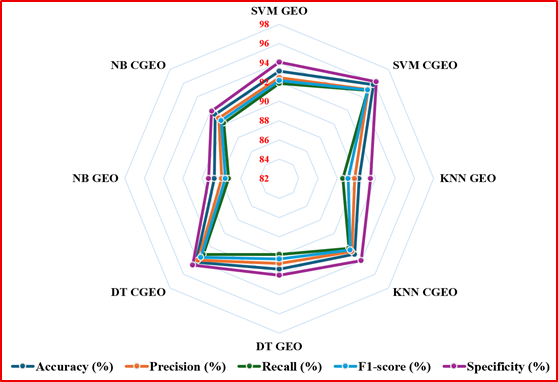
Hypertension is a major global public health problem and one of the leading risk factors for cardiovascular disease. Accurate classification and early identification are essential for effective treatment planning and long-term risk reduction. However, machine-learning models are often affected by redundant, irrelevant, or highly correlated features, which may reduce classification performance and increase computational burden. This study proposes a Chaotic Golden Eagle Optimization (CGEO) algorithm for feature selection and hypertension classification. The proposed method extends the original Golden Eagle Optimizer (GEO) by integrating a Chebyshev chaotic map to improve population diversity, strengthen the exploration–exploitation balance, and reduce premature convergence. The method was evaluated on a real hypertension dataset containing clinical and demographic attributes and was integrated with four classifiers: Support Vector Machine (SVM), k-Nearest Neighbors (KNN), Decision Tree (DT), and Naïve Bayes (NB) under the same experimental settings. Model performance was assessed using accuracy, precision, recall, F1-score, and specificity over 30 independent runs. The experimental results showed that CGEO consistently outperformed GEO across all classifiers. Among the evaluated models, CGEO-SVM achieved the best overall performance, with an accuracy of 95.78 percent and a specificity of 96.20 percent, while reducing the number of selected features by approximately 50%. An additional controlled SVM-based benchmark against PSO, GWO, and GA further showed that CGEO achieved the most favorable overall trade-off in terms of accuracy, specificity, F1-score, feature-reduction rate, and runtime under the present experimental setting. Statistical testing further confirmed that the differences between GEO and CGEO were significant at the 0.05 level. In addition, although CGEO required slightly more computation time than GEO, the overhead remained acceptable relative to the gains in predictive performance, stability, and feature subset compactness. These findings indicate that incorporating chaotic dynamics into a metaheuristic framework can significantly improve feature selection and medical data classification performance.
Article Details

This work is licensed under a Creative Commons Attribution-NonCommercial-NoDerivatives 4.0 International License.
References
Abbasi Fashami, S., Zangian, M., Minuchehr, A. and Zolfaghari, A. (2024). Loading pattern optimization of VVER-1000 reactor core based on the discrete golden eagle optimization algorithm. Nuclear Engineering and Technology 56(8): 3425 - 3434. doi: 10.1016/j.net.2024.03.042.
Albreiki, S., Simsekler, M.C.E., Qazi, A. and Bouabid, A. (2024). Assessment of the organizational factors in incident management practices in healthcare: A tree augmented Naive Bayes model. PLoS ONE 19(3): 1 - 20. doi: 10.1371/journal.pone.0299485.
Al-Gburi, Z.D.S. and Kurnaz, S. (2022). Optical disk segmentation in human retina images with golden eagle optimizer. Optik 271: 170103. doi: 10.1016/j.ijleo.2022.170103.
Appasani, D., Bokkisam, C.S. and Surendran, S. (2024). An Incremental Naive Bayes Learner for Real-time Health Prediction. Procedia Computer Science 235: 2942 - 2954. doi: 10.1016/j.procs.2024.04.278.
Boriratrit, S., Fuangfoo, P., Srithapon, C. and Chatthaworn, R. (2023). Adaptive meta-learning extreme learning machine with golden eagle optimization and logistic map for forecasting the incomplete data of solar irradiance. Energy and AI 13: 100243. doi: 10.1016/j.egyai.2023.100243.
Cortes, C., Vapnik, V. and Saitta, L. (1995). Support-Vector Networks. Machine Leaming 20: 273 - 297. doi: 10.1007/BF00994018.
Costa, V.G. and Pedreira, C.E. (2023). Recent advances in decision trees: an updated survey. Artificial Intelligence Review 56(5): 4765 - 4800. doi: 10.1007/s10462-022-10275-5.
Eluri, R.K. and Devarakonda, N. (2022). Binary Golden Eagle Optimizer with Time-Varying Flight Length for feature selection. Knowledge-Based Systems 247. doi: 10.1016/j.knosys.2022.108771.
Halder, R.K., Uddin, M.N., Uddin, M.A., Aryal, S. and Khraisat, A. (2024). Enhancing K-nearest neighbor algorithm: a comprehensive review and performance analysis of modifications. Journal of Big Data 11(1): 1 - 55. doi: 10.1186/s40537-024-00973-y.
Heidari, A.A., Mirjalili, S., Faris, H., Aljarah, I., Mafarja, M. and Chen, H. (2019). Harris hawks optimization: Algorithm and applications. Future Generation Computer Systems 97: 849 - 872. doi: 10.1016/j. future.2019.02.028.
Jayalekshmi, S. and Velusamy, R.L. (2023). Energy aware Load Balanced Clustering using Golden Eagle Optimization in MS based LR-WPAN. Procedia Computer Science 220: 812 - 819. doi: 10.1016/j.procs. 2023.03.108.
Liu, H., Zhou, M. and Liu, Q. (2019). An embedded feature selection method for imbalanced data classification. IEEE/CAA Journal of Automatica Sinica 6(3): 703 - 715. doi: 10.1109/JAS.2019.1911447.
Magesh, T., Devi, G. and Lakshmanan, T. (2023). Improving the performance of grid connected wind generator with a PI control scheme based on the metaheuristic golden eagle optimization algorithm. Electric Power Systems Research 214: 1 - 12. doi: 10.1016/j.epsr.2022.108944.
Markoulidakis, I. and Markoulidakis, G. (2024). Probabilistic Confusion Matrix: A Novel Method for Machine Learning Algorithm Generalized Performance Analysis. Technologies 12(7): 1 - 23. doi: 10.3390/technologies12070113.
Mohammadi-Balani, A., Dehghan Nayeri, M., Azar, A. and Taghizadeh-Yazdi, M. (2021). Golden eagle optimizer: A nature-inspired metaheuristic algorithm. Computers and Industrial Engineering 152. doi: 10.1016/j.cie.2020.107050.
Prosper chuks. (2022). Diabetes, Hypertension and Stroke Prediction [Data set]. Kaggle. https://www.kaggle.com/datasets/prosperchuks/health-dataset?select=hypertension_data.csv. Retrieved date 5 August 2025.
Rakotonirainy, R.G. and van Vuuren, J.H. (2020). Improved metaheuristics for the two-dimensional strip packing problem. Applied Soft Computing Journal 92: 1 - 13. doi: 10.1016/j.asoc.2020.106268.
Singh, P., Singh, N., Singh, K.K. and Singh, A. (2021). Chapter 5 - Diagnosing of disease using machine learning. In K.K. Singh, M. Elhoseny, A. Singh, & A.A. Elngar (Eds.), Machine Learning and the Internet of Medical Things in Healthcare (pp. 89 - 111). Academic Press. doi: 10.1016/B978-0-12-821229-5.00003-3.
Tanveer, M., Rajani, T., Rastogi, R., Shao, Y.H. and Ganaie, M.A. (2024). Comprehensive review on twin support vector machines. Annals of Operations Research 339(3): 1223 - 1268. doi: 10.1007/s10479-022-04575-w.
World Health Organization. (2024, May 7). WHO results report 2023 shows notable health achievements and calls for concerted drive toward Sustainable Development Goals. https://www.who.int/news/item/07-05-2024-who-results-report-2023-shows-notable-health-achievements-and-calls-for-concerted-drive-toward-sustainable-development-goals. Retrieved date 27 July 2025.
Yang, X., Zhen, L. and Li, Z. (2023). Binary golden eagle optimizer combined with initialization of feature number subspace for feature selection. Knowledge-Based Systems 282: 1 - 18. doi: 10.1016/j.knosys.2023.111109.
