
Efficiency of Phosphate Adsorption in Synthetic Wastewater using Mango Leaves Combined with Tap Water Treatment Plant Sludge
Article Sidebar
Main Article Content
Abstract
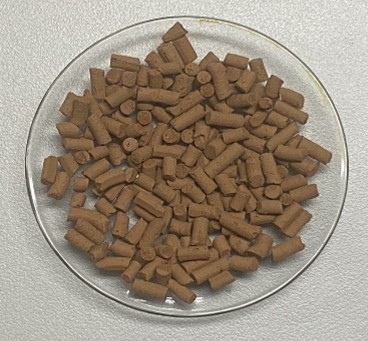
Phosphate is a major pollutant causing eutrophication in aquatic environments. Developing cost-effective and efficient adsorbent materials is crucial for wastewater treatment. This research aimed to investigate the efficiency of phosphate adsorption in synthetic wastewater using adsorbents prepared from tap water treatment plant sludge (S) mixed with mango leaves (LM) at ratios of 100:0, 70:30, 50:50, 30:70, and 0:100 by weight. The results showed that S-LM ratios of 100:0 and 70:30, calcined at 500ºC for 2 hours, could be successfully formed into pellets and were water-insoluble. The adsorbent surface was then modified by chitosan coating. The equilibrium time study revealed that 1.000 g of S-LM (70:30) adsorbent at room temperature and pH 7 reached adsorption equilibrium faster with chitosan coating (16 hours) compared to the uncoated adsorbent (24 hours). The adsorption efficiency study demonstrated that chitosan-coated adsorbents achieved higher removal efficiency than uncoated ones, with phosphate removal rates of 60.00% and 44.00%, respectively. The adsorption isotherm study showed that the highest correlation coefficient (R²) was 0.9910, close to 1.0, indicating excellent agreement with the Langmuir isotherm model and confirming monolayer adsorption behavior. The maximum adsorption capacity of S-LM (70:30)+C was 158.7302 mg/g for the chitosan-coated adsorbent and 14.7059 mg/g for S-LM (100:0). The chitosan-coated S-LM (70:30) adsorbent exhibited the highest efficiency due to the introduction of positively charged functional groups, particularly protonated amino groups (-NH3+), which attract negatively charged phosphate ions (PO43-) through electrostatic attraction mechanisms. This enhanced performance makes the adsorbent highly suitable for application in treating phosphate-contaminated wastewater.
Article Details

This work is licensed under a Creative Commons Attribution-NonCommercial-NoDerivatives 4.0 International License.
References
กรมควบคุมมลพิษ. (2565). รายงานสถานการณ์มลพิษของประเทศไทย ปี 2565. กรุงเทพฯ: กรมควบคุมมลพิษ กระทรวงทรัพยากรธรรมชาติและสิ่งแวดล้อม. 330 หน้า
ดวงพร แก่นแก้ว และอัจฉรา ดวงเดือน. (2550). การดูดซับฟลูออไรด์โดยใช้ดินเหนียวที่ปรับสภาพด้วยเถ้าแกลบดำ. ใน: การประชุมทางวิชาการของมหาวิทยาลัยเกษตรศาสตร์ ครั้งที่ 45. มหาวิทยาลัยเกษตรศาสตร์, กรุงเทพฯ. 112 - 120.
ธเรศ ศรีสถิต และกิตตินันท์ คงสืบชาติ. (2567). ดินเผาดูดชับจากดินเหนียวและขี้เลื่อยเพื่อการดูดซับแคดเมียมในน้ำเสีย สังเคราะห์. การวิจัยสิ่งแวดล้อมประยุกต์ 26(2): 1 - 12.
นพปฎล เสงี่ยมศักดิ์ และพงศกร พรรณรัตนศิลป์. (2555). ประสิทธิภาพการดูดซับนิกเกิลของดินเหนียวและดินทรายปนทรายแป้ง. วิศวกรรมสารฉบับวิจัยและพัฒนา 23(3): 46 - 53.
ปาจรีย์ บุญทวี และวนิดา ชูอักษร. (2564). การเปรียบเทียบประสิทธิภาพการดูดซับฟลูออไรด์ด้วยวัสดุดูดซับ. วารสารวิทยาศาสตร์และเทคโนโลยี มทร.สุวรรณภูมิ 5(1): 100 - 101.
ปิยนุช ใจแก้ว, ชาญชัย คหาปนะ และณภัทร โพธิ์วัน. (2565). ประสิทธิภาพของผักตบชวาต่อการดูดซับฟอสเฟตในน้ำเสีย จากกระบวนการผลิตปลาร้า. วารสารวิชาการเทคโนโลยีอุตสาหกรรม : มหาวิทยาลัยราชภัฏสวนสุนันทา 10(1): 52 - 60.
รัฐพล หงส์เกรียงไกร, อุษารัตน์ คาทับทิม, วิรัญญา เดชอุดม และวราวุฒิ หวังแววกลาง. (2562). การกำจัดตะกั่วออกจาก
น้ำเสียสังเคราะห์ด้วยตัวดูดซับใบผักแพว. วารสารวิทยาศาสตร์และเทคโนโลยี มทร.ธัญบุรี 9(1): 31 - 39.
สุดารัตน์ สมบัติศรี, ณัฐวุฒิ สุไชยชิต และชัยสิทธิ์ ภะวะ. (2562). การดูดซับทางชีวภาพฟอสเฟตด้วยกากมันสำปะหลังดัดแปร. วารสารวิชาการและวิจัย มทร.พระนคร 13(1): 170 - 179.
เสาวภา ไวยสุศรี (2559). การกำจัดฟอสเฟตในน้ำเสียโดยการดูดซับด้วยแคลเซียมคาร์บอเนตและแคลเซียมออกไซด์จากเปลือกไข่ไก่. วารสารวิชาการพระจอมเกล้าพระนครเหนือ 26(3): 475 - 486.
APHA–AWWA–WEF. (2017). Standard Methods for the Examination of Water and Wastewater (23rd ed.). Washington DC: American Public Health Association, American Water Works Association, Water Environment Federation, Denver.
Babatunde, A.O. and Zhao, Y.Q. (2007). Constructive Approaches Toward Water Treatment Works Sludge Management: An International Review of Beneficial Reuses. Critical Reviews in Environmental Science and Technology 37(2): 129 - 164. doi: 10.1080/10643380600776239.
Bhatnagar, A., Sillanpää, M. and Witek-Krowiak, A. (2015). Agricultural waste peels as versatile biomass for water purification - A review. Chemical Engineering Journal 270: 244 - 271. doi: 10.1016/j.cej.2015.01.135.
Correll, D.L. (1998). The role of phosphorus in the eutrophication of receiving waters: a review. Journal of Environmental Quality 27(2): 261 - 266. doi: 10.2134/jeq1998.00472425002700020004x.
De Gisi, S., Lofrano, G., Grassi, M. and Notarnicola, M. (2016). Characteristics and adsorption capacities of low-cost sorbents for wastewater treatment: A review. Sustainable Materials and Technologies 9: 10 - 40. doi: 10.1016/j.susmat.2016.06.002.
Dey, S., Sreenivasulu, A., Veerendra, G.T.N., Phani Manoj, A.V., and Haripavan, N. (2022). Synthesis and characterization of mango leaves biosorbents for removal of iron and phosphorus from contaminated water. Applied Surface Science Advances 11: 100292. doi: 10.1016/j.apsadv.2022.10292.
Dey, S. and Haripavan, N. (2023). Applications of Plants Leaf-Based Biosorbents for Removal of Iron and Phosphorus from Contaminated Water: A Review. Biomedical Materials & Devices 1: 122 - 145. doi: 10.1007/s44174-022-00029-w.
Guibal, E. (2004). Interactions of metal ions with chitosan-based sorbents: a review. Separation and Purification Technology 38(1): 43 - 74. doi: 10.1016/j.seppur.2003.10.004.
Ho, Y.S. (2006). Isotherms for the Sorption of Lead onto Peat: Comparison of Linear and Non-Linear Methods. Polish Journal of Environmental Studies 15(1): 81 - 86.
Huang, W., Wang, S., Zhu, Z., Li, L., Yao, X., Rudolph, V. and Haghseresht, F. (2008). Phosphate removal from wastewater using red mud. Journal of Hazardous Materials 158(1): 35 - 42. doi: 10.1016/j.jhazmat. 2008.01.061.
Huang, W., Zhang, Y. and Li, D. (2017). Adsorptive removal of phosphate from water using mesoporous materials: A review. Journal of Environmental Management 193: 470 - 482. doi: 10.1016/j.jenvman.2017.02.030.
Loganathan, P., Vigneswaran, S., Kandasamy, J. and Bolan, N.S. (2014). Removal and Recovery of Phosphate From Water Using Sorption. Critical Reviews in Environmental Science and Technology 44(8): 847 - 907. doi: 10.1080/10643389.2012.741311.
Natrayan, L., Kaliappan, S., Dheeraj Kumar Reddy, C.N., Karthick, M., Sivakumar, N.S., Patil, P.P. and Thanappan, S. (2022). Development and characterization of carbon-based adsorbents derived from agricultural wastes and their effectiveness in adsorption of heavy metals in wastewater. Bioinorganic Chemistry and Applications (1): 1659855. doi: 10.1155/2022/1659855.
Sharpley, A., Jarvie, H.P., Buda, A., May, L., Spears, B. and Kleinman, P. (2013). Phosphorus Legacy: Overcoming the Effects of Past Management Practices to Mitigate Future Water Quality Impairment. Journal of Environmental Quality 42(5): 1308 - 1326. doi: 10.2134/jeq2013.03.0098.
Smith, V.H. and Schindler, D.W. (2009). Eutrophication science: where do we go from here?. Trends in Ecology & Evolution 24(4): 201 - 207. doi: 10.1016/j.tree.2008.11.009.
Sowmya, A. and Meenakshi, S. (2013). An efficient and regenerable quaternary amine modified chitosan beads for the removal of nitrate and phosphate anions. Journal of Environmental Chemical Engineering 1(4): 906 - 915. doi: 10.1016/j.jece.2013.07.031.
Taweekarn, T., Wongniramaikul, W., Roop-o, P., Towanlong, W., and Choodum, A. (2024). Recovering Phosphate from Complex Wastewater Using Macroporous Cryogel Composited Calcium Silicate Hydrate Nanoparticles. Molecles 29: 228. doi: 10.3390/molecules29010228.
Usevičiūtė, L., Kaklauskas, A., Danila, V. and Januševičius, T. (2025). Enhanced aqueous phosphate removal using chitosan-modified zirconium-loaded cork biochar. Scientific Reports 15: 29240.doi: 10.1038/s41598-025-14819-x.
Yang, Y., Zhao, Y.Q., Babatunde, A.O., Wang, L., Ren, Y.X. and Han, Y. (2006). Characteristics and mechanisms of phosphate adsorption on dewatered alum sludge. Separation and Purification Technology 51(2): 193 - 200. doi: 10.1016/j.seppur.2006.01.013.
Zhang, X., Liu, X., Zhang, Z. and Chen, Z. (2021). Removal of phosphate from aqueous solution by chitosan coated and lanthanum loaded biochar derived from urban dewatered sewage sludge: adsorption mechanism and application to lab-scale columns. Water Science and Technology 84(12): 3891 - 3906. doi: 10.2166/wst.2021.485.
