การพัฒนาแบบจำลองการตรวจจับเสียงปลอมแปลงของบุคคลสาธารณะเพื่อบรรเทาภัยคุกคามจากข้อมูลบิดเบือนบนมิติไซเบอร์
Article Sidebar
Main Article Content
บทคัดย่อ
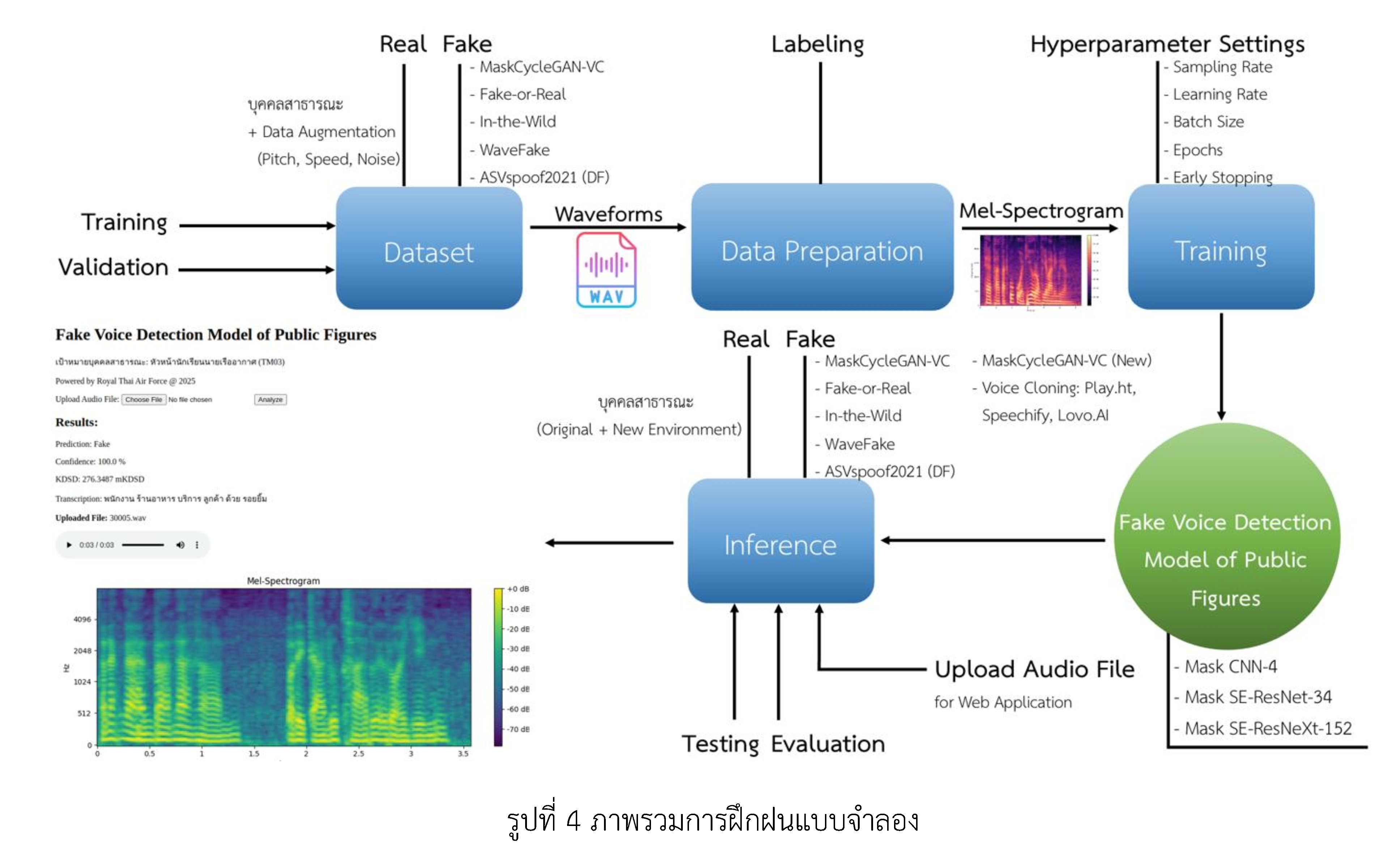
การวิจัยนี้มีวัตถุประสงค์เพื่อ 1) ศึกษาแนวทางการตรวจจับเสียงปลอมแปลงด้วยเทคโนโลยีปัญญาประดิษฐ์ 2) พัฒนาแบบจำลองการตรวจจับเสียงปลอมแปลงของบุคคลสาธารณะที่มีประสิทธิภาพ และ 3) นำเสนอแนวทางการประยุกต์ใช้งานในการปฏิบัติการทางไซเบอร์เชิงรับ กระบวนการวิจัยประกอบด้วยการเตรียมข้อมูลเสียงที่ครอบคลุมเทคโนโลยีการปลอมแปลงหลายประเภท เช่น การแปลงเสียง การโคลนเสียง และการแปลงข้อความเป็นเสียง พร้อมทั้งการสกัดคุณลักษณะเสียงด้วยเมลสเปกโตรแกรม (Mel-spectrogram) จากนั้นพัฒนาและต่อยอดสถาปัตยกรรมเชิงลึก 3 แบบ ได้แก่ Mask CNN-4 Mask SE-ResNet-34 และ Mask SE-ResNeXt-152 เพื่อสร้างแบบจำลองเฉพาะด้านสำหรับการแยกแยะเสียงจริงและเสียงปลอมของบุคคลสาธารณะ ผลการประเมินด้วยชุดทดสอบและชุดข้อมูลใหม่ที่แบบจำลองไม่เคยเห็นมาก่อน พบว่าแบบจำลองทั้งหมดสามารถจำแนกได้อย่างแม่นยำ โดยเฉพาะ Mask SE-ResNeXt-152 ซึ่งให้ประสิทธิภาพสูงสุดที่ความแม่นยำ (accuracy) 98.33% นอกจากนี้ยังได้พัฒนาเว็บแอปพลิเคชันเพื่อประยุกต์ใช้งานจริง โดยสามารถแสดงผลการพยากรณ์ ค่าความเชื่อมั่น ค่าระยะห่างเสียงเชิงลึกแบบเคอร์เนล และการถอดเสียงพูดเป็นข้อความ เพื่อสนับสนุนการตัดสินใจเชิงปฏิบัติการทางไซเบอร์เชิงรับ การทดสอบด้วยชุดข้อมูล NKRAFA Thai ยังยืนยันว่าแบบจำลองมีประสิทธิภาพสูงกว่าการฟังของมนุษย์ โดยอัตราการตัดสินผิดสองกรณีหลัก (เสียงปลอมถูกตัดสินว่าเป็นเสียงจริงและเสียงจริงถูกตัดสินว่าเป็นเสียงปลอม) ลดลงจาก 56% และ 41% เหลือศูนย์ สะท้อนศักยภาพของแบบจำลองในการบรรเทาภัยคุกคามจากข้อมูลบิดเบือนในมิติไซเบอร์
Article Details

อนุญาตภายใต้เงื่อนไข Creative Commons Attribution-NonCommercial-NoDerivatives 4.0 International License.
เอกสารอ้างอิง
กฤติภูมิ ผลาจันทร์, สุพศิน วงศ์ลาภสุวรรณ, ธนพล รุ่มนุ่ม, สัจจาภรณ์ ไวจรรยา และ ณัฐโชติ พรหมฤทธิ์. (2566). การจำแนกเสียงคนจริงและเสียงสังเคราะห์ปัญญาประดิษฐ์ด้วยโครงข่ายประสาทเทียมแบบคอนโวลูชัน. วารสารวิทยาศาสตร์ มข. 51(2): 170 - 179. doi: 10.14456/kkuscij.2023.15.
ไทยรัฐออนไลน์. (2568). แพทองธาร เผยโดนแก๊งคอลฯ ปลอมเสียงผู้นำประเทศหลอกโอนเงิน สั่ง รมว.ดีอี ตรวจสอบ. แหล่งข้อมูล: https://www.thairath.co.th/news/politic/2836244. ค้นเมื่อวันที่ 10 มีนาคม 2568.
พายัพ ศิรินาม และ ประสงค์ ปราณีตพลกรัง. (2566). การพัฒนาโมเดลการเลียนเสียงเชิงลึกในการประยุกต์ใช้งานด้านสงครามไซเบอร์. วารสารสถาบันวิชาการป้องกันประเทศ 14(1): 162 - 178.
สถาบันส่งเสริมการสอนวิทยาศาสตร์และเทคโนโลยี. (2563). รายวิชาเพิ่มเติมวิทยาศาสตร์และเทคโนโลยี ฟิสิกส์ ชั้นมัธยมศึกษาปีที่ 5 เล่มที่ 4 [ฉบับ e-book]. พิมพ์ครั้งที่ 1. กรุงเทพฯ: สถาบันส่งเสริมการสอนวิทยาศาสตร์และเทคโนโลยี. หน้า 29 - 30.
สำนักงานตำรวจแห่งชาติ. (2567). 4 รูปแบบอาชญากรรมออนไลน์ที่ต้องจับตามองในปี 2567 เมื่อ AI ถูกใช้ในด้านมืด ปลอมได้สารพัด. แหล่งข้อมูล: https://www.facebook.com/photo.php?fbid=766631268843499. ค้นเมื่อวันที่ 10 มีนาคม 2568.
อานนท์ บางเสน และ พายัพ ศิรินาม. (2568). การประยุกต์ใช้เทคโนโลยีปัญญาประดิษฐ์เชิงกำเนิดในการแปลงเสียง. วารสารวิทยาศาสตร์และเทคโนโลยีนายเรืออากาศ 21(2): 135 - 157.
Abdeldayem, M. (2021). The Fake-or-Real (FoR) Dataset (deepfake audio). Source: https://www.kaggle.com /datasets/mohammedabdeldayem/the-fake-or-real-dataset. Retrieved date 14 February 2025.
ASVspoof Consortium. (2021). ASVspoof 2021 Deepfake (DF) database. Source: https://zenodo.org/record/4835108. Retrieved date 14 February 2025.
Barbiero, P., Squillero, G. and Tonda, A. (2020). Modeling generalization in machine learning: A methodological and computational study. arXiv preprint arXiv:2006.15680.
Binkowski, M., Donahue, J., Dieleman, S., Clark, A., Elsen, E., Casagrande, N., Cobo, L. C. and Simonyan, K. (2020). High fidelity speech synthesis with adversarial networks. In: Proceedings of the International Conference on Learning Representations (ICLR 2020). ICLR, Online.
Donahue, C., McAuley, J. and Puckette, M. (2019). Adversarial audio synthesis. In: International Conference on Learning Representations (ICLR) 2019. 1-18.
Fathima, G., Kiruthika, S., Malar, M. and Nivethini, T. (2024). Deepfake Audio Detection Model Based on Mel Spectrogram Using Convolutional Neural Network. International Journal of Creative Research Thoughts (IJCRT) 12(4): 208 - 215.
Frank, J. and Schönherr, L. (2021). WaveFake: A Data Set to Facilitate Audio Deepfake Detection. In: NeurIPS Datasets and Benchmarks Track 2021. NeurIPS Foundation, Online. Source: https://openreview .net/forum?id=IO7jcf63iDI. Retrieved date 14 February 2025.
Gartner. (2025). 2025 Gartner® Market Guide for AI Trust, Risk and Security Management (AI TRiSM). Source: https://www.proofpoint.com/us/resources/analyst-reports/gartner-market-guide-ai-trism. Retrieved date 10 March 2025.
Gohil, M., Yang, H., Tumanov, A., Delimitrou, C. and Venkataraman, S. (2024). Can machine learning models generalize across cloud environments? IEEE Computer Architecture Letters 23(1): 12 - 15.
He, K., Zhang, X., Ren, S. and Sun, J. (2016). Deep residual learning for image recognition. In: IEEE Conference on Computer Vision and Pattern Recognition (CVPR 2016). IEEE, Las Vegas, USA. 770-778. doi:10.1109/CVPR.2016.90.
Henderson, P., Islam, R., Bachman, P., Pineau, J., Precup, D. and Meger, D. (2018). Deep Reinforcement Learning That Matters. In: 32nd AAAI Conference on Artificial Intelligence (AAAI 2018). AAAI Press, New Orleans, USA. 3207-3214.
Hu, J., Shen, L. and Sun, G. (2018). Squeeze-and-excitation networks. In: IEEE Conference on Computer Vision and Pattern Recognition (CVPR 2018). IEEE, Salt Lake City, USA. 7132-7141. doi:10.1109/CVPR.2018. 00745.
HuggingFace. (2024). wav2vec2-large-xlsr-53-th. Source: https://huggingface.co/airesearch/wav2vec2-large-xlsr-53-th. Retrieved date 14 February 2025.
Jovanović, M. and Campbell, M. (2022). Generative Artificial Intelligence: Trends and Prospects. IEEE Computer Society 55(10): 107 - 112.
Kaneko, T., Kameoka, H., Tanaka, K. and Hojo, N. (2021). MaskCycleGAN-VC: Learning Non-parallel Voice Conversion with Filling in Frames. In: IEEE International Conference on Acoustics, Speech and Signal Processing (ICASSP 2021). IEEE, Toronto, Canada. 5919 - 5923.
Keskar, N.S., Mudigere, D., Nocedal, J., Smelyanskiy, M., and Tang, P.T.P. (2017). On large-batch training for deep learning: Generalization gap and sharp minima. In: International Conference on Learning Representations (ICLR).
Kong, J., Kim, J. and Bae, J. (2020). HiFi-GAN: Generative adversarial network for efficient and high fidelity speech synthesis. Advances in Neural Information Processing Systems 33: 17022-17033.
Kumar, K., Kumar, R., de Boissiere, T., Gestin, L., Teoh, W.Z., Sotelo, J., de Brebisson, A., Bengio, Y. and Courville, A. (2019). MelGAN: Generative adversarial networks for conditional waveform synthesis. Advances in Neural Information Processing Systems 32: 14881-14892.
Liu, X., Wang, X., Sahidullah, M., Patino, J., Delgado, H., Kinnunen, T., Todisco, M., Yamagishi, J., Evans, N., Nautsch, A. and Lee, K.A. (2023). ASVspoof 2021: Towards Spoofed and Deepfake Speech Detection in the Wild. IEEE/ACM Transactions on Audio, Speech, and Language Processing, 31: 1 - 17.
LOVO. (2025). AI Voice Cloning & Text to Speech Online Tool. Source: https://lovo.ai. Retrieved date 14 February 2025.
Maas, A.L., Hannun, A.Y. and Ng, A.Y. (2013). Rectifier nonlinearities improve neural network acoustic models. In: 30th International Conference on Machine Learning (ICML 2013). International Machine Learning Society, Atlanta, USA. 1 - 6.
Masters, D., and Luschi, C. (2018). Revisiting small batch training for deep neural networks. arXiv preprint arXiv:1804.07612.
McFee, B., Raffel, C., Liang, D., Ellis, D. P. W., McVicar, M., Battenberg, E. and Nieto, O. (2015). librosa: Audio and music signal analysis in Python. In: 14th Python in Science Conference (SciPy 2015). SciPy, Austin, USA. 18 - 25. doi:10.25080/Majora-7b98e3ed-003.
Mohamed, A. (2022). In-the-Wild Dataset. Source: https://www.kaggle.com/datasets/abdallamohamed 312/in-the-wild-dataset. Retrieved date 14 February 2025.
Pedregosa, F., Varoquaux, G., Gramfort, A., Michel, V., Thirion, B., Grisel, O., Blondel, M., Prettenhofer, P., Weiss, R., Dubourg, V., Vanderplas, J., Passos, A., Cournapeau, D., Brucher, M., Perrot, M. and Duchesnay, E. (2011). Scikit-learn: Machine learning in Python. Journal of Machine Learning Research 12: 2825 - 2830.
Play.ht. (2025). AI Voice Cloning & Text to Speech Online Tool. Source: https://play.ht. Retrieved date 14 February 2025.
Shashank, N., Sathvik, S., Tanmaya, R. and Nethravathi, B. (2024). Enhancing sequence learning with masking in recurrent neural networks. International Research Journal of Modernization in Engineering Technology and Science (IRJMETS) 6(1): 2238 - 2246. doi: 10.56726/IRJMETS48489.
Speechify. (2025). AI Voice Cloning & Text to Speech Online Tool. Source: https://speechify.com. Retrieved date 14 February 2025.
StickCui. (2019). PyTorch-SE-ResNet. Source: https://github.com/StickCui/PyTorch-SE-ResNet/blob/master/ model/model.py. Retrieved date 14 February 2025.
van den Oord, A., Dieleman, S., Zen, H., Simonyan, K., Vinyals, O., Graves, A., Kalchbrenner, N., Senior, A. and Kavukcuoglu, K. (2016). WaveNet: A generative model for raw audio. In: 9th ISCA Speech Synthesis Workshop (SSW9). International Speech Communication Association (ISCA), Sunnyvale, California, USA. 125.
Vanacore, A., Pellegrino, M.S. and Ciardiello, A. (2024). Fair evaluation of classifier predictive performance based on binary confusion matrix. Computational Statistics 39: 363 - 383. doi: 10.1007/s00180-022-01301-9.
Yi, J., Wang, C., Tao, J., Zhang, X., Zhang, C.Y. and Zhao, Y. (2023). Audio Deepfake Detection: A Survey. arXiv preprint arXiv: 2308.14970.
