
Monitoring and Predicting Chemical Testing of Water Types: LIMS System
Article Sidebar
Main Article Content
Abstract
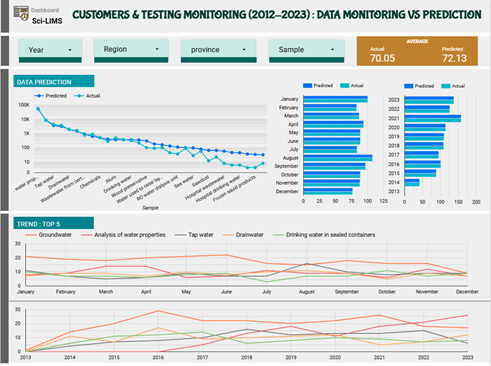
Data management plays a crucial role in Laboratory Information Management Systems (LIMS), which are used to collect customer information and conduct chemical tests for water sample. However, successfully managing chemical testing processes presents obstacles, particularly in terms of financial expenditures, resource allocation, and waste management. A well-designed dashboard can help optimize chemical testing and improve resource planning. This study presents data in the form of dashboards that feature both historical and predictive maintenance observations. The primary goal is to evaluate and show historical water sample data, which will serve as the foundation for developing a prediction model using Gradient Boosted Regression. The study process consists of collecting data from the water sample testing service from LIMS, followed by data processing, which involves cleaning the data. This cleaned data is then used to create a model and present the visualization from both the predictions and the actual data. The R-squared score from this model is 0.82. By analyzing and forecasting the volume of water samples, the study helps improve the accuracy of resource allocation, allowing for more efficient planning and management of chemical testing operations. Ultimately, this approach contributes to reducing waste and minimizing unnecessary expenses, optimizing both financial and environmental outcomes in water quality testing.
Article Details

This work is licensed under a Creative Commons Attribution-NonCommercial-NoDerivatives 4.0 International License.
References
Wang, D., Singhasemanon, N. and Goh, K. (2016). A statistical assessment of pesticide pollution in surface waters using environmental monitoring data: Chlorpyrifos in Central Valley. Science of The Total Environment 571: 332 - 341. doi: 10.1016/j.scitotenv.2016.07.159.
Yang, J. (2023). Predicting water quality through daily concentration of dissolved oxygen using improved artificial intelligence. In Scientific Reports, 13. doi: 10.1038/s41598-023-47060-5.
Nair, J.P. and Vijaya, P.M.S. (2021). Predictive models for river water quality using machine learning and big data techniques - A survey. In: Proceedings of the 2021 International Conference on Artificial Intelligence and Smart Systems (ICAIS) Coimbatore, India: IEEE. 1747 - 1753. doi: 10.1109/ICAIS509 30.2021.9395832.
Khan, Y. and Chai, S.S. (2016). Predicting and analyzing water quality using machine learning: A comprehensive model. In: Proceedings of the IEEE Long Island Systems, Applications and Technology Conference (LISAT). Farmingdale, New York: IEEE. 1 - 6. doi: 10.1109/LISAT.2016.7494106.
Li, Y., Mao, S., Yuan, Y., Wang, Z., Kang, Y. and Yao, Y. (2023). Beyond tides and time: Machine learning’s triumph in water quality forecasting. American Journal of Applied Mathematics and Statistics 11(3): 89 - 97. doi: 10.12691/ajams-11-3-2.
Wei, S., Richard, R., Hogue, D., Mondal, I., Xu, T., Boyer, T. and Hamilton, K. (2024). High resolution data visualization and machine learning prediction of free chlorine residual in a green building water system. Water Research X 24(11): 100244. doi: 10.1016/j.wroa.2024.100244.
