
Technical Study of Extracting Waste Cooling Energy from Air Conditioning System and Storage as Chilled Water
Article Sidebar
Main Article Content
Abstract
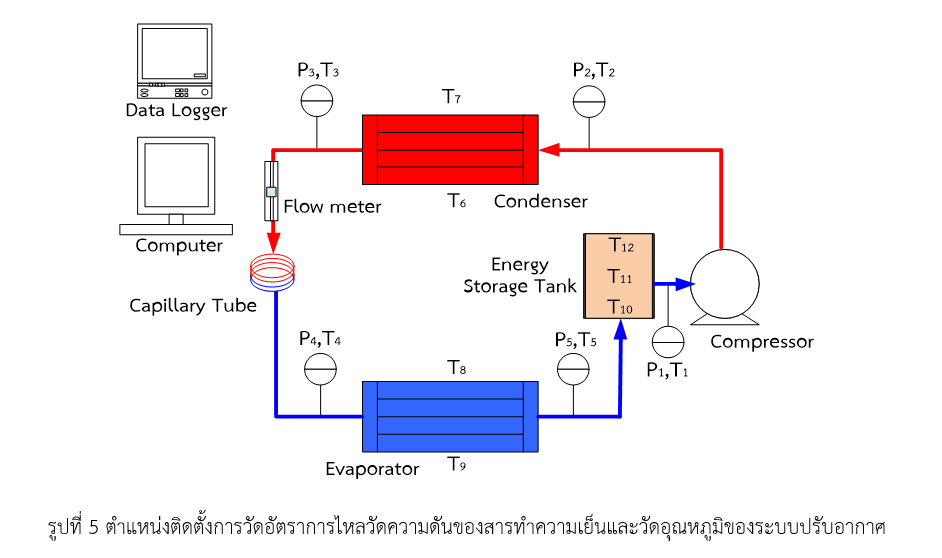
The aim of this research was to perform a technical study on extraction of waste cooling energy from air conditioning system and storage as chilled water. The experimental unit consisted of a vapor compression refrigeration system with a capacity of 3.52 kW (12,000 BTU/hr), and an air-cooled condenser. R-22 refrigerant was used in the system. The cold energy storage tank was made from a 1 mm thick aluminum board and had a diameter of 330 mm and a height of 450 mm. This tank was filled with 23 L of water and wrapped with thermal insulation material. The coiled copper tube with an internal diameter of 15.87 mm, was entwined to a diameter of 260 mm with a 39 mm pitch spacing. The cold energy storage tank was installed between the evaporator and the compressor. During testing, the usual designed room temperature of 25oC was used, and the air conditioning loads were adjusted to 900, 1,800 and 2,200 W, respectively. The results showed that when the initial water temperature at the beginning of the experiment was 25oC, it decreased steadily until it reached a constant value that was maintained throughout the rest of the time period. In the cold energy storage tank, the average cool water temperatures were 18.73, 16.36 and 13.25oC, respectively. The heat transfer rates of condenser were 4.10, 3.81 and 3.65 kW, respectively. The average power consumption of the air conditioning system was 1,062.42, 1,092.04 and 1,112.71 W, respectively. In terms of the coefficient of performance of the system, the values were 3.43, 3.22 and 3.04, respectively. Furthermore, this research has identified advantages of cold energy storage tank, including their uncomplicated equipment and minimal installation space requirements. These tanks operate on the principle of extracting waste cold energy from the refrigerant, with the water within the tank serving to absorb the waste cold energy from the refrigerant. Moreover, the findings from the experiments suggest potential applications for the chilled water stored in cold energy storage tank. For instance, this chilled water can be used to assist in reducing the indoor air temperature before the air conditioning system is turned on, thereby accelerating the cooling process, particularly when combined with evaporative cooling systems. Alternatively, the chilled water can be employed to lower the air temperature before it transfers heat to the condenser, aiming to enhance the efficiency of the air conditioning system. This approach requires the combination of a heat exchanger.
Article Details

This work is licensed under a Creative Commons Attribution-NonCommercial-NoDerivatives 4.0 International License.
References
ชัยฤทธิ์ สีเสมอ และไชยณรงค์ จักรธรานนท์. (2564). การประเมินการนำพลังงานกลับมาใช้ใหม่ในกระบวนการผลิตนม. วารสารวิชาการ มทร.สุวรรณภูมิ 9(2): 199 - 211.
ไชยณรงค์ จักรธรานนท์. (2559). ระบบทำความเย็นและปรับอากาศ. พิมพ์ครั้งที่ 2. กรุงเทพฯ: ภาควิชาวิศวกรรมเครื่องกล คณะวิศวกรรมศาสตร์ มหาวิทยาลัยธรรมศาสตร์. หน้า 1 - 51.
ธวัชชัย สุขะ และดามร บัณฑุรัตน์. (2556). การออกแบบและพัฒนาระบบกักเก็บพลังงานความร้อนในรูปน้ำแข็งสำหรับการปรับอากาศในโรงเรือน. ใน: การประชุมวิชาการสมาคมวิศวกรรมเกษตรแห่งประเทศไทยระดับชาติครั้งที่ 15 และระดับนานาชาติครั้งที่ 7. มหาวิทยาลัยเทคโนโลยีราชมงคลธัญบุรีร่วมกับสมาคมวิศวกรรมเกษตรแห่งประเทศไทย, พระนครศรีอยุธยา. หน้า 119 - 126.
นันทพร วันเรียน, ฉันทนา พันธุ์เหล็ก และสมชาย มณีวรรณ์. (2564). การศึกษาเชิงเทคนิคระบบกักเก็บความเย็นร่วมกับสารเปลี่ยนสถานะสำหรับการปรับอากาศภายในอาคาร. วารสารวิชาการพระจอมเกล้าพระนครเหนือ 31(4): 758 - 769.
นิกร เนื่องอุตม์, ปิยากร จันทะนะ, สมนึก เครือสอน และณรงค์ฤทธิ์ พิมพ์คำวงศ์. (2559). การเพิ่มประสิทธิภาพเครื่องปรับอากาศแบบแยกส่วนโดยใช้ลมเย็นจากพัดลมระบายอากากาศ. วารสารวิชาการและวิจัย มทร.พระนคร 10(1): 15 - 23.
ศิริรัตน์ สุลา, สมชาย มณีวรรณ์ และ ฉันทนา พันธุ์เหล็ก. (2565). ระบบกักเก็บความเย็นในอาคารแบบคอนกรีตมวลเบาร่วมกับสารเปลี่ยนสถานะ. วารสารวิชาการพระจอมเกล้าพระนครเหนือ 32(3): 804 - 814.
สมัญญา อ่วมงาม. (2560). การศึกษาเปรียบเทียบสารกันเยือกแข็งสำหรับการกักเก็บพลังงานในรูปน้ำเย็น. วิทยานิพนธ์วิศวกรรมศาสตรมหาบัณฑิต, มหาวิทยาลัยเทคโนโลยีพระจอมเกล้าธนบุรี. กรุงเทพฯ: 64 หน้า
สิริสวัสดิ์ จึงเจริญนิรชร และทวีวัฒน์ สุภารส. (2563). การเพิ่มประสิทธิภาพระบบปรับอากาศด้วยการลดอุณหภูมิสารทำความเย็นก่อนเข้าคอนเดนเซอร์โดยใช้ถังแลกเปลี่ยนความร้อน. วารสารวิจัย มหาวิทยาลัยเทคโนโลยีราชมงคลศรีวิชัย 12(2): 312 - 322.
Ezan, M.A., Erek, A. and Dincer, I. (2011). Energy and exergy analyses of an ice-on-coil thermal energy storage system. Energy 36(11): 6375 - 6386.
Juengjaroennirachon, S., Pratinthong, N., Namprakai, P. and Suparos, T. (2017). Performance Enhancement of Air Conditioning using Thermosyphon System’s Energy Storage Unit for Cooling Refrigerant before entering the Condenser. Journal of Mechanical science and Technology 31: 393 - 400.
Lamrani, B., Marbet, S. E., Rehman, T. and Kousksou, T. (2024). Comprehensive analysis of waste heat recovery and thermal energy storage integration in air conditioning systems. Energy Conversion and Management: X 24: 100708. doi: 10.1016/j.ecmx.2024.100708.
Liang, Y., Yang, H., Wang, H., Bao, X. and Cui, H. (2024). Enhancing energy efficiency of air conditioning system through optimization of PCM-based cold energy storage tank: A data center case study. Energy 286: 129641. doi: 10.1016/j.energy.2023.129641.
Yan, W.M., Gao, K.E., Sajjad, U., Chien, L.H. and Amani, M. (2023). Experimental study of dynamic melting process in an ice-on-coil storage system. Journal of Energy Storage 73: 109177 doi: 10.1016/j.est. 2023.
