Emerging Technologies for Sustainable Food Innovation: Integrating Processing, Powder Engineering, Digitalisation, Circularity, and Sustainable Packaging
Keywords:
Sustainable food innovation, Emerging technologies, Food processing, Powder engineering, Circular economyAbstract
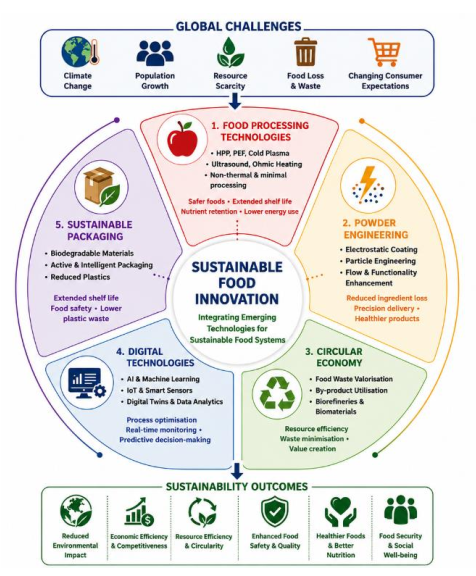
The food sector is under increasing pressure to improve productivity and food security while reducing resource consumption, food loss, waste, and environmental impacts. Emerging technologies are providing new approaches to address these challenges, but their contribution to sustainability depends on their technical performance, economic feasibility, and integration within the wider food system. This review examines recent advances in sustainable food innovation, focusing on five complementary areas: advanced food processing, powder engineering, circular food systems, digital transformation, and sustainable packaging. Technologies including high-pressure processing, pulsed electric fields, cold plasma, ultrasound, electrostatic powder coating, artificial intelligence, food-waste valorisation, and biodegradable and active packaging are discussed in relation to their effects on processing efficiency, resource use, product quality, and waste reduction. The review also considers the main barriers to wider adoption, including scale-up, investment costs, regulatory requirements, process integration, data availability, and variability in raw materials and processing conditions. Particular attention is given to the need for life cycle, techno-economic, and social assessment to determine whether improvements at individual processing stages translate into benefits at the food-system level. Future research should focus on integrating complementary technologies, developing data-driven and resource-efficient manufacturing systems, and improving the commercial viability of circular and sustainable solutions. Such an integrated approach can help move promising technologies from laboratory research towards practical applications that support more resilient, efficient, and sustainable food systems.
References
Abera, G. (2019). Review on high-pressure processing of foods. Cogent Food & Agriculture, 5(1), 1568725. https://doi.org/10.1080/23311932.2019.1568725
Alamandi, M. (2025). Sustainable innovation management: balancing economic growth and environmental responsibility. Sustainability, 17(10), 4362. https://doi.org/10.3390/su17104362
Alam, M.W., Kumar, J.V., & Awad, M., et al. (2025). Emerging trends in food process engineering: integrating sensing technologies for health, sustainability, and consumer preferences. Journal of Food Process Engineering, 48, e70035. https://doi.org/10.1111/jfpe.70035
Balasubramaniam, V. M., Lee, J., & Serventi, L. (2023). Understanding new foods: Development of next generation of food processing, packaging, and ingredients technologies for clean label foods. In L. Serventi (Ed.), Sustainable Food Innovation. pp. 157-167. Cham: Springer International Publishing. https://doi.org/10.1007/978-3-031-12358-0_12
Barringer, S. A., & Sumonsiri, N. (2015). Electrostatic coating technologies for food processing. Annual Review of Food Science and Technology, 6(1), 157-169. https://doi.org/10.1146/annurev-food-022814-01552
Biesbroek, S., Kok, F. J., & Tufford, A. R., et al. (2023). Toward healthy and sustainable diets for the 21st century: Importance of sociocultural and economic considerations. Proceedings of the National Academy of Sciences, 120(26), e2219272120. https://doi.org/10.1073/pnas.2219272120
Boruah, B., & Ray, S. (2024). Current progress in the valorization of food industrial by-products for the development of functional food products. Food Science and Applied Biotechnology, 7(2), 289-317. https://doi.org/10.30721/fsab2024.v7.i2.349
Boudalia, S., Symeon, G. K., & Dotas, V., et al. (2026). The valorization of agrifood byproducts and waste to advance the sustainable development goals: current state and new perspectives. Sustainability, 18(5), 2165. https://doi.org/10.3390/su18052165
Çakmakçı, R., Salık, M. A., & Çakmakçı, S. (2023). Assessment and Principles of Environmentally Sustainable Food and Agriculture Systems. Agriculture, 13(5), 1073. https://doi.org/10.3390/agriculture13051073
Cerutti, N., Lamb, W. F., & Crippa, M., et al. (2023). Food system emissions: a review of trends, drivers, and policy approaches, 1990–2018. Environmental Research Letters, 18(7), 074030. https://doi.org/10.1088/1748-9326/acddfd
Chatzimitakos, T., Athanasiadis, V., & Kalompatsios, D., et al. (2023). Pulsed electric field applications for the extraction of bioactive compounds from food waste and by-products: a critical review. Biomass, 3(4), 367-401. https://doi.org/10.3390/biomass3040022
Corigliano, O., Morrone, P., & Algieri, A. (2025). Navigating the challenges of sustainability in the food processing chain: insights into energy interventions to reduce footprint. Energies, 18(2), 296. https://doi.org/10.3390/en18020296
Corradini, M. G., Homez-Jara, A. K., & Chen, C. (2024). Virtualization and digital twins of the food supply chain for enhanced food safety. Advances in Food and Nutrition Research, 111, 71-91. https://doi.org/10.1016/bs.afnr.2024.06.001
Datta, B., Buehler, M. J., & Chow, Y., et al. (2026). Artificial intelligence for food innovation. Nature Food, 7, 644–654. https://doi.org/10.1038/s43016-026-01380-7
Dávalos-Saucedo, C. A., Rossi-Márquez, G., & Rodríguez-Miranda, S., et al. (2026). Precision edible coating engineering: deposition physics, image metrology and a roadmap toward digital-twin-ready edible surface interfaces. Coatings, 16(7), 812. https://doi.org/10.3390/coatings16070812
Díaz-de-Cerio, E., & Trigueros, E. (2025). Evaluating the sustainability of emerging extraction technologies for valorization of food waste: microwave, ultrasound, enzyme-assisted, and supercritical fluid extraction. Agriculture; Basel, 15(19), 2100. https://doi.org/10.3390/agriculture15192100
Ding, H., Tian, J., & Yu, W., et al. (2023). The Application of Artificial Intelligence and Big Data in the Food Industry. Foods, 12(24), 4511. https://doi.org/10.3390/foods12244511
Dutta, D., & Sit, N. (2024), A comprehensive review on types and properties of biopolymers as sustainable bio-based alternatives for packaging. Food Biomacromolecules, 1, 58-87. https://doi.org/10.1002/fob2.12019
D’Agaro, E., Rosa, F. & Akentieva, N.P. (2021). New technology tools and life cycle analysis (LCA) applied to a sustainable livestock production. The EuroBiotech Journal, 5(3), 130-141. https://doi.org/10.2478/ebtj-2021-0022
Ekezie, F. G. C., Sun, D. W., & Han, Z., et al. (2017). Microwave-assisted food processing technologies for enhancing product quality and process efficiency: A review of recent developments. Trends in Food Science & Technology, 67, 58-69. https://doi.org/10.1016/j.tifs.2017.05.014
Engel‐Cox, J. A., Wikoff, H. M., & Reese, S. B. (2022). Techno‐economic, environmental, and social measurement of clean energy technology supply chains. Journal of Advanced Manufacturing and Processing, 4(3), e10131. https://doi.org/10.1002/amp2.10131
Galanakis, C. M. (2024). The future of food. Foods, 13(4), 506. https://doi.org/10.3390/foods13040506
Gamage, A., Thiviya, P., & Liyanapathiranage, A., et al. (2024). Polysaccharide-based bioplastics: eco-friendly and sustainable solutions for packaging. Journal of Composites Science, 8(10), 413. https://doi.org/10.3390/jcs8100413
Gao, X., Wang, Z., & Sun, G., et al. (2026). Pulsed electric field (PEF) technology for preserving fruits and vegetables: Applications, benefits, and comparisons. Food Reviews International, 42(2), 540-565. https://doi.org/10.1080/87559129.2025.2489754
Gavahian, M. (2024). Opinion on the prospects of emerging food processing technologies to achieve sustainability in the industry by reduced energy consumption, waste reduction and valorisation, and improved food nutrition. International Journal of Food Science and Technology, 59(11), 8135-8140. https://doi.org/10.1111/ijfs.17525
Golshany, H., Bakry, I. A., & Seddiek, A. S., et al. (2026). Synergistic design of sustainable plant-based foods: The emerging role of protein–polysaccharide interactions for next-generation food structures. Journal of Carbohydrate Chemistry, 45(1–3), 25–73. https://doi.org/10.1080/07328303.2026.2631809
Hailu, G. G., Kumar, A., & Khan, I., et al. (2026). Unlocking the potential of precision food processing: industrial, biotechnological, and nutritional perspectives. Comprehensive Reviews in Food Science and Food Safety, 25(3), e70490. https://doi.org/10.1111/1541-4337.70490
Heydari, M. (2024). Cultivating sustainable global food supply chains: A multifaceted approach to mitigating food loss and waste for climate resilience. Journal of Cleaner Production, 442, 141037. https://doi.org/10.1016/j.jclepro.2024.141037
Hossain, M. S., Wazed, M. A., & Preya, M. S. A., et al. (2026). A Comprehensive review of biotechnological innovations in valorization of food waste: enhancing nutritional, techno‐functional properties, and process optimization for sustainable product development. Food Frontiers, 7(2), e70194. https://doi.org/10.1002/fft2.70194
Hussain, M., Abdullah, M., & Ashraf, M. N., et al. (2025). World food hunger in 2050 and nano solutions: probabilities and prospects based on plant based food. In H. Tombuloglu, G. Tombuloglu & K.R. Hakeem, et al. (Eds.), Nanomaterials for Enhanced Plant-Based Food Production, 11-21. Academic Press. https://doi.org/10.1016/B978-0-443-23688-4.00010-5
Iranshahi, K., Brun, J., & Arnold, T., et al. (2025). Digital twins: Recent advances and future directions in engineering fields. Intelligent Systems with Applications, 26, 200516. https://doi.org/10.1016/j.iswa.2025.200516
Jacob-John, J., D’Souza, C., & Marjoribanks, T., et al. (2021). Synergistic Interactions of SDGs in Food Supply Chains: A Review of Responsible Consumption and Production. Sustainability, 13(16), 8809. https://doi.org/10.3390/su13168809
Javed, T., Oluwole-Ojo, O., & Zhang, H., et al. (2025). System design, modelling, energy analysis, and industrial applications of ohmic heating technology. Food and Bioprocess Technology, 18(3), 2195-2217. https://doi.org/10.1007/s11947-024-03568-w
Katsigiannis, A. S., Bayliss, D. L., & Walsh, J. L. (2022). Cold plasma for the disinfection of industrial food‐contact surfaces: An overview of current status and opportunities. Comprehensive Reviews in Food Science and Food Safety, 21(2), 1086-1124. https://doi.org/10.1111/1541-4337.12885
Knorr, D., & Augustin, M. A. (2025). Towards resilient food systems: interactions with indigenous knowledge. Trends in Food Science & Technology, 156, 104875. https://doi.org/10.1016/j.tifs.2025.104875
Ligarda-Samanez, C. A., Huamán-Carrión, M. L., & Calsina-Ponce, W. C., et al. (2025). Technological innovations and circular economy in the valorization of agri-food by-products: advances, challenges and perspectives. Foods, 14(11), 1950. https://doi.org/10.3390/foods14111950
Likitwattanasade, T., & Barringer, S. A. (2015). The influence of particle size on separation and dustiness in powder mixtures during nonelectrostatic and electrostatic coating. Journal of Electrostatics, 77, 44-50. https://doi.org/10.1016/j.elstat.2015.07.001
Linares, G., & Rojas, M. L. (2022). Ultrasound-assisted extraction of natural pigments from food processing by-products: a review. Frontiers in Nutrition, 9, 891462. https://doi.org/10.3389/fnut.2022.891462
Lisboa, H. M., Pasquali, M. B., & Dos Anjos, A. I., et al. (2024). Innovative and sustainable food preservation techniques: enhancing food quality, safety, and environmental sustainability. Sustainability, 16(18), 8223. https://doi.org/10.3390/su16188223
Martínez-Monteagudo, S. I., Yan, B., & Balasubramaniam, V. M. (2017). Engineering process characterization of high-pressure homogenization—from laboratory to industrial scale. Food Engineering Reviews, 9(3), 143-169. https://doi.org/10.1007/s12393-016-9151-5
Marques, C., Güneş, S., & Vilela, A., et al. (2025). Life-cycle assessment in agri-food systems and the wine industry—a circular economy perspective. Foods, 14(9), 1553. https://doi.org/10.3390/foods
Meijer, G. W., Lähteenmäki, L., & Stadler, R. H., et al. (2021). Issues surrounding consumer trust and acceptance of existing and emerging food processing technologies. Critical Reviews in Food Science and Nutrition, 61(1), 97-115. https://doi.org/10.1080/10408398.2020.1718597
Melikoglu, M. (2026). Artificial intelligence and deep learning in food shelf life management: A global review. Food and Humanity, 6, 101089. https://doi.org/10.1016/j.foohum.2026.101089
Mkhari, T., Adeyemi, J. O., & Fawole, O. A. (2025). Recent advances in the fabrication of intelligent packaging for food preservation: a review. Processes, 13(2), 539. https://doi.org/10.3390/pr13020539
Murugesan, A., & Li, H. (2026). Toward sustainable food packaging: Innovations in biodegradable materials, smart technologies, and AI integration. Comprehensive Reviews in Food Science and Food Safety, 25(1), e70397. https://doi.org/10.1111/1541-4337.70397
Ndiata, F. K., Masood, T., & Mehnen, J. (2025). Enabling digital transformation in food manufacturing small and medium enterprises: key drivers, barriers and strategic frameworks. Journal of Innovative Digital Transformation, 2(3), 233–251. https://doi.org/10.1108/JIDT-02-2025-0008
Nema, P. K., Sehrawat, R., & Ravichandran, C., et al. (2022). Inactivating food microbes by high‐pressure processing and combined nonthermal and thermal treatment: A review. Journal of Food Quality, 2022(1), 5797843. https://doi.org/10.1155/2022/5797843
Oluwole, O., Ibidapo, O., & Arowosola, T., et al. (2023). Sustainable transformation agenda for enhanced global food and nutrition security: a narrative review. Frontiers in Nutrition, 10, 1226538. https://doi.org/10.3389/fnut.2023.1226538
Onyeaka, H., Nwaiwu, O., & Obileke, K., et al. (2023). Global nutritional challenges of reformulated food: A review. Food Science & Nutrition, 11, 2483–2499. https://doi.org/10.1002/fsn3.3286
Panda, J., Mishra, A. K., & Mohanta, Y. K., et al. (2024). Exploring biopolymer for food and pharmaceuticals application in the circular bioeconomy: An agro-food waste-to-wealth approach. Waste and Biomass Valorization, 15(10), 5607-5637. https://doi.org/10.1007/s12649-024-02452-0
Panou, A., & Karabagias, I. K. (2023). Biodegradable packaging materials for foods preservation: sources, advantages, limitations, and future perspectives. Coatings, 13(7), 1176. https://doi.org/10.3390/coatings13071176
Pignata, C., D'angelo, D., & Fea, E., et al. (2017). A review on microbiological decontamination of fresh produce with nonthermal plasma. Journal of Applied Microbiology, 122(6), 1438-1455. https://doi.org/10.1111/jam.13412
Rahmani, R., Jesus, C., & Lopes, S. I. (2024). Implementations of digital transformation and digital twins: exploring the factory of the future. Processes, 12(4), 787. https://doi.org/10.3390/pr12040787
Rizwan, D., Kirmani, S. B. R., & Masoodi, F. A. (2025). Circular Economy in the Food Systems: A Review. Environmental Quality Management, 34(4), e70096. https://doi.org/10.1002/tqem.70096
Ray, R. C., Behera, S. S., & Awogbemi, O., et al. (2025). Beyond enzymes and organic acids, solid-state fermentation as an alternative for valorizing fruits and vegetable wastes into novel bio-products in a circular economy: A critical review. AIMS Microbiology, 11(2), 462. https://doi.org/10.3934/microbiol.2025021
Song, Y., Yuan, Y., & Zhu, J. (2025). A review on applications of fine particles integrated with fluidization technologies. The Canadian Journal of Chemical Engineering, 103(4), 1474-1493. https://doi.org/10.1002/cjce.25260
Sousa, G., Ferreira-Dias, S., & Tecelão, C., et al. (2025). Potential of marine biomolecules: Advances in extraction and applications of proteins, polysaccharides, and antioxidant compounds. Foods, 14(15), 2555. https://doi.org/10.3390/foods14152555
Srivastava, P. K., & Sit, N. (2025). A review on fruit and vegetable processing using traditional and novel methods. Future Postharvest and Food, 2(1), 4-26. https://doi.org/10.1002/fpf2.12046
Suhag, R., Kellil, A., & Razem, M. (2024). Factors influencing food powder flowability. Powders, 3(1), 65-76. https://doi.org/10.3390/powders3010006
Sumonsiri, N., Akkaraekthalin, P., & Rungsardthong, V. (2020). Effect of electrode voltage for NaCl coating on baked potato chips in continuous electrostatic coating system. International Journal of Agricultural and Biological Engineering, 13(3), 213-216. https://dx.doi.org/10.25165/j.ijabe.20201303.5152
Sumonsiri, N., & Barringer, S. A. (2024). Coating foods with powders. In B. Bhandari, N. Bansal, & M. Zhang, et al. (Eds.), Handbook of Food Powders. pp. 495-506. Woodhead Publishing. https://doi.org/10.1016/B978-0-323-98820-9.00019-3
Šuput, D., Kurek, M., & Stupar, A. (2026). Industrial Scaling and Commercialization of Biopolymer-Based Food Packaging: Processing, Performance, Regulatory and Sustainability Challenges. Coatings, 16(8), 894. https://doi.org/10.3390/coatings16080894
Teixé-Roig, J., Oms-Oliu, G., & Odriozola-Serrano, I., et al. (2023). Emulsion-based delivery systems to enhance the functionality of bioactive compounds: towards the use of ingredients from natural, Sustainable Sources. Foods, 12(7), 1502. https://doi.org/10.3390/foods12071502
Vickram, S., Infant, S.S., & Balamurugan, B.S., et al. (2025), Techno-economic and life cycle analysis of biorefineries: assessing sustainability and scalability in the bioeconomy. Environmental Quality Management, 34, e70077. https://doi.org/10.1002/tqem.70077
Wisser, D., Grogan, D. S., & Lanzoni, L., et al. (2024). Water use in livestock agri-food systems and its contribution to local water scarcity: a spatially distributed global analysis. Water, 16(12), 1681. https://doi.org/10.3390/w16121681
Yang, H., Jiao, W., & Zouyi, L., et al. (2025). Artificial intelligence in the food industry: innovations and applications. Discover Artificial Intelligence, 5(1), 60. https://doi.org/10.1007/s44163-025-00296-8
Yin, Y., & Woo, M. W. (2024). Transitioning of petroleum-based plastic food packaging to sustainable bio-based alternatives. Sustainable Food Technology, 2(3), 548-566. https://doi.org/10.1039/d4fb00028e
Yuan, X., Fang, Y., Diao, Y., Wu, B., Wen, X., Nag, A., & Liang, Y. (2026). Non-Thermal Processing Technologies in Food Industries. Foods, 15(10), 1677. https://doi.org/10.3390/foods15101677
Downloads
Published
Issue
Section
Categories
License
Copyright (c) 2026 Journal of Applied Science and Emerging Technology

This work is licensed under a Creative Commons Attribution-NonCommercial-NoDerivatives 4.0 International License.


