The Distinct Aroma Characteristics Among Commercially Cultivated World Mango Varieties
Keywords:
Ester, Mangifera indica, Polyembryony, TerpeneAbstract
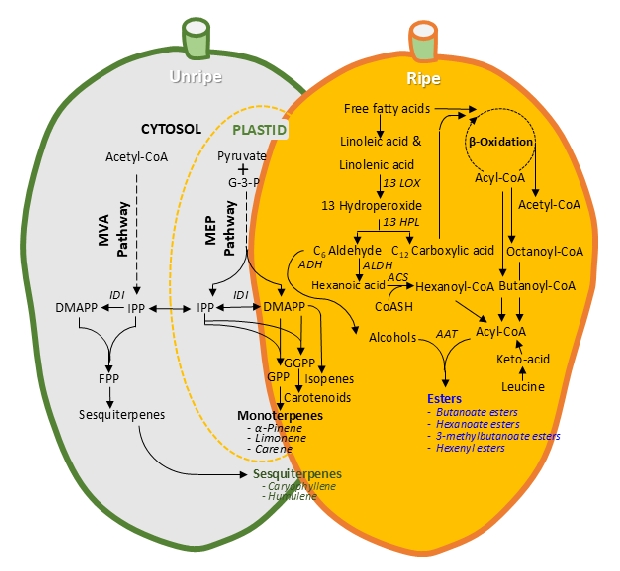
Mango ranks among the most widely consumed tropical fruits worldwide, following bananas, oranges, and pineapples. At present, more than 1,000 mango cultivars have been identified; however, only a limited number are cultivated on a commercial scale in the global market. Prominent examples include ‘Alphonso’ (India), ‘Carabao’ (the Philippines), ‘Irwin’ and ‘Kent’ (United States), ‘Kensington Pride’ (Australia), and ‘Nam Dok Mai’ (Thailand). These cultivars are generally characterized by a balanced sweet–sour flavor profile and relatively low fiber content, although such traits are not unique to them and can also be observed in other varieties. Consequently, distinct aroma attributes are likely a key determinant of consumer preference, as discussed in this review.
References
Ali, G. S., Eltaher, S., Li, J., Freeman, B., & Singh, S. (2025). GWAS identifies a polyembryony locus in mango: development of KASP and PACE markers for marker-assisted breeding. Frontiers in Plant Science, 16, 1508027. https://doi.org/ 10.3389/fpls.2025.1508027
Bonneau, A., Boulanger, R., Lebrun, M., Maraval, I., & Gunata, Z. (2016). Aroma compounds in fresh and dried mango fruit (Mangifera indica L. cv. Kent): impact of drying on volatile composition. International Journal of Food Science & Technology, 51(3), 789–800. https://doi.org/10.1111/ijfs.13038
Derese, S., Guantai, E. M., Souaibou, Y., & Kuete, V. (2017). Mangifera indica L. (Anacardiaceae). In V. Kuete (Ed.), Medicinal Spices and Vegetables from Africa. pp. 451–483. London: Academic Press. https://doi.org/10.1016/B978-0-12-809286-6.00021-2
Hunter, G. L. K., Bucek, W. A., & Radford, T. (1974). Volatile components of canned Alphonso mango. Journal of Food Science, 39(5), 900–903. https://doi.org/10.1111/j.1365-2621.1974.tb07271.x
Idstein, H., & Schreier, P. (1985). Volatile constituents of Alphonso mango (Mangifera indica). Phytochemistry, 24(10), 2313–2316. https://doi.org/10.1016/S0031-9422(00)83033-2
Kulkarni, R. S., Chidley, H. G., Pujari, K. H., Giri, A. P., & Gupta, V. S. (2012). Geographic variation in the flavour volatiles of Alphonso mango. Food Chemistry, 130(1), 58–66. https://doi.org/10.1016/j.foodchem.2011.06.053
Kuroki, R., Sakano, R., Hattori, S., & Morishita, S. (2021). Comparing odor-active compounds in three mango (Mangifera indica L.) cultivars by aroma extract dilution analysis and the method for evaluating odor interactions. Food Science and Technology Research, 27(1), 103–109. https://doi.org/ 10.3136/fstr.27.103
Lalel, H. J. D., Singh, Z., & Tan, S. C. (2003). Aroma volatiles production during fruit ripening of ‘Kensington Pride’ mango. Postharvest Biology and Technology, 27(3), 323–336. https://doi.org/10.1016/S0925-5214(02)00117-5
Laohaprasit, N., Ambadipudi, D. S., & Srzednicki, G. (2011). Optimisation of extraction conditions of volatile compounds in 'Nam Dok Mai' mangoes. International Food Research Journal, 18(3), 1043–1049.
Laohaprasit, N., Kukreja, R. K., & Arunrat, A. (2012). Extraction of volatile compounds from ‘Nam Dok Mai’ and ‘Maha Chanok’ mangoes. International Food Research Journal, 19(4), 1445–1448.
MacLeod, A. J., MacLeod, G., & Snyder, C. H. (1988). Volatile aroma constituents of mango (cv Kensington). Phytochemistry, 27(7), 2189–2193. https://doi.org/10.1016/0031-9422(88)80124-9
Meurant, N., Holmes, R., MacLeod, N., Fullelove, G., & Bally, Ian. (1999). Mango Information Kit (Key Issues Section). 1st ed., Queensland: Department of Primary Industries, Queensland Horticulture Institute. pp.1–71.
Naef, R., Velluz, A., & Jaquier, A. (2006). The perfume of carabao mangoes (Mangifera indica L.): Identification of uncommon unsaturated fatty acid esters in the SPME of the intact fruit. European Food Research and Technology, 222(5–6), 554–558. https://doi.org/10.1007/s00217-005-0132-9
Ochoa, E. D. C. M., Andrade-Rodríguez, M., Rodríguez, M. R., & Monter, A. V. (2012). Identification of zygotic and nucellar seedlings in polyembryonic mango cultivars. Pesquisa Agropecuária Brasileira, 47(11), 1629–1636. https://doi.org/10.1590/S0100-204X2012001100010
Pandit, S. S., Chidley, H. G., Kulkarni, R. S., Pujari, K. H., Giri, A. P., & Gupta, V. S. (2009). Cultivar relationships in mango based on fruit volatiles profiles. Food Chemistry, 114(1), 363–372. https://doi.org/10.1016/j.foodchem.2008.09.107
Tandel, J., Tandel, Y., Kapadia, C., Singh, S., Gandhi, K., Datta, R., Singh, S., & Yirgu, A. (2023). Nontargeted metabolite profiling of the most prominent Indian mango (Mangifera indica L.) cultivars using different extraction methods. ACS Omega, 8(43), 40184–40205. https://doi.org/10.1021/acsomega.3c03670
Tunsakul, T., Noichinda, S., Bodhipadma, K., Rutatip, S., & Wongs-Aree, C. (2021). Differences in terpenes from 3 cultivars of Nam Dok Mai mango. Agricultural Science Journal, 52(1)(Suppl.), 233–236.
Downloads
Published
Issue
Section
Categories
License
Copyright (c) 2026 Journal of Applied Science and Emerging Technology

This work is licensed under a Creative Commons Attribution-NonCommercial-NoDerivatives 4.0 International License.


