Effects of Ash Derived from Quality Improvement of Coconut Husk by Leaching with Water
Keywords:
Coconut husk, Bed agglomeration, Leaching, Ash, CombustionAbstract
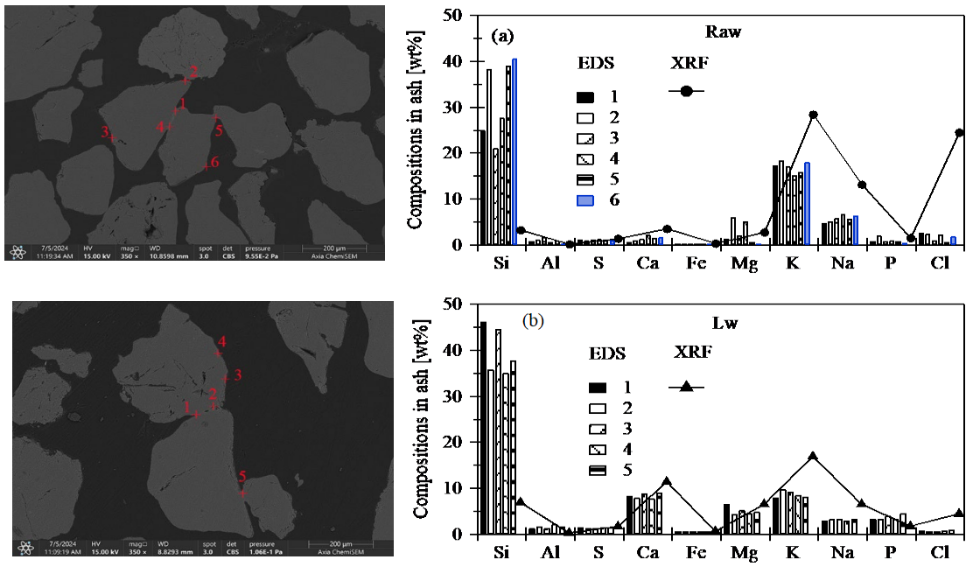
This study investigates the method of water washing coconut husk fuel to increase its quality. X-ray fluorescence (XRF) was used to study the fuel ash's composition and determine the degree of fouling and agglomeration issues using two parameters: the Bed Agglomeration Index (BAI) and the Base to Acid Ratio (Rb/a). The study revealed that the quantities of K₂O, Na₂O, and Cl were decreased by 40.4%, 50.4%, and 82.0%, respectively, after washing the coconut husk fuel with water at a flow rate of 197 milliliters per minute for 25 minutes. The time needed for bed particle defluidization was 32 minutes for the untreated sample and 78 minutes for the water-washed sample when untreated and water-washed coconut husk fuel were burned at 800 °C in a fluidized bed reactor.
References
Basu, P. (2006). combustion and gasification in fluidized beds. Taylor and Francis Group. p.129.
Chaivatamaset, P., Tia, S., & Methaviriyasilp, W., et al. (2019). Bed particle agglomeration and defluidization in the rubber wood and coir-fired fluidized bed. Waste and Biomass Valorization, 10, 3457-3470. https://doi.org/10.1007/s12649-018-0358-y
DEDE. (2023). Thailand Alternative Energy Situation 2023. Retrieved August 10, 2026, from https://pei.dede.go.th/dataset/2566-thailand-alternative-energy-situation-2023
Deng, L., Xi Jin, J. L., & Che, D. (2018). Ash deposition behaviors during combustion of raw and water washed biomass fuels. Journal of the Energy Institute, 1-12. https://doi.org/10.1016/j.joei.2018.07.009
Elled, A. L., Åmand, L. E., & Steenari, B. M. (2013). Composition of agglomerates in fluidized bed reactors for thermochemical conversion of biomass and waste fuels. Fuel, 111, 696-708. https://doi.org/10.1016/j.fuel.2013.03.018
Guo, Q., Cheng, Z., Chen, G., et al. (2020). Optimal strategy for clean and efficient biomass combustion based on ash deposition tendency and kinetic analysis. Journal of Cleaner Production, 271. https://doi.org/10.1016/j.jclepro.2020.122529
Homdoung, N., Sasujit, K., Uttharuan, J., et al. (2019). Influence of torrefaction temperature and time on the yields and properties of torrefied biomass. Engineering and Applied Science Research, 46(2), 170-175. https://doi.org/10.14456/easr.2019.19
Ma, Q., Han, L., & Huang, G. (2017). Evaluation of different water-washing treatments effects on wheat straw combustion properties. Bioresour Technol, 245, 1075-1083. https://doi.org/10.1016/j. biortech.2017.09.052
Mu, L., Li, T., & Wang, Z., et al. (2021). Influence of water/acid washing pretreatment of aquatic biomass on ash transformation and slagging behavior during co-firing with bituminous coal. Energy, 234. https://doi.org/10.1016/j.energy.2021.121286
Silvennoinen, J., & Hedman, M. (2013). Co-firing of agricultural fuels in a full-scale fluidized bed boiler. Fuel Processing Technology, 105, 11-19. https://doi.org/10.1016/j.fuproc.2011.05.019
Singhal, A., Goossens, M., & Fantozzi, D., et al. (2021). Step washing: A modified pretreatment approach for industrial applications to improve chemical composition of agricultural residues. Bioresour Technol, 341. https://doi.org/10.1016/j.biortech.2021.125753
Singhal, A., Konttinen, J., & Joronen, T. (2021). Effect of different washing parameters on the fuel properties and elemental composition of wheat straw in water-washing pre-treatment. Part 1: Effect of washing duration and biomass size. Fuel, 292. https://doi.org/10.1016/j.fuel.2021.120206
Unchaisri, T., & Fukuda, S. (2022). Investigation of ash formation and deposit characteristics in CFB co-combustion of coal with various biomass fuels. Journal of the Energy Institute, 105, 42-52. https://doi.org/10.1016/j.joei.2022.08.005
Unchaisri, T., & Oechaiyaphum, K. (2024). Development of electrical conductivity measurement tool and online data logging by a microcontroller., The 2nd International Conference on Science and Technology (INCOST), Pathum Thani, Thailand.
Vamvuka, D., & Zografos, D. (2004). Predicting the behaviour of ash from agricultural wastes during combustion. Fuel, 83(14-15), 2051-2057. https://doi.org/10.1016/j.fuel.2004.04.012
Wang, L., Skjevrak, G., & Hustad, J. E., et al. (2012). Sintering characteristics of sewage sludge ashes at elevated temperatures. Fuel Processing Technology, 96, 88-97. https://doi.org/10.1016/j. fuproc.2011.12.022
Werkelin, J., Skrifvars, B.-J., Zevenhoven, M., et al. (2010). Chemical forms of ash-forming elements in woody biomass fuels. Fuel, 89(2), 481-493. https://doi.org/10.1016/j.fuel.2009.09.005
Downloads
Published
Issue
Section
Categories
License
Copyright (c) 2026 Journal of Applied Science and Emerging Technology

This work is licensed under a Creative Commons Attribution-NonCommercial-NoDerivatives 4.0 International License.


