Satisfaction Study Using Online Teaching Aids of Faculty Members in the Department of Agro-industrial, Food and Environment Technology
Keywords:
Online Teaching Tools, Online Teaching and Learning, Educational Technology, Learning Management System (LMS), New Normal LearningAbstract
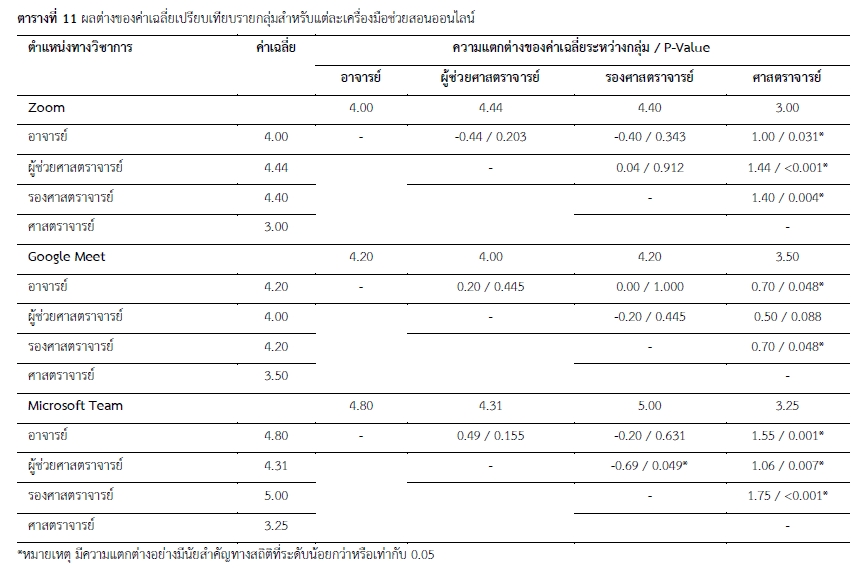
This study aimed to collect data regarding online teaching tools and the satisfaction of faculty members from the Department of Agro-Industrial, Food, and Environmental Technology, Faculty of Applied Science, King Mongkut's University of Technology North Bangkok, Bangkok, Thailand. The study encompassed 30 faculty members across three disciplines: 1) Agro-Industrial Technology, 2) Food Science and Technology, and 3) Environmental Science and Technology. Additionally, the study examined the grouping of online teaching tool usage in theoretical and practical courses. Data collection and statistical evaluation included frequency, mean, standard deviation, and one-way ANOVA analysis using IBM® SPSS® Statistics Version 28.0.0.0. The study's key findings revealed that there was no significant difference in satisfaction with online teaching tools between theoretical and practical courses. Faculty members from all three disciplines demonstrated similar levels of efficiency in utilizing these tools. The overall satisfaction with online teaching tools was found to be very high. However, when the tools were categorized by service provider, a statistically significant difference at P-Value < 0.05 level was observed among professors. This difference could be attributed to the varying convenience and compactness of course content provided by each service provider.
References
Barman, D., & Roy, S. K. (2023). The Transition from Offline to Online: Unveiling the Challenges and Opportunities. International Journal For Multidisciplinary Research, 5(4), 4444.
Camargo, C. P., Tempski, P. Z., Busnardo, F. F., Martins, M. D. A., & Gemperli, R. (2020). Online learning and COVID-19: a meta-synthesis analysis. Clinics, 75, e2286. https://doi.org/10.6061/clinics/2020/e2286
Dawley, L. (Ed.). (2007). The tools for successful online teaching. IGI Global. https://doi.org/10.4018/978-1-59140-956-4
Dhawan, S. (2020). Online Learning: A Panacea in the Time of COVID-19 Crisis. Journal of Educational Technology Systems, 49, 5-22. https://doi.org/10.1177/0047239520934018
Gregory, S., & Bannister-Tyrrell, M. (2017). Digital learner presence and online teaching tools: higher cognitive requirements of online learners for effective learning. Research and Practice in Technology Enhanced Learning, 12, 1-17. https://doi.org/10.1186/s41039-017-0059-3
Hongsuchon, T., Emary, I.M., Hariguna, T., & Qhal, E.M. (2022). Assessing the Impact of Online-Learning Effectiveness and Benefits in Knowledge Management, the Antecedent of Online-Learning Strategies and Motivations: An Empirical Study. Sustainability, 14(5), 1-16. https://doi.org/10.3390/su14052570
Jena, P. K. (2020). Online learning during lockdown period for covid-19 in India. International Journal of Multidisciplinary Educational Research (IJMER), 9.
Prahani, B. K., & Cheng, T. H. (2020). “New Normal” in Learning and Teaching. Studies in Learning and Teaching, 1(2), 63-65. https://doi.org/10.46627/silet.v1i2.41
Suwastini, N. K. A., Dewi, K. I. R., & Dantes, G. R. (2023). Benefits of online learning according to recent studies. Jurnal Inovasi Dan Teknologi Pembelajaran, 10(1), 32-42. https://doi.org/10.17977/um031v10i12023p031
Vasishta, P. A., Roy, A., & Sivaswamy, V. (2021). Online Tools for Teaching and Learning. Journal of Contemporary Issues in Business and Government, 57(2), 534-542.
Yuhanna, I.S., Alexander, A., & Kachik, A. (2020). Advantages and disadvantages of Online Learning. Journal Educational Verkenning, 1-7. https://doi.org/10.48173/jev.v1i2.54
Downloads
Published
Issue
Section
Categories
License
Copyright (c) 2026 Journal of Applied Science and Emerging Technology

This work is licensed under a Creative Commons Attribution-NonCommercial-NoDerivatives 4.0 International License.


