The Application of Using Local Plant for Determination of Formalin Contaminated in Food
Keywords:
Formaldehyde, Formalin, Local plant, Residue chemicalAbstract
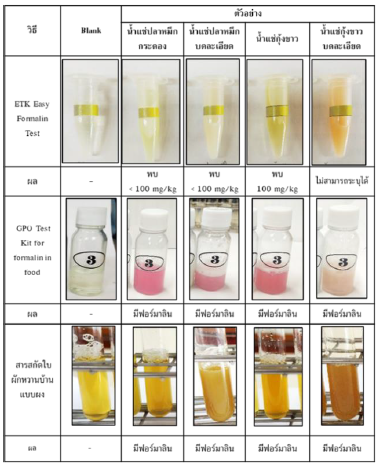
This research aimed to apply extracted from local plants to determine formalin residue in food. The precipitation would be appeared from this reaction. Four plants in Phyllanthaceae family were studied, 2 pants were consisted of adenosine (Phyllanthus acidus and Sauropus androgynus) and another 2 were Antidesma bunius and Phyllanthus emblica. It was found that only the extract from Sauropus androgynus was precipitated with formalin. The Sauropus androgynus extract was made to be powder by freeze drying process. Using 0.5 gram of extract powder in 5 milliliters of formalin solution showed 5% w/v formalin concentration as the detection limit This extract powder was then applied to determine formalin in squid and white shrimp. For method validation, the results were compared with those determined by commercial formalin test kit. Formalin detection of this developed method showed the similar results with all commercial products. This research showed the useful of determination of formalin in food by using plant extracted to be simple and rapid test kit. Moreover, this research is also adding value to the local plant.
References
Abe, Y., Kobayashi, N., Yamaguchi, M., Mutsuga, M., Ozaki, A., Kishi, E., & Sato, K. (2021). Determination of formaldehyde and acetaldehyde levels in poly (ethylene terephthalate)(PET) bottled mineral water using a simple and rapid analytical method. Food Chemistry, 344, 128708.
Feng, W.-S, Hao, Z., & Meng, L. (2017). Flavonoids - From Biosynthesis to Human Health. Intech. 24-25.
Leeya, Y., Mulvany, M. J., Queiroz, E. F., Marston, A., Hostettmann, K., & Jansakul, C. (2010). Hypotensive activity of an n-butanol extract and their purified compounds from leaves of Phyllanthus acidus (L.) Skeels in rats. European journal of pharmacology, 649(1-3), 301-313.
Liu, Y., Jia, H., Sun, Z., Pan, Y., Zhang, G., & Zheng, S. (2019). High-efficiency removal of gaseous HCHO by amine functionalized natural opoka. Chemical Physics Letters, 722, 32-38.
Marsal, A., Cuadros, S., Cuadros, R. M., Font, J., & Manich, A. M. (2018). Dyestuffs and formaldehyde content in split leather treated with formaldehyde resins. Dyes and Pigments, 158, 50-59. https://doi.org/10.1016/j.dyepig.2018.05.027.
Reay, G. A. (1936). Testing for the presence of formaldehyde in salt-cured ling. Analyst, 61(719), 78-85.
Ries, S., Wert, V., O'Leary, N. F. D., & Nair, M. (1990). 9-β-L (+) Adenosine: A new naturally occurring plant growth substance elicited by triacontanol in rice. Plant growth regulation, 9(3), 263-273.
Sibirny, V., Demkiv, O., Klepach, H., Honchar, T., & Gonchar, M. (2011). Alcohol oxidase-and formaldehyde dehydrogenase-based enzymatic methods for formaldehyde assay in fish food products. Food Chemistry, 127(2), 774-779.
Sousa, M., Ousingsawat, J., Seitz, R., Puntheeranurak, S., Regalado, A., Schmidt, A., & Kunzelmann, K. (2007). An extract from the medicinal plant Phyllanthus acidus and its isolated compounds induce airway chloride secretion: a potential treatment for cystic fibrosis. Molecular Pharmacology, 71(1), 366-376.
Teixeira, L. S., Leão, E. S., Dantas, A. F., Pinheiro, H. L., Costa, A. C., & De Andrade, J. B. (2004). Determination of formaldehyde in Brazilian alcohol fuels by flow-injection solid phase spectrophotometry. Talanta, 64(3), 711-715.
Thepchuay, Y., Chairit, W., Saengsane, N., Porrawatkul, P., & Pimsen, R. (2022). Simple and green colorimetric method for the detection of formaldehyde in vegetable samples. Journal of Food Composition and Analysis, 111, 104623.https://doi.org/10.1016/j.jfca.2022. 104623
United States Environmental Protection Agency. Integrated Risk Information System (IRIS) on Formaldehyde. National Center for Environmental Assessment. Office of Research and Development. Washington DC: U.S. EPA, 1999.
Wahed, P., Razzaq, M. A., Dharmapuri, S., & Corrales, M. (2016). Determination of formaldehyde in food and feed by an in-house validated HPLC method. Food chemistry, 202, 476-483.
Wang, P. H., & Lee, S. S. (1997). Active chemical constituents from Sauropus androgynus. Journal of the Chinese Chemical Society, 44(2), 145-149.
World Health Organization. Formaldehyde in Drinking-water. Background document for development of WHO Guidelines for drinking-water quality. Geneva: WHO, 2005.
Yasri, N. G., Seddik, H., & Mosallb, M. A. (2015). Spectrophotometric determination of formaldehyde based on the telomerization reaction of tryptamine. Arabian Journal of Chemistry, 8(4), 487-494.
Zhang, L. (2018). Formaldehyde: Exposure, Toxicity and Health Effects. 1st ed., Royal Society of Chemistry. pp 389.
Zhang, Y.-T., Liao, L.-G., & Tan, M., et al. (2024). Design of an ultra-sensitive nanoprobe based on poly β-cyclodextrin for formaldehyde detection in food and biological samples. Microchemical Journal. 199. 110090. https://doi.org/10.1016/ j.microc.2024.110090
Zhao, J., & Fan, B. 2006. Spectrophotometric Determination Method of Formaldehyde. Guangdong Trace Elements Science, 13(2), 17-22.
Downloads
Published
Issue
Section
Categories
License
Copyright (c) 2025 Journal of Applied Science and Emerging Technology

This work is licensed under a Creative Commons Attribution-NonCommercial-NoDerivatives 4.0 International License.


