Development product of chili-mulberry sauce mixed with Ladyfinger banana
Keywords:
sauce, mulberry, Ladyfinger banana, antioxidant capacity, total phenolicAbstract
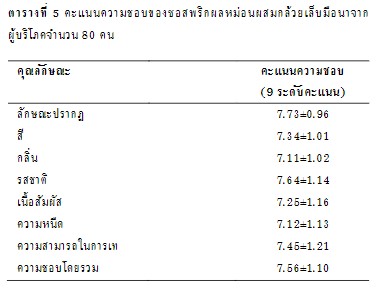
The objective of this research was to develop chili-mulberry sauce mixed with Ladyfinger banana (MSL) to satisfy consumers, as required by community enterprises. The effect of the quantity and/or types of ingredients on chemical and physical properties, and sensory evaluation of MSL was studied. It was revealed that ingredients of 12.15% fresh red Chi Fah chili, 2.70% fresh Kra Liang chili, 12.15% dried red Chi Fah chili, 10% sugar, 16% vinegar, 5% garlic, 4% salt, 9.35% Ladyfinger banana and 28.6% mulberry juice were appropriate to produce MSL. The amount of modified tapioca starch (MTS) and xanthan gum (XG), 0.03% and 0.05%, respectively were sufficient to improved viscosity and stability of MSL product. The sensory acceptance was evaluated between like moderately to like very much (7.12-7.73) by 80general consumers and could be kept at least 12 weeks. The total solid was not significantly different (24.51-24.68%). The pH and total acidity were between 3.86-3.90 and 1.16-1.19%, respectively. The antioxidant capacity (DPPH) and total phenolic content gradually increased during 6-week storage and then decreased until 12-week storage while anthocyanin continuously decreased during 12-week storage. The color explained as L* and a* were likely to decrease while b* was likely to increase. During 12-week storage, layer separation was not found and there were less of total microorganisms, yeasts and molds and E. coli than those of Thai specified standard.
References
Almeida, F. S., & Sato, A. C. K. (2019). Structure of gellan gum–hydrolyzed collagen particles: Effect of starch addition and coating layer. Food research international, 121, 394-403.
AOAC. (2000). Official Methods of Analysis of AOAC International. Virginia: Association of Official Analysis Chemists.
Auppatak, C., Suttha, V.,&Bunyasawat, J. (2015). Development of readymade sauce product from water melon rind waste. Research report. Faculty of Home Economics Technology, Rajamangala University of Technology Phra Nakhon. (in Thai).
Baharfar, R., Azimi, R.,& Mohseni, M. (2015). Antioxidant and antibacterial activity of flavonoid-, polyphenol-and anthocyanin-rich extracts from Thymus kotschyanusboiss & hohen aerial parts.Journal of Food Science and Technology,52(10), 6777-6783.
BAM. (2001). Bacteriological Analytical Manual. U.S. Food and Drug Administration.https://www.fda.gov/Food/FoodScienceResearch/Laboratory Methods/ucm2006949.htm.
Butkhup, L. (2012). A comparative study of flavonoid content and antioxidant activity in various mulberry cultivars. Research report. The Thailand Research Fund (TRF).(in Thai).
Cai, X., Du, X., Zhu, G., Cai, Z.,& Cao, C. (2020). The use of potato starch/xanthan gum combinations as a thickening agent in the formulation of tomato ketchup. CyTA -Journal of Food,18(1), 401-408.
Castro-Lopez, C., Sanchez-Alejo, E. J., Saucedo-Pompa, S., Rojas, R., Aranda-Ruiz, J.,& Martínez-Avila, G. C. (2016). Fluctuations in phenolic content, ascorbic acid and total carotenoids and antioxidant activity of fruit beverages during storage.Heliyon,2(9),e00152. https://doi.org/10.1016/j. heliyon.2016.e00152.
Chaikham, P. (2018). Effect of coconut and white sugar on qualities of healthy chili sauce mixed with ripe papaya pulp. The Golden Teak: Science and Technology Journal, 5(2), 1-5. (in Thai).
Department Intellectual Property. (2015). Chumphon Ladyfinger banana. http://www.ipthailand.go.th/ images/781/gi_56100097.pdf. (in Thai).
Đilas, S., Čanadanović, B. J., & Ćetković, G. (2009). By-products of fruits processing as a source of phytochemicals.Chemical Industry and Chemical Engineering Quarterly/CICEQ,15(4), 191-202.
Gamonpilas, C., Pongjaruvat, W., Fuongfuchat, A., Methacanon, P., Seetapan, N.,&Thamjedsada, N. (2011). Physicochemical and rheological characteristics of commercial chili sauces as thickened by modifiedstarch or modified starch/xanthan mixture. Journal of Food Engineering, 105(2), 233-240.
Hatano, T., Kagawa, H., Yasuhara, T.,& Okuda, T. (1988). Two new flavonoids and other constituents in licorice root: Their relative astringency and radical scavenging effects. Chemical and Pharmaceutical Bulletin, 36, 2090-2097.
Howard, R. M., Jacqueline, H. B.,& Anna, V. A. R. (2012). Sensory and Consumer Research in Food Product Design and Development. Wiley-Blackwell.
Hur, S. J., Lee, S. Y., Kim, Y. -C., Choi, I.,& Kim, G. -B. (2014). Effect of fermentation on the antioxidant activity in plant-based foods. Food Chemistry, 160, 346-356.
Jeenphakdee, K. (2003). Study on chili sauce production from banana flour[Master’sThesis]. School of Gradute Studies. King Mongkut’s Institute of Technology Ladkrabang. (in Thai).
Jiang, Y.,& Nie, W. J. (2015). Chemical properties in fruits of mulberry species from the Xinjiang province of China. Food Chemistry, 174, 460-466.
Kaewruang, W., Wongcharernwanakit, S., Ingkaninan, K.,&Wongthai, J. (2006). Antioxidant and folic acid in fruit of different mulberry (Morusspp.) Varieties. Abstract. https://qsds.go.th/newosrd/wp-content/ uploads/sites/115/2021/08/2549-19.pdf. (in Thai).
Lee, I. H., Hung, Y. -H.,& Chou, C. C. (2008). Solid-state fermentation with fungi to enhance the antioxidative activity, total phenolic and anthocyanin contents of black bean. International Journal of Food Microbiology, 121(2), 150-156.
Lee, J., Durst, R. W., Wrolstad, R. E., & Collaborators: Eisele T Giusti MM Hach J Hofsommer H Koswig S Krueger DA Kupina; S Martin SK Martinsen BK Miller TC Paquette F Ryabkova A Skrede G Trenn U Wightman JD. (2005). Determination of total monomeric anthocyanin pigment content of fruit juices, beverages, natural colorants, and wines by the pH differential method: collaborative study. Journal of AOAC international, 88(5), 1269-1278.
Lohachoompol, V., Srzednicki, G., & Craske, J. (2004). The change of total anthocyanins in blueberries and their antioxidant effect after drying and freezing. Journal of Biomedicine and Biotechnology, 2004(5), 248.
Maina, A. (2008). Development of chili sauce mixed banana product. [Master’s Thesis]. Graduate School. Chiang Mai University. (in Thai).
Michael Eskin, N.A. (1990). Biochemistry of Food. (2nded.). New York, USA: Academic Press.
Miglio, C., Chiavaro, E., Visconti, A., Fogliano, V.,& Pellegrini, N. (2008). Effects of different cooking methods on nutritional and physicochemical characteristics of selected vegetables. Journal of Agricultural and Food Chemistry,56(1), 139-147.
Ministry of Industry. (2018). Thai Community Product Standard. Chili sauce 289/2561. (in Thai).
Ministry of Public Health. (2000). Notification of the Ministry of Public Health. Re: Some particular kinds of sauces. No. 201.
Naczk, M.,& Shahidi, F. (2006). Phenolics in cereals, fruits and vegetables: Occurrence, extraction and analysis. Journal of Pharmaceutical and Biomedical Analysis, 41(5), 1523-1542.
Natić, M. M., Dabić, D. Č., Papetti, A., Akšić, M. M. F., Ognjanov, V., Ljubojević, M., & Tešić, Ž. L. (2015). Analysis and characterisation of phytochemicals in mulberry (Morus alba L.) fruits grown in Vojvodina, North Serbia. Food chemistry, 171, 128-136.
Nuaypirom, W. (2003). Mulberry fruit and processing. Chiang Mai Mulberry Research Institute. Department of Agriculture, Ministry of Agriculture and Cooperatives. Bangkok, Thailand: Nantakarn Graphic Printing. (in Thai).
Pongsawatmanit, R., Yakard, N., & Suwonsichon, T. (2011). Effect of xanthan gum on the quality of syrup thickened by modified starch during heating and storage. Agriculture and Natural Resources, 45(1), 128-135.
Promkhan, S., Rimkeeree, H., Chantrapornchai, W.,& Cheanuputh, S. (2007). Development of pineapple thick sauce. Food,37(2), 173-185. (in Thai).
Sangteerakij, D., Rodyu, S.,& Junden, S. (2023). Nutrition composition and anthocyanin content of mulberry fruits (Morus albaL.) by different ripening stage grown in the south of Thailand, applicants in sorbet and sherbet ice-cream and analysis of physical, chemical and sensory evaluation. Emirates Journal of Food and Agriculture,35(2),130-138.
Sikora, M., Juszczak, L., Sady,M., & Krawontka, J. (2003). Use of starch/xanthan gum combinations as thickeners of cocoa syrups. Food/Nahrung, 47(2), 106-113.
Sikora, M., Kowalski, S., Tomasik, P.,& Sady, M. (2007). Rheological and sensory properties of dessert sauces thickened by starch–xanthan gum combinations. Journal of Food Engineering, 79(4), 1144-1151.
Singleton, V. L., Orthofer, R.,& Lamuela-Raventos, R. M. (1999). Analysis of total phenols and other oxidation substrates and antioxidants by means of Folin-Ciocalteu reagent. Methods in Enzymology, 299, 152-178.
Siripanporn, J., Boonpunt, T.,& Teangpook, C. (1999). Study on processing of banana sauce. Food,29(3),167-179. (in Thai).
Sonsa-ard, N., Thongpliw, N.,&Thongmaen, P. (2016). Production of mixed wine from sunroot and mulberry. pp. A297-A303.In The 8th Rajamangala Surin Conference (8th RSC) “Research for Thailand 4.0”, 22-23 December 2016, Rajamangala University of Technology Isan SURIN Campus, Surin. (in Thai).
Srikram, A., Tapanapannitikul, O., Saelim, J., & Suwannawong, S. (2019). The production of chili sauce suitable for community enterprises.Khon Kaen Agriculture Journal, 47(Suppl. 1), 1031-1036. (in Thai).
Stone, H. & Sidel, J. L. (2004). Sensory Evaluation Practices. 408 p. Redwood City,Academic Press Inc.
Thampitak, K., Pimisa, R., Pongcharoen, P.,&Hwanhlem, N. (2020). Antioxidant activity, chemical, physical and microbiological properties of ripe black mulberry (Morus nigraL.) cultivated in Khaokho, Phetchabun. Agricultural Science Journal, 51(1) (Suppl. 1), 26-31. (in Thai).
The Office of Industrial Economics. (2016). New market...MENA (Middle East and North Africa).Ministry of Industry. http://fic.nfi.or.th/mena/images/pdf/Book_MENA.pdf(in Thai).
The Queen Sirikit Department of Sericulture.(2019). Alternative Sericulture Product: Thailand Agriculture Mobile Information System. Office of Sericulture Research and Development, The Queen Sirikit Department of Sericulture. (in Thai).
The Queen Sirikit Department of Sericulture.(2023). The 5-Year Action Plan of The Queen Sirikit Sericulture Office Region 5: Chumphon Province(2023 -2027). TheQueen Sirikit Sericulture Office Region 5: Chumphon Province.(in Thai).
Downloads
Published
Issue
Section
Categories
License
Copyright (c) 2023 Journal of Applied Science and Emerging Technology

This work is licensed under a Creative Commons Attribution-NonCommercial-NoDerivatives 4.0 International License.


