Development of Prototype NMU-AQI Device for Real-Time Monitoring of Indoor Air Quality
Keywords:
Indoor Air Qualily, NB-ioT, Temperature, Humidity, CO2, CO, PM 2.5, Ozone, TVOC, Web Application, Data AnalyticAbstract
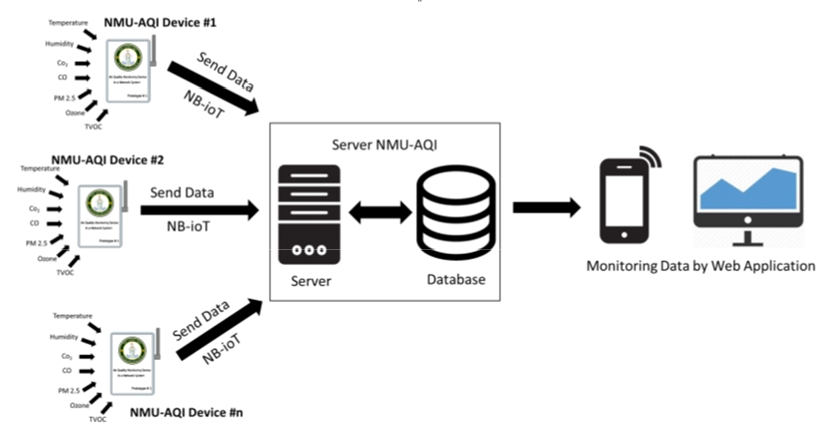
This research presents the use of IoT technology in the development of a prototype indoor air quality measurement system called NMU-AQI. To the standard, it consists of a total of 7 sensors to measure, including temperature, relative humidity. Carbon dioxide concentration Carbon Monoxide Concentration Airborne particulate matter less than 2.5 microns or PM 2.5, ozone gas and Total Volatile Organic Compounds (TVOC) with a microcontroller to take readings from the sensor based on the Real Time Operating System (RTOS) to aid in processing. Result of receiving data from various sensors As well as transmitting the data obtained from the sensor through the NB-ioT to the server to store the data in the database and process the data. For displaying the sensor values through a developed web application. It can support NMU-AQI connection and display of multiple prototype devices simultaneously. In the case of installation in a variety of locations which can bring the sensor values of each NMU-AQI to be displayed and compared in different values according to the need by selecting the installed location The preliminary results found that Able to measure indoor air quality for all 7 units, the values obtained are consistent and do not exceed the abnormality with indoor air quality standards. The proposed system can be used in recording applications. Analyze data and view trends in indoor air quality.
References
Bimaridi, A.,Putra, K.D., Djunaedy, E., &Kirom, M.R. (2017). Assasment of Outside Air Supply for Split ACsystem–Part A: Affordable Instrument. Procedia Engineering, 170, 248–254.
Budde, M.,El Masri, R.,Riedel, T., &Beigl, M. (2013). Enabling low-cost particulate matter measurement forparticipatory sensing scenarios. In Proceedings of the 12th International Conference on Mobile and Ubiquitous Multimedia(p.19), Lulea, Sweden.
Bureau of environmental. (2014).Report air quality standard for buildings in Thailand. Ministry of Public Health. (in thai)
Bureau of environmental. (2021). Air quality monitoring index inside public buildings. Ministry of Public Health. (in thai)
Hong, C. S., Ghani, A. S. A., & Khairuddin, I. M. (2018, March). Development of an Electronic Kit for detecting asthma in Human Respiratory System. In IOP Conference Series: Materials Science and Engineering (Vol. 319, No. 1, p. 012040). IOP Publishing.
Korncharoen, C., Nantiwatana, P., Sirted, T., & Yoothanom, N. (2017). Wireless communication technology for the Internet of Things.NBTC journal, 2(2), 269-287. (in thai)
Kujaroentavon, K., Kiattisin, S., Leelasantitham, A., & Thammaboosadee, S. (2015) Air quality classification in Thailand based on decision tree.https://ieeexplore.ieee.org/document/7017436
Liu, H.Y.,Schneider, P.,Haugen, R., &Vogt, M.(2019).Performance assessment of a low-cost PM2.5 sensor for a nearfour-month period in Oslo, Norway. Atmosphere, 10, 41.
McKercher, G.R., &Vanos, J.K. (2018). Low-cost mobile air pollution monitoring in urban environments: A pilot studyin Lubbock, Texas. Environ. Technol, 39, 1505–1514.
Nguyen, T.N.T.,Ha, D.V.,Do, T.N.N.,Nguyen, V.H.,Ngo, X.T.,Phan, V.H., &Bui, Q.H. Air pollution monitoringnetwork using low-cost sensors, a case study in Hanoi, Vietnam. In Proceedings of the IOP Conference Series: Earth and Environmental Science(Vol. 266, p. 012017). IOP Publishing.
Ongwandee, M. (2009). Occupant Exposure to Volatile Organic Compounds (VOCs) in Office Buildings in Bangkok. National research council of Thailand. (in thai)
Pollution control department.(2554) .Knowledge air pollution, lessons, concepts, and management. Ministry of natural resources and environment. (in thai)
Pusapukdepob, J., & Pulket, C. (2004). Indoor air quality and symptoms related to sick building syndrome of the office workers in the hospitals, Chonburi province. Journal of Public Health, 34, 189-199. (in thai)
Siwadechathep, C. (2015). Problem indoor air quality in buildings. https://www.safety stou.com/UserFiles/File/54113%20unit15.doc> (in thai)
Suárez, J.I.,Arroyo, P.,Lozano, J.,Herrero, J.L.,& Padilla, M.(2018).Bluetooth gas sensing module combined withsmartphones for air quality monitoring. Chemosphere, 205, 618–626.
WHO.(1988).WHO Regional Publications European Series No. 31 Indoor air quality: biological contaminants.
WHO.(2005).WHO Air quality guidelines for particulate matter, ozone, nitrogen dioxide And sulfur dioxide,Globalupdate2005.https://apps.who.int/iris/bitstream/10665/69477/1/WHO_SDE_PHE_OEH_06.02_eng.pdf
WHO.(2010).WHO guidelines for indoor air quality: selected pollutants.https://www.euro.who.int/__data/assets/pdf_file/0009/128169/e94535.pdf
Downloads
Published
Issue
Section
Categories
License
Copyright (c) 2023 Journal of Applied Science and Emerging Technology

This work is licensed under a Creative Commons Attribution-NonCommercial-NoDerivatives 4.0 International License.


