
The Radiation Oncology Department: Design Guidelines, Implementation Challenges, and Lessons Learned in Thai Public Hospitals
Article Sidebar
Main Article Content
Abstract
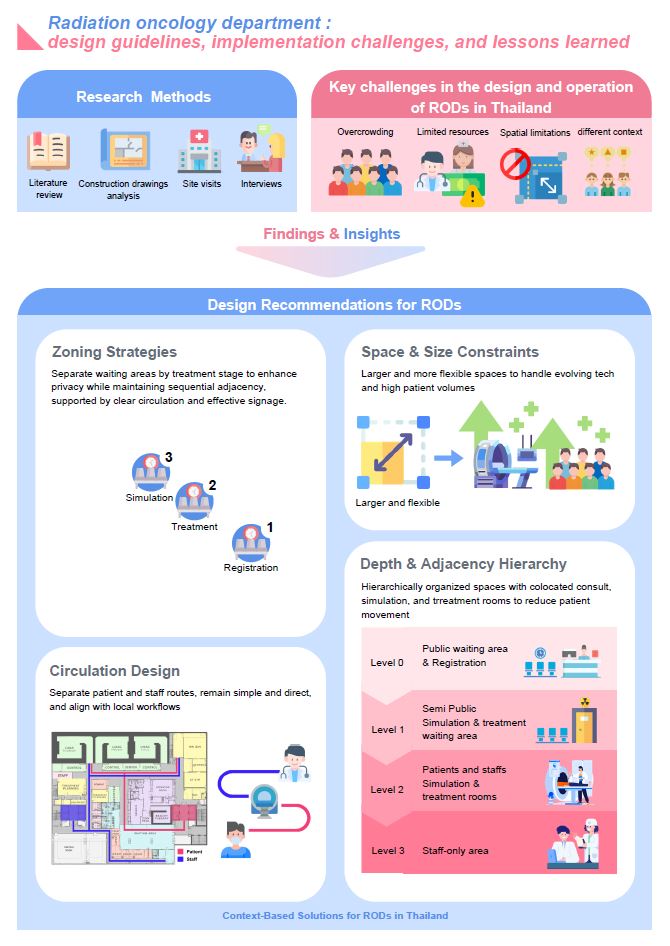
The radiation oncology department (ROD) is a specialized healthcare unit utilizing advanced radiation technologies to deliver precise cancer treatment, which demand complex coordination of space, safety, and multidisciplinary workflows. Although several ROD design guidelines exist, they are tailored to developed economies, remain piecemeal, and lack comprehensive feedback from practitioners in other socio-cultural conditions regarding their implementation process, difficulties, and outcomes. This research thus (1) synthesizes ROD design guidelines, (2) investigates the implementation challenges, and (3) collects insights and experiences from healthcare professionals involved in ROD operations. A mixed-method approach is employed, incorporating literature review, construction drawing analysis, site visits, and follow-up interviews. It reveals significant design and operational challenges, e.g., overcrowded waiting areas, limited spatial flexibility, constrained resources, differing workflow patterns, and context-specific user behaviors, complicating the direct application of international guidelines. It then offers tentative design guidance, e.g., zoning strategies aligned with treatment stages, flexible and sufficiently sized spaces, clear circulation routes separating staff and patient flows, spatial depth to support privacy and safety, and functional adjacencies that enhance procedural flow and interdisciplinary collaboration. This research serves as a foundation for context-responsive ROD design in Thailand and other similar settings. Future research should expand the case study pool, apply post-occupancy evaluations, explore patient experiences, and implement codesign models.
Article Details

This work is licensed under a Creative Commons Attribution-NonCommercial-NoDerivatives 4.0 International License.
References
Allmark, P., & Machaczek, K. (2018). Realism and pragmatism in a mixed methods study. Journal of Advanced Nursing, 74(6), 1301–1309. https://doi.org/10.1111/jan.13523
Ariyatum, B., Holland, R., Sirisalee, P., & Prommin, D. (2009). Identifying strategic directions for design development of general hospital equipment for Thailand. The Design Journal, 12(1), 69–93. https://doi.org/10.2752/175630609X391578
Bhatti, O. S., Ghufran, M. A., & Shah, A. U. (2023). Transforming adversity into opportunity: Assessing user satisfaction in hospital transformation in lieu of a pandemic through the multi-corridor expansion model for epidemic management and environmental design enhancement. Nakhara: Journal of Environmental Design and Planning, 22(2), Article 308. https://doi.org/10.54028/NJ202322308
Crocker, S. (2021). A call for intersectional healthcare design research. HERD: Health Environments Research & Design Journal, 14(1), 273–277. https://doi.org/10.1177/1937586720964729
Department of Health. (2013). Health building note 02-01: Cancer treatment facilities. https://www.england.nhs.uk/wp-content/uploads/2021/05/HBN_02-01_Final.pdf
Department of Veterans Affairs. (2008). Radiation therapy service design guide. https://www.cfm.va.gov/til/dGuide/dgRadTh.pdf
Firoozi, A. A., & Firoozi, A. A. (2025). Transformative design in healthcare. Springer Nature Switzerland.
International Atomic Energy Agency. (2008). Setting up a radiotherapy programme: Clinical, medical physicals, radiation protection and safety aspects. https://www-pub.iaea.org/MTCD/Publications/PDF/pub1296_web.pdf
International Atomic Energy Agency. (2014). Radiotherapy facilities: Master planning and concept design considerations. https://www-pub.iaea.org/MTCD/Publications/PDF/Pub1645web-46536742.pdf
International Health Facility Guidelines. (2017). Part B – health facility briefing & design: 230 oncology unit – Radiation. https://www.healthfacilityguidelines.com/ViewPDF/ViewIndexPDF/iHFG_part_b_oncology_radiation
International Atomic Energy Agency, & World Health Organization. (2021). Technical specifications of radiotherapy equipment for cancer treatment. https://www.who.int/publications/i/item/9789240019980
Jellema, P., Annemans, M., & Heylighen, A. (2020). The roles of cancer care facilities in users’ well-being. Building Research & Information, 48(3), 254–268. https://doi.org/10.1080/09613218.2019.1620094
Jiravanichkul, S., Pinich, S., Sreshthaputra, A., & Jarutach, T. (2026). Does one size fit all? Well-being environmental assessment criteria in low-and middle-income aging communities in Thailand. Nakhara: Journal of Environmental Design and Planning, 25(1), Article 604. https://doi.org/10.54028/NJ202625604
Kantarci, M., Aydin, S., Oğul, H., & Kizilgöz, V. (2025). New imaging techniques and trends in radiology. Diagnostic and Interventional Radiology, 31(5), 505–517. https://doi.org/10.4274/dir.2024.242926
Laovisutthichai, V., Viryasiri, T., Low, S. P., Sangnin, K., Kramomtong, W., & Panjapiyakul, N. (2025). Collaborative architecture, engineering, construction, and operations (AECO) practice model for healthcare facilities in Thailand. International Journal of Construction Management, 1–21. https://doi.org/10.1080/15623599.2025.2546014
Lam, J., Ng, B., Shen, S., & Wong, C. (2015). How is interprofessional collaboration applied by radiation therapists in the radiation therapy department in British Columbia? Journal of Medical Imaging and Radiation Sciences, 46(3), S43–S51. https://doi.org/10.1016/j.jmir.2015.04.016
Mannontaratana, P., Laovisutthichai, V., Viryasiri, T., Jamnothai, M., & Poonpermpun, W. (2025). Prescriptive-based building regulations: Challenges and recommendations for modernization in the case of Bangkok. Nakhara: Journal of Environmental Design and Planning, 24(3), Article 519. https://doi.org/10.54028/NJ202524519
Marks, L. B., Jackson, M., Xie, L., Chang, S. X., Burkhardt, K. D., Mazur, L., Jones, E. L., Saponaro, P., LaChapell, D., Baynes, D. C., & Adams, R. D. (2011). The challenge of maximizing safety in radiation oncology. Practical Radiation Oncology, 1(1), 2–14. https://doi.org/10.1016/j.prro.2010.10.001
Mettler Jr, F. A., Huda, W., Yoshizumi, T. T., & Mahesh, M. (2008). Effective doses in radiology and diagnostic nuclear medicine: A catalog. Radiology, 248(1), 254–263. https://doi.org/10.1148/radiol.2481071451
Ministry of Public Health. (2015). Koomeu gaan okbaep aa-kaan lae sa-paap waetlom sa-taan bor-ri-gaan suk-ka-paap [General guidelines to designing healthcare buildings and environment]. https://dcd.hss.moph.go.th/web/attachments/article/266/210917_053752.pdf
Ministry of Public Health. (2016). Koomeu gaan okbaep aa-kaan lae sa-paap waetlom sa-taan bor-ri-gaan suk-ka-paap [General guidelines to designing healthcare buildings and environment]. https://hss.moph.go.th/fileupload_doc_slider/2016-11-16--158.pdf
Ministry of Public Health. (2021). Koomeu kwaam bplotpai taang hong bpadtibatgaan daan rangsee [Radiation laboratory safety manual]. https://www.dmsc.moph.go.th/th/download/306/km/119
Ministry of Public Health. (2024). Phaenkan pongkan lae khuapkhum rong mareng haeng chat [National cancer control programme]. https://www.nci.go.th/doc/cc/67-75.pdf
Ostlund, U., Kidd, L., Wengstrom, Y., & Rowa-Dewar, N. (2011). Combining qualitative and quantitative research within mixed method research designs: A methodological review. International Journal of Nursing Studies, 48(3), 369–383. https://doi.org/10.1016/j.ijnurstu.2010.10.005
Prugsiganont, S., & Jensen, P. A. (2019). Identification of space management problems in public hospitals: The case of Maharaj Chiang Mai Hospital. Facilities, 37(7/8), 435–454. https://doi.org/10.1108/F-01-2018-0001
Rostenberg, B., & Horii, S. C. (2006). The architecture of medical imaging: Designing healthcare facilities for advanced radiological diagnostic and therapeutic techniques. Wiley.
Viryasiri, T., Laovisutthichai, V., Sangnin, K., Dhanakoses, K., Roopkaew, P., & Viryasiri, P. (2024). Hospital design principles implementation: Reflections from practitioners in Thailand. Journal of Asian Architecture and Building Engineering, 23(1), 43–56. https://doi.org/10.1080/13467581.2023.2215842
Wardhani, D. K., Hanan, H., & Firmansyah (2026). Sustainable architecture practice in Indonesia: Navigating global standards and local knowledge. Nakhara: Journal of Environmental Design and Planning, 25(1), Article 608. https://doi.org/10.54028/NJ202625608
Waroonkun, T., & Prugsiganont, S. (2022). Preventing the spread of COVID-19 through environmental design in Thai community hospitals. Frontiers in Built Environment, 8, Article 947211. https://doi.org/10.3389/fbuil.2022.947211
Wiriyakraikul, C., Amatyakul, W., & Dhanakoses, K. (2022). The design of physical components of endoscopy units: A case study of four major public hospitals in Thailand. Nakhara: Journal of Environmental Design and Planning, 21(1), Article 202. https://doi.org/10.54028/NJ202221202
World Health Organization. (2025). Cancer. https://www.who.int/news-room/fact-sheets/detail/cancer
