
Integrating Bangkok’s Western Canals for Micro-Mobility and Last-Mile Connectivity: A Spatial Analysis of Man-Powered Paddle-Boat Movement
Article Sidebar
Main Article Content
Abstract
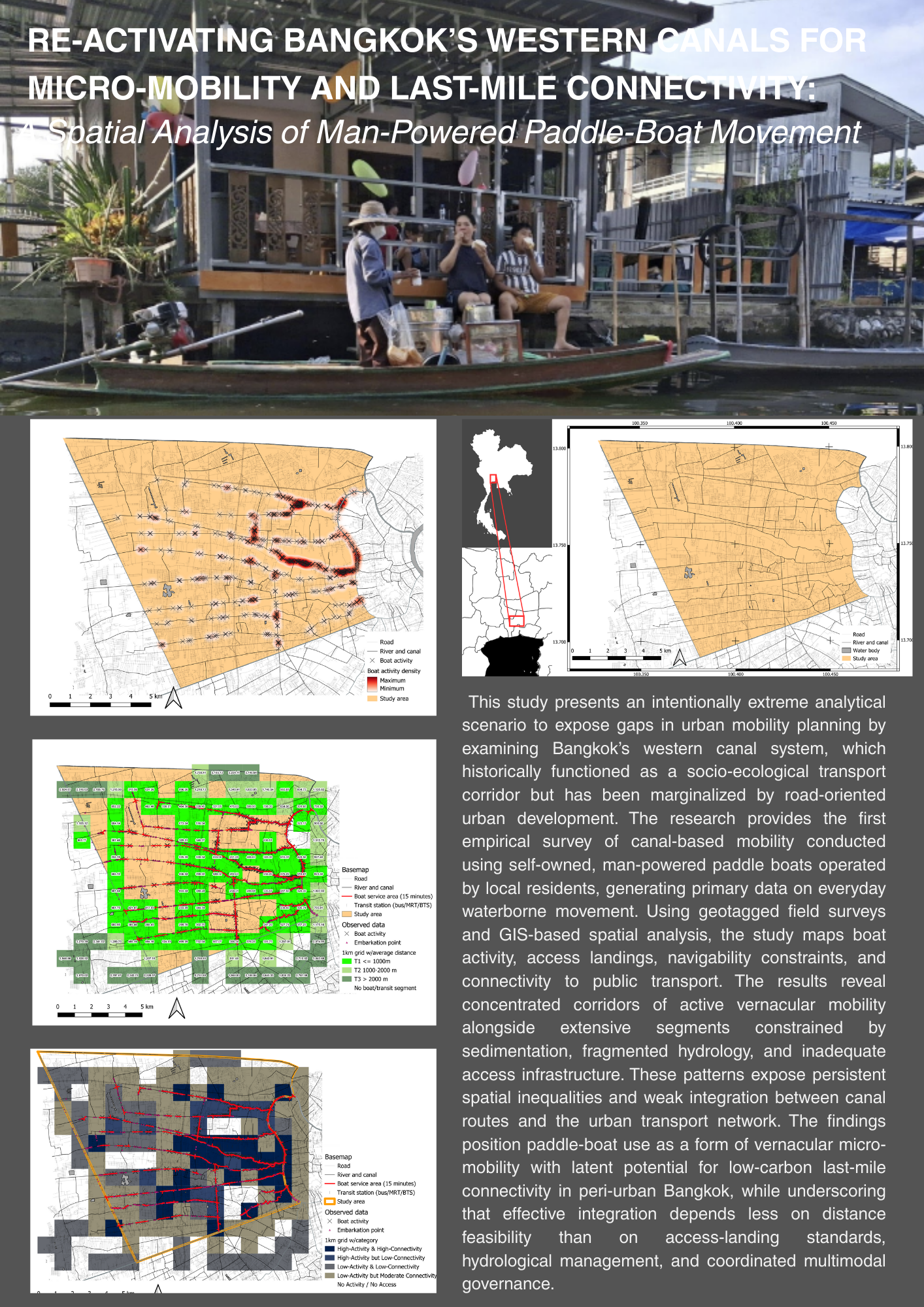
This study presents an intentionally extreme analytical scenario to expose gaps in urban mobility planning by evaluating the potential of Bangkok’s western canal system to function as vernacular micro-mobility infrastructure for last-mile connectivity. The research provides the first empirical survey of canal-based mobility conducted using self-owned, man-powered paddle boats operated by local residents, generating primary data on everyday waterborne movement. Using geotagged field surveys and GIS-based spatial analysis, the study maps boat activity, access landings, navigability constraints, and connectivity to public transport. The results reveal concentrated corridors of active vernacular mobility alongside extensive segments constrained by sedimentation, fragmented hydrology, and inadequate access infrastructure. These patterns expose persistent spatial inequalities and weak integration between canal routes and the urban transport network. The findings position paddle-boat use as a form of vernacular micro-mobility with latent potential for low-carbon last-mile connectivity in peri-urban Bangkok, while underscoring that effective integration depends less on distance feasibility than on access-landing standards, hydrological management, and coordinated multimodal governance.
Article Details

This work is licensed under a Creative Commons Attribution-NonCommercial-NoDerivatives 4.0 International License.
References
Abduljabbar, R. L., Liyanage, S., & Dia, H. (2021). The role of micro-mobility in shaping sustainable cities: A systematic literature review. Transportation research part D: transport and environment, 92, Article 102734. https://doi.org/10.1016/j.trd.2021.102734
Allam, Z., Bibri, S. E., Chabaud, D., & Moreno, C. (2022). The ‘15-minute city’concept can shape a net-zero urban future. Humanities and Social Sciences Communications, 9(1), Article 126. https://doi.org/10.1057/s41599-022-01145-0
Arifwidodo, S. D., Chandrasiri, O., & Rueangsom, P. (2025). Is proximity to parks associated with physical activity and well-being? Insights from 15-minute parks policy initiative in Bangkok, Thailand. Sustainability, 17(16), Article 7457. https://doi.org/10.3390/su17167457
Aritua, B., Cheng, L., van Liere, R., & de Leijer, H. (2021). Blue routes for a new era: Developing inland waterways transportation in China. World Bank Publications. https://documents1.worldbank.org/curated/en/908191600317351237/pdf/Blue-Routes-for-a-New-Era-Developing-Inland-Waterways-Transportation-in-China.pdf
Calderon-Rivera, N., Bartuseviciene, I., & Ballini, F. (2024). Sustainable development of inland waterways transport: A review. Journal of Shipping and Trade, 9(1), Article 3. https://doi.org/10.1186/s41072-023-00162-9
Casper, B. (2014). Amphibian identity? Waterspatial resilience of Khlong in Bangkok. Nakhara: Journal of Environmental Design and Planning, 10, 61–76. https://ph01.tci-thaijo.org/index.php/nakhara/article/view/104861
Chankrajang, T., & Vechbanyongratana, J. (2020). Canals and orchards: The impact of transport network access on agricultural productivity in nineteenth-century Bangkok. The Journal of Economic History, 80(4), 996–1030. https://doi.org/10.1017/S0022050720000509
Cheranchery, M. F. (2024). Exploring the potential and viability of inland waterway transport as a sustainable passenger transportation solution in emerging countries. Case Studies on Transport Policy, 15, Article 101126. https://doi.org/10.1016/j.cstp.2023.101126
City of Copenhagen. (2021). Mobility facts and figures city of Copenhagen 2021. Radkompetenz. https://radkompetenz.at/wp-content/uploads/2022/03/Copenhagen-Mobility-facts-and-figures-2021.pdf
Comi, A., & Polimeni, A. (2024). Assessing potential sustainability benefits of micromobility: A new data driven approach. European Transport Research Review, 16(1), Article 19. https://doi.org/10.1186/s12544-024-00640-6
Cui, C., & Zhang, Y. (2024). Integration of shared micromobility into public transit: A systematic literature review with grey literature. Sustainability, 16(9), Article 3557. https://doi.org/10.3390/su16093557
D’Acierno, L., Tanzilli, M., Tescione, C., Pariota, L., Di Costanzo, L., Chiaradonna, S., & Botte, M. (2022). Adoption of micro-mobility solutions for improving environmental sustainability: Comparison among transportation systems in urban contexts. Sustainability, 14(13), Article 7960. https://doi.org/10.3390/su14137960
Doeppers, D. F. (2016). Feeding Manila in peace and war, 1850–1945. University of Wisconsin Press.
Fong, B., Fong, A. C., & Hong, G. Y. (2023). Sustainable micromobility management in Smart Cities. IEEE Transactions on Intelligent Transportation Systems, 24(12), 15890–15896. https://doi.org/10.1109/TITS.2023.3292377
Hossain, M., & Iamtrakul, P. (2007). Water transportation in Bangkok: Past, present, and the future. Journal of Architectural/Planning Research and Studies (JARS), 5(2), 1–24. https://doi.org/10.56261/jars.v5i2.169138
Iamtrakul, P., & Raungratanaamporn, I.-s. (2016). The study on promoting hybrid canal-rail connectivity in Bangkok and its vicinity. International Journal of Building, Urban, Interior and Landscape Technology (BUILT), 8, 13–26. https://ph02.tci-thaijo.org/index.php/BUILT/article/view/169266
Iamtrakul, P., Srivanit, M., & Klaylee, J. (2017). Resilience in urban transport towards hybrid canal-rail connectivity linking Bangkok’s canal networks to mass rapid transit lines. International Journal of Building, Urban, Interior and Landscape Technology, 10, 27–42. https://ph02.tci-thaijo.org/index.php/BUILT/article/view/117033
Irvine, K., Likitswat, F., Sahavacharin, A., Suwanarit, A., Lertwarapornpong, T., & Chitwatkulsiri, D. (2023). The agrihood design: Valuation of ecosystem services for NbS visions in peri-urban housing estate development, Bangkok, Thailand. Journal of Architectural/Planning Research and Studies (JARS), 21(1), 115–140. https://doi.org/10.56261/jars.v21.257520
Irvine, K., Suwanarit, A., Likitswat, F., Sahavacharin, A., Das, D., Foo, M. C. D., & Chitwatkulsiri, D. (2025). Smart city visioning and design to enhance sustainability, resilience, and community wellbeing: A comparison of Bangkok, Thailand, and Singapore through a smart environment and smart mobility lens. Journal of Architectural/Planning Research and Studies (JARS), 23(1), Article 275490. https://doi.org/10.56261/jars.v23.275490
Janjevic, M., & Ndiaye, A. B. (2014). Inland waterways transport for city logistics: A review of experiences and the role of local public authorities. Urban transport XX, 138, 279–290. https://www.witpress.com/Secure/elibrary/papers/UT14/UT14024FU1.pdf
Kanuri, C., Venkat, K., Maiti, S., & Mulukutla, P. (2019). Leveraging innovation for last-mile connectivity to mass transit. Transportation Research Procedia, 41, 655–669. https://doi.org/10.1016/j.trpro.2019.09.114
Kiatthanawat, A., & Yodsurang, P. (2024). The study of the built environment potential for cultural tourism development around Bang Phrom canal, Taling Chan and Thawi Watthana districts, Bangkok. Journal of Liberal Arts, Maejo University, 12(1), 110–134. https://so03.tci-thaijo.org/index.php/liberalartsjournal/article/view/268753
Kiatthanawat, A., & Yodsurang, P. (2025, December 10–13). Shortcut canals in western Bangkok: Exploring conditions and connectivity at entrance node points design with precarity [Paper presentation]. The 13th Conference of the Pacific Rim Community Design Network (PRCD25 Bangkok), Bangkok, Thailand.
Kiatthanawat, A., Yodsurang, P., & Krasae-in, A. (2024). Exploring Thai vernacular houses for heritage tourism along the western Bangkok canals. Nakhara: Journal of Environmental Design and Planning, 23(1), Article 407. https://doi.org/10.54028/NJ202423407
Kingngoen, C., & Srisatit, T. (2022). Development of Bobae wholesale garment night flea market on public footpath of Phadung Krungkaseam canal bank and Krungkaseam road, Bangkok, Thailand. Thai Environmental Engineering Journal, 36(3), 35–45. https://so05.tci-thaijo.org/index.php/teej/article/view/261076/176871
Lim, S., & Lee, G. (2026). Spatiotemporal analysis for travel patterns of the personal mobility using an explainable machine learning approach: A case of Seoul, South Korea. Environment and Planning B: Urban Analytics and City Science, 53(2), 363–376. https://doi.org/10.1177/23998083251359763
Madapur, B., Madangopal, S., & Chandrashekar, M. (2020). Micro-mobility infrastructure for redefining urban mobility. European Journal of Engineering Science and Technology, 3(1), 71–85. https://dpublication.com/journal/EJEST/article/view/163/136
Mateo-Babiano, I. B. (2012). Public life in Bangkok's urban spaces. Habitat International, 36(4), 452–461. https://doi.org/10.1016/j.habitatint.2012.04.001
Mihic, S., Golusin, M., & Mihajlovic, M. (2011). Policy and promotion of sustainable inland waterway transport in Europe–Danube River. Renewable and sustainable energy reviews, 15(4), 1801–1809. https://doi.org/10.1016/j.rser.2010.11.033
Moreno, C. (2024). The 15-minute city: A solution to saving our time and our planet. John Wiley & Sons. https://onlinelibrary.wiley.com/doi/book/10.1002/9781394308774
MTR Corporation Limited. (2024). Moving forward: Annual report 2023. https://www.mtr.com.hk/archive/corporate/en/mtr-annual-report/2023.pdf
Narin, N., Changthong, K., Khamwichai, S., Maneeyai, P., Suwannakat, P., & Suwannaphong, S. (2021). The factors affecting Thai tourists' decision on visiting Khlong Bang Luang floating market, Phasi Charoen, Bangkok. RICE Journal of Creative Entrepreneurship and Management, 2(2), 69–77. https://so12.tci-thaijo.org/index.php/RJCM/article/view/2479/1695
Nikitas, A. (2024). Micromobility and shared mobility. In Handbook of travel behaviour (pp. 320–338). Edward Elgar Publishing. https://doi.org/10.4337/9781839105746.00025
Numsuk, W. (2025). Dynamics of landscape transformation and governance of Bangkok’s urban waterways. Nakhara: Journal of Environmental Design and Planning, 24(2), Article 511. https://doi.org/10.54028/NJ202524511
Office of Transport and Traffic Policy and Planning. (2019). Kan khayai senthang kan doenrua nai khlong nai khet Krung Thep Maha Nakhon lae parimonthon [Expansion of waterway routes in canals in the Bangkok Metropolitan Region]. https://www.otp.go.th/uploads/tiny_uploads/PDF/2562-07/25620718-05.pdf
Rabe, P., & Leeruttanawisut, K. (2025). A tale of two cities: Restoration of Bangkok's waterways in a “post-amphibious” setting. In M. Van Eerd & B. Banerjee (Eds.), Rivers, cities and people (pp. 46–70). Routledge India. https://doi.org/10.4324/9781003603436-4
Rau, J. L., & Nutalaya, P. (2020). Geomorphology and land subsidence in Bangkok, Thailand. In Applied geomorphology (pp. 181–201). Routledge. https://www.taylorfrancis.com/chapters/edit/10.4324/9781003027461-12/geomorphology-land-subsidence-bangkok-thailand-jon-rau-prinya-nutalaya
Rondinelli, D. A. (1983). Towns and small cities in developing countries. Geographical review, 73(4), 379–395. https://doi.org/10.2307/214328
Singh, P., Dixit, R. J., & Kishor, K. (2025). Enhancing urban mobility with cloud integration. In Advancements in cloud-based intelligent informative engineering (pp. 31–52). IGI Global Scientific Publishing. https://www.igi-global.com/chapter/enhancing-urban-mobility-with-cloud-integration/375858
Tanabe, S. (1977). Historical geography of the canal system in the Chao Phraya river delta. Journal of the Siam Society, 65(2), 23–72. https://thesiamsociety.org/knowledge-hub/uploads/research/175/663f8b5e49a99.pdf
The Nation Thailand. (2025, August 28). BMA improves over 1,100 kms of sidewalks to be pedestrian-friendly. https://www.nationthailand.com/news/general/40054635
Tohiguchi, M., Denpaiboon, C., Matsuda, H., & Hashimoto, S. (2002). Transformation of the canal-side settlements in greater Bangkok. Journal of Architecture and Planning (transactions of Aij), 67(551), 245–252. https://doi.org/10.3130/aija.67.245_1
Tontisirin, N., & Anantsuksomsri, S. (2021). Measuring transit accessibility benefits and their implications on land value capture: A case study of the Bangkok Metropolitan Region. The Annals of Regional Science, 67, 415–449. https://doi.org/10.1007/s00168-021-01053-2
UN-HABITAT. (2024). World cities report 2024: Cities and climate action. Stylus Publishing, LLC. https://unhabitat.org/world-cities-report-2024-cities-and-climate-action
Unakul, M. H. (2012). Reconnecting Bangkok’s heritage landscape: Urban waterways and the modern city. The Journal of the Siam Society, 100, 183–208. https://thesiamsociety.org/wp-content/uploads/2012/04/JSS_100_0m_MontiraHorayanguraUnakul_ReconnectingBangkoksHeritageLandscapeUrbanWaterwaysAndTheModernCity.pdf
Van Berkel, T. J. (2020). Reducing travel time within urban areas with watertaxi networks [Master thesis, Delft University of Technology]. TuDelft. https://resolver.tudelft.nl/uuid:8d15f145-3c7e-45c7-86df-0f2dd102e5b9
Wattanamano, N., Yodsurang, P., & Nasher, T. H. (2024). From riverine to urban reality: Tracing the transformation of riverfront communities - A case study of Koh Kret, Khlong Om Non, and Khlong Chak Phra-Khlong Bangkok Yai. NAJUA: History of Architecture and Thai Architecture, 21(2), 301–348. https://doi.org/10.69598/najuahata.21.2.275138
Wibowo, R. Y. (2023). Between user’s practice and infrastructure condition: Safety challenges of e-scooters utilization in Bangkok, Thailand. International Journal of Building, Urban, Interior and Landscape Technology, 21(2), 7–20. https://doi.org/10.56261/built.v21.247898
Yodsurang, P. (2023). Lost and found: The water-based settlement of the historic city of Ayutthaya. Restauro Archeologico, 30(1), 496–501. https://doi.org/10.36253/rar-14356
Yodsurang, P., Kiatthanawat, A., Wattanamano, N., Krasae-In, A., Yodpichai, K., & Saratapun, N. (2026). Responsive architecture in riparian zones: Synthesising spatial design interaction along the North Khlong Om Non-canal. Journal of Asian Architecture and Building Engineering, 1–14. https://doi.org/10.1080/13467581.2026.2620905
