
Participatory Statutory Frameworks and the Formulation of Local Heritage Conservation Plans: Legal Models and Comparative Case Studies
Article Sidebar
Main Article Content
Abstract
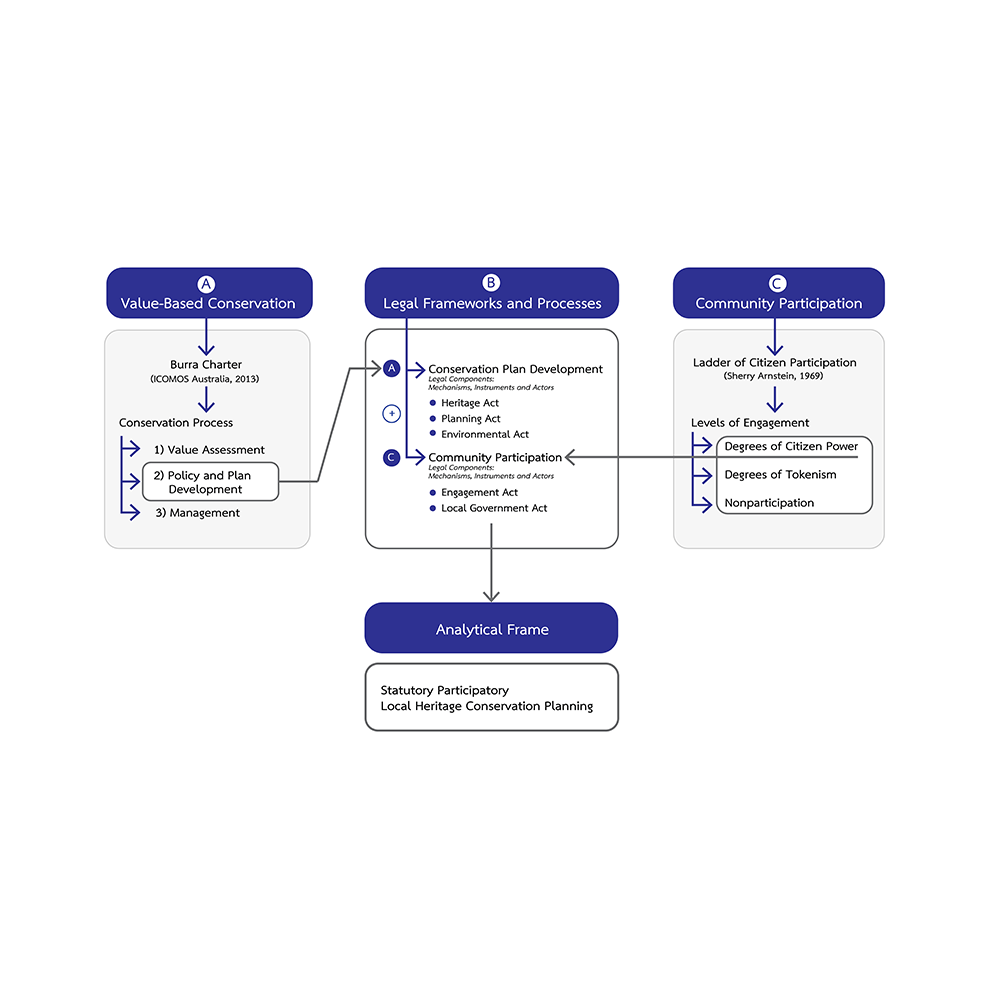
This article examines statutory frameworks and participatory processes in local heritage conservation planning, with a particular focus on comparative legal structures and institutional arrangements for public participation. It explores how value-based conservation principles, community engagement, and legal systems can be integrated to promote meaningful and empowered participation. The study identifies and analyzes three comparative statutory models in a global context—the Mediated Model, Cohesive Model, and Constrained Model—each representing a distinct approach to the interaction among heritage, planning, and local government legislation. The analysis then draws on case studies from the United Kingdom, the United States, and Australia, examining in detail the formulation of local conservation plans and their associated mechanisms, instruments, and actors. The findings indicate that inclusive and effective conservation planning depends on the extent to which legal systems balance authority between central and local governments, institutionalize participation through statutory provisions, and support community involvement throughout the planning process. In doing so, the article contributes to urban heritage governance scholarship by demonstrating how statutory participatory conservation planning can move beyond procedural consultation toward substantive community agency in shaping conservation outcomes. On this basis, the article develops three interrelated conceptual strategies as the theoretical pillars of its conclusion: Integrated Participatory Legal Framework, which emphasizes cross-sectoral and central–local legal integration; Mobilizing Participatory Processes, which focuses on the procedural activation of mechanisms, instruments, and actors in plan formulation; and Active Legal Empowerment, which advances participation as both a legal and governance outcome through direct community engagement. Together, these strategies provide a conceptual basis for strengthening the legitimacy and sustainability of statutory participatory conservation planning.
Article Details

This work is licensed under a Creative Commons Attribution-NonCommercial-NoDerivatives 4.0 International License.
References
Abdel-Fattah, G. F., Gabr, M. I., & Ezzeldin, M. (2025). Sustainable community participation in heritage conservation plans: A systematic literature review comparing international frameworks with practices. Journal of Engineering Sciences and Information Technology, 9(1), 48–67. https://doi.org/10.26389/AJSRP.W211124
Adlercreutz, T. (2002). Protection through planning: Public participation in planning and listing processes – A Swedish outlook. In ICOMOS International Committee on Legal, Administrative and Financial Issues (Ed.), Participación pública y protección a través del planeamiento y la catalogación / Protection through planning, public participation in planning and listing processes. ICOMOS Spain.
Alatalu, R. (2015). Effective enforcement of legislation. In V. Kawathekar (Ed.), Shared global experiences for protection of built heritage (pp. 7–11). SPA Press. https://iclafi.icomos.org/wp-content/uploads/2025/07/ICLAFI-2015-India-LegalAdminFramework.pdf
Arnstein, S. R. (1969). A ladder of citizen participation. Journal of the American Institute of Planners, 35(4), 216–224. https://doi.org/10.1080/01944366908977225
Australia International Council on Monuments and sites. (2013). The Burra Charter: The Australia ICOMOS charter for places of cultural significance, 2013. Australia ICOMOS. https://australia.icomos.org/publications/burra-charter-practice-notes/
Avrami, E., Mason, R., & de la Torre, M. (Eds.). (2000). Values and heritage conservation: Research report. Getty Conservation Institute. http://hdl.handle.net/10020/gci_pubs/values_heritage_research_report
Banik, D. (Ed.). (2008). Rights and legal empowerment in eradicating poverty. Ashgate Publishing.
Bassoli, M. (2010). Local governance arrangements and democratic outcomes (with some evidence from the Italian case). Governance, 23(3), 485–508. https://doi.org/10.1111/j.1468-0491.2010.01491.x
Belausteguigoitia, J., Alonso, I., Chueca, A., Elizegi, A., Hierro, S., Olavarri, L., & Sanz, E. (2021). Measuring participation: A comparative study of citizen engagement processes in urban planning. WIT Transactions on Ecology and the Environment, 253, 279–291. https://doi.org/10.2495/SC210241
Birmingham City Council. (2017). Birmingham development plan: Planning for sustainable growth (Adopted January 2017). https://www.birmingham.gov.uk/info/20054/local_plan_documents/78/birmingham_development_plan
Boer, B., & Wiffen, G. (2006). Heritage law in Australia. Oxford University Press.
Booth, P. (2011). Culture, planning and path dependence: Some reflections on the problems of comparison. Town Planning Review, 82(1), 13–28. https://doi.org/10.3828/tpr.2011.4
Chohan, A. Y., & Ki, P. W. (2005). Heritage conservation a tool for sustainable urban regeneration: A case study of Kaohsiung and Tainan, Taiwan [Conference paper]. 41st ISoCaRP Congress, Heritage Conservation a Tool for Sustainable Urban Regeneration, Bilbao, Spain. https://www.isocarp.net/Data/case_studies/693.pdf
Civic Amenities Act 1967, c. 69 (UK.).
Community Empowerment (Scotland) Act 2015, asp 6 (Scot.).
Congress on the European Architectural Heritage. (1975). The Declaration of Amsterdam. Council of Europe. https://civvih.icomos.org/wp-content/uploads/2022/03/Declaration-of-Amsterdam_25_10_1975.pdf
Council of Europe. (1975). Declaration of Amsterdam: Congress on the European architectural heritage, Amsterdam, 21–25 October 1975. https://civvih.icomos.org/wp-content/uploads/2022/03/Declaration-of-Amsterdam_25_10_1975.pdf
Council of Europe. (2005). Council of Europe framework convention on the value of cultural heritage for society (Faro Convention, CETS No. 199; entered into force 1 June 2011). https://www.coe.int/en/web/conventions/full-list/-/conventions/treaty/199
Council of Europe. (2016). Council of Europe framework convention on the value of cultural heritage for society: Meeting of the Faro Convention community. https://rm.coe.int/council-of-europe-framework-convention-on-the-value-of-cultural-herita/1680727daa
Court, S., & Wijesuriya, G. (2015). People-centered approaches to the conservation of cultural heritage: Living heritage guidance note. ICCROM. https://www.iccrom.org/publication/people-centred-approaches-conservation-cultural-heritage-living-heritage
Davidoff, P. (1965). Advocacy and pluralism in planning. Journal of the American Institute of Planners, 31(4), 331–338. https://doi.org/10.1080/01944366508978187
Dawood, L., Hart, B. D., Lawrence, S., & Youngkin, D. (2010). Environmental reviews & case studies: Section 106 of the National Historic Preservation Act of 1966: A streamlined approach for sidewalk improvement projects. Environmental Practice, 12(2), 134–143. https://doi.org/10.1017/S1466046610000128
de la Torre, M. (Ed.). (2002). Assessing the values of cultural heritage: Research report. Getty Conservation Institute. http://hdl.handle.net/10020/gci_pubs/values_cultural_heritage
de la Torre, M., MacLean, M., Mason, R., & Myers, D. (2005). Heritage values in site management: Four case studies (M. de la Torre (Ed.). Getty Conservation Institute. https://www.getty.edu/conservation/publications_resources/books/heritage_values_site_mgmnt.html
Elbakidze, M., Dawson, L., Andersson, K., Axelsson, R., Angelstam, P., Stjernquist, I., Teitelbaum, S., Schlyter, P., & Thellbro, C. (2015). Is spatial planning a collaborative learning process? A case study from a rural–urban gradient in Sweden. Land Use Policy, 48, 270–285. https://doi.org/10.1016/j.landusepol.2015.05.001
Engagement Institute. (n.d.). IAP2 spectrum of public participation. https://engagementinstitute.org.au/resources/iap2-public-participation-spectrum/
Environmental Planning and Assessment Act 1979, No. 203 (NSW) (Austl.). https://legislation.nsw.gov.au/view/html/inforce/current/act-1979-203
Fatimah, S., Abdi, E., & Meisari, W. C. (2025). Community empowerment for strengthening the local economy based on cultural heritage in Kampung Tudong, Pontianak City. Journal of Indonesian Tourism and Policy Studies, 10(1), 1–16. https://doi.org/https://doi.org/10.7454/jitps.v10i1.1141
Federal Republic of Nigeria. (1992). Nigerian Urban and Regional Planning Act 1992 (No. 88 of 1992). FAOLEX. https://faolex.fao.org/docs/pdf/nig120669.pdf
Feilden, B. M. (2003). Conservation of historic buildings (3rd ed.). Architectural Press.
Golub, S. (2003). Beyond rule of law orthodoxy: The legal empowerment alternative (Rule of Law Series, Working Paper No. 41). Carnegie Endowment for International Peace. https://carnegieendowment.org/research/2003/10/beyond-rule-of-law-orthodoxy-the-legal-empowerment-alternative
Great Britain. Committee on Public Participation in Planning. (2014). People and planning: Report of the Committee on Public Participation in Planning (The Skeffington Committee report). Routledge. https://doi.org/10.4324/9780203794968
(Original work published 1969)
Guzmn, P. C., Pereira Roders, A. R., & Colenbrander, B. J. F. (2014). Bridging the gap between urban development and cultural heritage protection. In Proceedings of the 34th Annual Conference of the International Association for Impact Assessment (IAIA14): Impact assessment for social and economic development (pp. 1–6). International Association for Impact Assessment. https://conferences.iaia.org/2014/IAIA14-final-papers/Guzman,%20P.C.%20Bridging%20the%20gap%20between%20urban%20development%20and%20cultural%20heritage%20protection.pdf
Hall, P. (1992). Urban and regional planning (3rd ed.). Routledge.
Harvey, D. (2008). The right to the city. New Left Review, 53, 23–40. https://newleftreview.org/issues/ii53/articles/david-harvey-the-right-to-the-city
Harvey, D. (2012). Rebel cities: From the right to the city to the urban revolution. Verso.
Healey, P., & Williams, R. H. (1993). European urban planning systems: Diversity and convergence. Urban Studies, 30(4–5), 701–720. https://doi.org/10.1080/00420989320081881
Heritage Act 1977, No. 136 (NSW) (Austl.). (Current version). NSW Legislation. https://legislation.nsw.gov.au/view/html/inforce/current/act-1977-136
Heritage NSW. (2020). Material threshold policy. NSW Government.
Hobson, E. (2004). Conservation and planning: Changing values in policy and practice. Routledge. https://doi.org/10.4324/9780203402320
Hooghe, L., & Marks, G. (2003). Unraveling the central state, but how? Types of multi-level governance. American Political Science Review, 97(2), 233–243. https://doi.org/10.1017/S0003055403000649
Ibrahim, Z. (2007). Urban conservation: A framework for community involvement in Malaysia [Doctoral dissertation, Sheffield Hallam University]. Sheffield Hallam University Research Archive (SHURA). https://shura.shu.ac.uk/19853/
International Centre for the Study of the Preservation and Restoration of Cultural Property (2009). Cultural heritage and the law: Protecting immovable heritage in English-speaking countries of sub-Saharan Africa (ICCROM Conservation Studies, 8). https://www.iccrom.org/sites/default/files/publications/2019-11/iccrom_ics08_culturalheritageandlaw_en.pdf
International Council for Local Environmental Initiatives. (1996). The local agenda 21 planning guide: An introduction to sustainable development planning. IUCN Library Center. https://portals.iucn.org/library/node/27064
Jacobs, J. (1961). The death and life of great American cities. Random House.
Jokilehto, J. (1999). A history of architectural conservation. Butterworth-Heinemann.
Jokilehto, J. (2002). A history of architectural conservation. Butterworth-Heinemann.
Jokilehto, J. (2007). International charters on urban conservation: Some thoughts on the principles expressed in current international doctrine. City & Time, 3(3), 23–42. http://ceci-br.org/novo/revista/docs2008/CT-2008-119.pdf
Joshi, N., & Widodo, J. (Eds.). (2018). Managing change: Urban heritage and community development in historic Asian cities (2nd ed.). Department of Architecture, School of Design & Environment, National University of Singapore.
Kelsen, H. (1967). Pure theory of law (M. Knight, Trans.). University of California Press. (Original work published 1960)
Kopetzky, A. D. (2011). Arnstein revisited: Measuring and evaluating citizen participation in the program planning, development, and implementation process [Doctoral dissertation, University of Nebraska–Lincoln].
Koren, G. (2002). Protection through planning: Public participation in planning and listing processes. In ICOMOS International Committee on Legal, Administrative and Financial Issues (Ed.), Participación pública y protección a través del planeamiento y la catalogación / Protection through planning, public participation in planning and listing processes (Conference volume). ICOMOS Spain.
Kowalski, W. (1999, 22–24 July). Protection through planning: Public participation in planning and listing processes under Polish law [Conference presentation]. ICOMOS International Committee on Legal, Administrative and Financial Issues (ICLAFI), Protection through planning: Public participation in planning and listing processes. Toledo, Spain.
Lefebvre, H. (1996). Writings on cities (E. Kofman & E. Lebas, Trans. & Eds.). Blackwell.
Local Government Act 1993 (NSW).
Local Government Act 2009 (Qld).
Localism Act 2011, c. 20 (UK).
London Borough of Ealing. (2023). A strategic review of Ealing’s conservation areas: Generic management plan for conservation areas. Ealing Council. https://www.ealing.gov.uk/download/downloads/id/18859/generic_management_plan_for_conservation_areas.pdf
Mackay, R. (2019). Values-based management and the Burra Charter: 1979, 1999, 2013. In E. Avrami, S. Macdonald, R. Mason, & D. Myers (Eds.), Values in heritage management: Emerging approaches and research directions (pp. 110–126). Getty Conservation Institute.
Madhury, M., & Sarker, L. (2024). Heritage values and community perception: A look into the historic ruins of Dinajpur Rajbari. Nakhara: Journal of Environmental Design and Planning, 23(1), Article 401. https://doi.org/10.54028/NJ202423401
Maier, K. (2001). Citizen participation in planning: Climbing a ladder? European Planning Studies, 9(6), 707–719. https://doi.org/10.1080/09654310120073775
Margaryan, L. (2018). A review of: Heritage, conservation and communities. Engagement, participation and capacity building. Tourism Geographies, 20(3), 575–577. https://doi.org/10.1080/14616688.2018.1462845
Marquis-Kyle, P., & Walker, M. (1992). The illustrated Burra Charter: Good practice for heritage places. Australia ICOMOS.
Mason, R. (2002). Assessing values in conservation planning: Methodological issues and choices. In M. de la Torre (Ed.), Assessing the values of cultural heritage: Research report (pp. 5–30). Getty Conservation Institute.
Mason, R., & Avrami, E. (2002). Heritage values and challenges of conservation planning. In J. M. Teutonico & G. Palumbo (Eds.), Management planning for archaeological sites: An international workshop organized by the Getty Conservation Institute and Loyola Marymount University, May 2000 (pp. 13–26). Getty Conservation Institute.
Meneghin, E., Favaro, F., & Vasumi, G. (2024). Enhancing community engagement and capacity-building in UNESCO world heritage sites: Comprehensive approaches. In Enhancing viability of the Communities – Living Heritage (pp. 111–128). ICHCAP & WHIPIC. https://www.unesco-ichcap.org/board.es?mid=a10301000000&bid=A105&act=view&list_no=20604
Ministry of Local Government and Regional Development. (2018). Act relating to municipalities and county authorities (The Local Government Act) (LOV-2018-06-22-83). Lovdata. https://lovdata.no/dokument/NLE/lov/2018-06-22-83
Mulrennan, M. E., Mark, R., & Scott, C. H. (2012). Revamping community-based conservation through participatory research. The Canadian Geographer / Le Géographe canadien, 56(2), 243–259. https://doi.org/10.1111/j.1541-0064.2012.00415.x
National Heritage Act 1983, c. 47 (UK).
National Historic Preservation Act of 1966, Pub. L. No. 89-665, 80 Stat. 915 (1966) (codified as amended at 54 U.S.C. § 300101 et seq.).
National Historic Preservation Act, 54 U.S.C. § 306108 (1966).
Newman, P., & Thornley, A. (1996). Urban planning in Europe: International competition, national systems and planning projects (1st ed.). Routledge. https://doi.org/10.4324/9780203427941
Nielsen, R. (2012). Sustaining legal empowerment in initiatives to support local land rights. International Institute for Environment and Development. https://www.iied.org/sites/default/files/pdfs/migrate/G03513.pdf
O’Keefe, P. J. (1999). Provision for public participation in planning and listing processes in international instruments. International Committee on Legal, Administrative and Financial Issues (ICLAFI), International Council on Monuments and Sites.
Office of Natural Resources and Environmental Policy and Planning. (2011). Chut khwam ru dan kan anurak phatthana lae borihan chatkan mueang kao lem thi 2: Naeo khit lae lakken doi thuapai kieokap kan anurak phatthana lae fuenfu mueang kao [Knowledge series on conservation, development, and management of old towns: Volume 2—Concepts and general criteria for conservation, development, and revitalization of old towns]. https://shorturl.at/Y4WNz
Orbasli, A. (2008). Architectural conservation: Principles and practice. Wiley-Blackwell. https://www.wiley.com/en-us/Architectural+Conservation%3A+Principles+and+Practice-p-9780632040254
Othengrafen, F. (2009). Planning cultures in Europe: Decoding cultural phenomena in urban and regional planning (1st ed.) Routledge. https://doi.org/10.4324/9781315246727
Pace, G. (2021). Heritage conservation and community empowerment: Tools for living labs. In G. Pace & R. Salvarani (Eds.), Underground built heritage valorisation: A handbook. Proceedings of the first Underground4value training school (pp. 197–218). CNR Edizioni. https://doi.org/10.48217/MNGSPC01
Pateman, C. (2014). Participation and democratic theory. Cambridge University Press. https://doi.org/10.1017/CBO9780511720444
Phattanawasin, S. (2009). Conservation and development of Koh Kret community environment in Nonthaburi. Journal of Architectural/Planning Research and Studies, 6(2), 15–32. https://doi.org/10.56261/jars.v6i2.168750
Pickard, R. (Ed.). (2001). Policy and law in heritage conservation. Taylor & Francis. https://doi.org/10.4324/9780203857564
Pimonsathean, Y. (2020). Lak khit dan khunkha khong kan anurak sathapattayakam nai prathet Thai [Architectural conservation in Thailand and the values-based approach]. The Association of Siamese Architects under Royal Patronage. https://www.yumpu.com/xx/document/view/63488437
Pimonsathean, Y. (2024, May 31). Moradok chumchon thi lutmu mua kothomo khat kotmai anurak [Community heritage slipping away when Bangkok lacks conservation law]. SHT Knowledge Hub. The Siam Society. https://thesiamsociety.org/knowledge-hub/multimedia/101
Planning (Listed Buildings and Conservation Areas) Act 1990, c. 9 (UK).
Planning and Compulsory Purchase Act 2004, c. 5 (UK).
Planning and Compulsory Purchase Act 2004, c. 5, ss. 38A–38C (UK).
Planning and Development Act 2000, No. 30 of 2000, s. 20 (Ir.).
Poulios, I. (2010). Moving beyond a values-based approach to heritage conservation. Conservation and Management of Archaeological Sites, 12(2), 170–185. https://doi.org/10.1179/175355210X12792909186539
Protection of Historic Properties, 36 C.F.R. pt. 800 (2026).
Rae, M. M. (2015). Legal and administrative framework for the protection of heritage in Argentina. International Committee on Legal, Administrative and Financial Issues (ICLAFI), International Council on Monuments and Sites.
Rae, M. M. (2017). Legal and administrative framework for the protection of heritage in Argentina. In Shared global experiences for protection of built heritage (pp. 20–35). SPA Press.
Raz, J. (1979). The authority of law: Essays on law and morality. Clarendon Press.
Reap, J. K. (1999, 22–24 July). Preservation through planning: Public participation in the planning and listing processes in the State of Georgia (United States of America) [Conference presentation]. Protection through Planning: Public Participation in Planning and Listing Processes, International Committee on Legal, Administrative and Financial Issues (ICLAFI), Toledo, Spain.
Sandercock, L. (1998). Towards cosmopolis: Planning for multicultural cities. John Wiley & Sons.
Silva, K. D. (2006). Conserving Asian urban heritage: The need for re-conceptualizing the value-based management approach. In S. Silapacharanan & J. Campbell (Eds.), Asian approaches to conservation (pp. 16–23). Chulalongkorn University.
Smith, A. (2023). Heritage conservation in rapidly growing cities. OSF Preprints. https://doi.org/10.31219/osf.io/teycu
Staneva, H. (1999, 22–24 July). Protection through planning: Public participation in planning and listing processes in the Republic of Bulgaria [Conference volume]. In Protection through planning: Public participation in planning and listing processes, International Committee on Legal, Administrative and Financial Issues, ICOMOS.
Stubbs, J. H., & Makas, E. G. (2011). Architectural conservation in Europe and the Americas: National experiences and practice. John Wiley & Sons. https://www.wiley.com/en-se/Architectural+Conservation+in+Europe+and+the+Americas-p-9780470901113
Sullivan, K. (2021). The authenticity of community participation in heritage in New South Wales [Doctoral dissertation, University of New South Wales]. UNSWorks. https://doi.org/10.26190/unsworks/2008
Swedish National Heritage Board. (2014). The Faro Convention: Council of Europe framework convention on the social value of cultural heritage. Swedish National Heritage Board.
Taylor, K., & Verdini, G. (2022). Management planning for cultural heritage: Place and their significance. Routledge. https://doi.org/10.4324/9781315718484
Town and Country Planning Act 1990, c. 8, ss. 61E–61Q & Sched. 4B–4C (UK).
Tsintskiladze, M. (2024). Role of community empowerment in the sustainable cultural heritage management: A review. Proceedings of the International Conference on Business, Management and Economics, 1(1), 22–31. https://doi.org/10.33422/icbmeconf.v1i1.210
U.S. Department of Commerce. (1924). A Standard State Zoning Enabling Act. U.S. Government Printing Office.
U.S. Department of Commerce. (1928). A Standard City Planning Enabling Act. U.S. Government Printing Office.
UNESCO World Heritage Centre. (2014). Engaging local communities in stewardship of World Heritage: A methodology based on the COMPACT experience (World Heritage Papers No. 40). https://whc.unesco.org/en/series/40
UNESCO World Heritage Centre. (2025). Operational guidelines for the implementation of the World Heritage Convention (WHC.25/01). https://whc.unesco.org/en/guidelines/
UN-Habitat. (2007). A guide for municipalities: Inclusive and sustainable urban development planning Vol. 1. https://unhabitat.org/a-guide-for-municipalities-inclusive-and-sustainable-urban-development-planning-volume-1
UN-Habitat. (2009). Planning sustainable cities: Global report on human settlements 2009. Earthscan; United Nations Human Settlements Programme. https://unhabitat.org/planning-sustainable-cities-global-report-on-human-settlements-2009
UN-Habitat. (2012). Urban legal empowerment: Strengthening local democracy and legal empowerment in urban development. UN-Habitat.
UN-Habitat. (2015). International guidelines on urban and territorial planning. https://unhabitat.org/international-guidelines-on-urban-and-territorial-planning
United Nations Children’s Fund. (2020). Minimum quality standards and indicators for community engagement. https://www.unicef.org/mena/media/8401/file/19218_minimumquality-report_v07_rc_002.pdf.pdf
United Nations. (1993). Report of the United Nations conference on environment and development, Rio de Janeiro, 3–14 June 1992: Vol. 2. Proceedings of the Conference (A/CONF.151/26/Rev.1(Vol.II)). https://digitallibrary.un.org/record/168679
Urban and Regional Planning Act, No. 88 of 1992, Cap. N138, Laws of the Federation of Nigeria 2004 (Nig.).
Walker, M., & Marquis-Kyle, P. (2004). The illustrated Burra Charter: Good practice for heritage places. Australia ICOMOS. https://australia.icomos.org/publications/burra-charter-practice-notes/illustrated-burra-charter/
Wijesuriya, G. (2018). Living heritage. In A. Heritage & J. Copithorne (Eds.), Sharing conservation decisions: Current issues and future strategies (pp. 43–56). International Centre for the Study of the Preservation and Restoration of Cultural Property (ICCROM). https://www.iccrom.org/sites/default/files/2018-05/sharing_conservation_decisions_2018_web.pdf
Worthing, D., & Gwilliams, K. (2002). Managing change in the built heritage. In Proceedings of the CIB W070 2002 Global Symposium: Applying and Extending the Global Knowledge Base (pp. 564–577). International Council for Building (CIB). https://www.irbnet.de/daten/iconda/CIB_DC25103.pdf
Zhang, W., Taib, N., & Taib, M. (2025). Balancing authenticity and adaptive reuse: Resident-centric conservation strategies for Huizhou traditional dwellings. Nakhara: Journal of Environmental Design and Planning, 24(2), Article 513. https://doi.org/10.54028/NJ202524513.
Zhang, X., Edelenbos, J., & Gianoli, A. (2024). Identifying modes of managing urban heritage: Results from a systematic literature review. City, Culture and Society, 36, Article 100560. https://doi.org/10.1016/j.ccs.2023.100560
