
Comparison of Horizontal and Vertical Natural Ventilation Strategies in Urban Townhouses
Article Sidebar
Main Article Content
Abstract
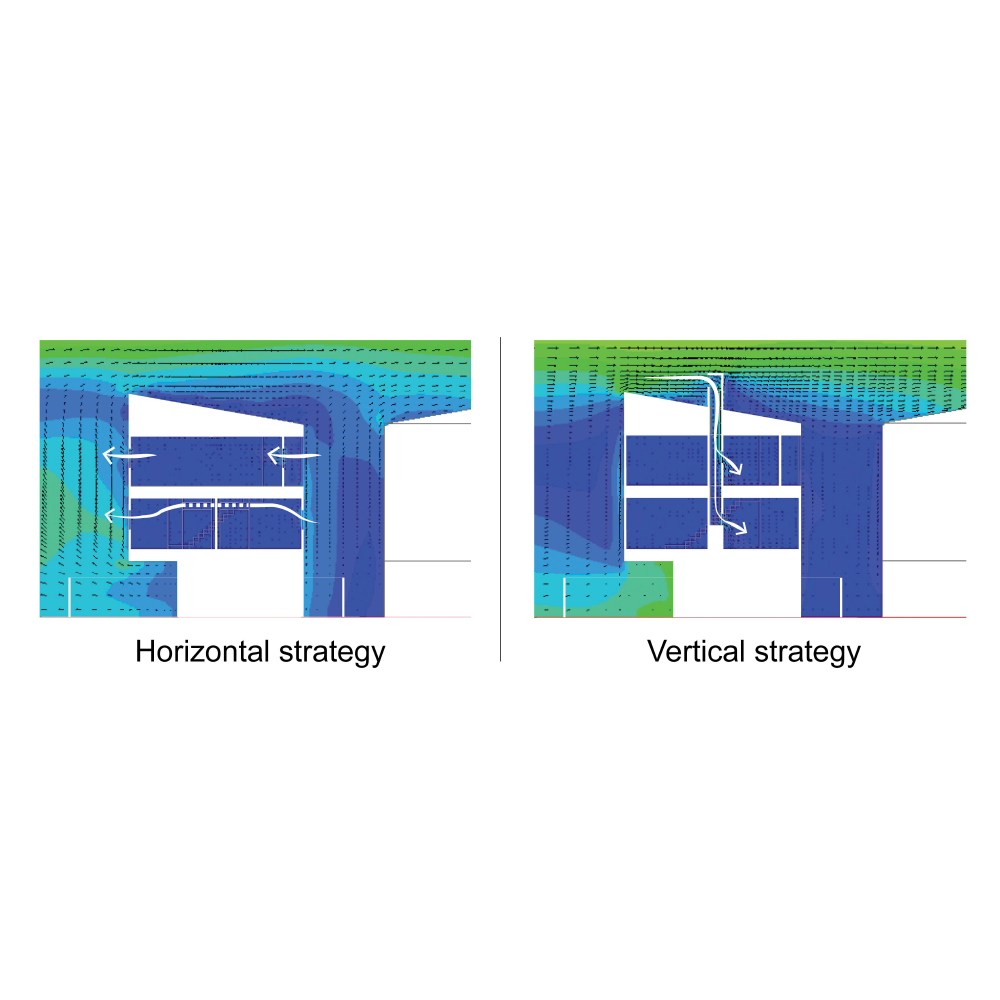
This research proposes horizontal and vertical natural ventilation strategies for upper-floor bedrooms of typical townhouse buildings, aiming to solve problems caused by single-sided ventilation and wind obstruction from adjacent buildings in housing development projects. A comparative study of ventilation performance was conducted for various building scenarios using Computational Fluid Dynamics (CFD) simulation under four design-strategy variables, two wind directions, two different street widths, and two townhouse layout types, totaling 32 cases. The results show that the bedrooms of typical townhouses have very low air movement through the average indoor air velocity coefficient (Cvi = 0.01–0.03) and very low airflow rate through the product of air velocity coefficient at openings and inlet area (Cvo × A = 0.01–0.04) values, especially in second-floor bedrooms with single-sided ventilation. Vertical and horizontal ventilation strategies can slightly increase the Cvi, while significantly improving the Cvo × A values, enabling indoor air quality to meet the required ventilation criteria. The one-way wind catcher provides the highest values in Cvo × A (0.08–0.13), followed by the two-way wind catcher (Cvo × A = 0.04–0.13), and then the horizontal ventilation strategy (Cvo × A = 0.04–0.11). From comparing the influence of the four variables on the ventilation performance of townhouses, the design-strategy variable has the greatest impact on increasing Cviand Cvo × A values, followed by wind direction, and then street width and layout type, which have similar levels of influence. The findings ultimately give a comprehensive set of guidelines for townhouse design in urban conditions.
Article Details

This work is licensed under a Creative Commons Attribution-NonCommercial-NoDerivatives 4.0 International License.
References
American Society of Heating, Refrigerating and Air-Conditioning Engineers. (2023). ANSI/ASHRAE standard 55: Thermal environmental conditions for human occupancy. https://www.ashrae.org/technical-resources/bookstore/standard-55-thermal-environmental-conditions-for-human-occupancy
Calautit, J. K., Hughes, B. R., & Ghani, S. A. (2013). A numerical investigation into the feasibility of integrating green building technologies into row houses in the Middle East. Architectural Science Review, 56(4), 279–296. https://doi.org/10.1080/00038628.2012.686433
Centers for Disease Control and Prevention. (2024a) About ventilation and respiratory viruses. https://www.cdc.gov/niosh/ventilation/about/index.html
Centers for Disease Control and Prevention. (2024b). How much ventilation is enough? https://www.cdc.gov/niosh/ventilation/prevention/Aim-for-5.html
Cheung, T., Li, J., Goh, J., Sekhar, C., Cheong, D., & Tham, K. W. (2022). Evaluation of aerosol transmission risk during home quarantine under different operating scenarios: A pilot study. Building and Environment, 225, Article 109640. https://doi.org/10.1016/j.buildenv.2022.109640
Drach, P. R. C. (2009). A study on air circulation: The case of house VI of “Vila” 37 with the application of wind-catch. Building Simulation, 2, 307–316. https://doi.org/10.1007/s12273-009-9415-6
Ibiyeye, A. I., Shari, Z., & Jaafar, M. F. Z. (2016). Evaluating natural ventilation provisions and occupants’ ventilation behaviour in five terrace housing types in Putrajaya, Malaysia. Archnet-IJAR International Journal of Architectural Research, 10(2), 130–152. https://www.archnet.org/publications/10698
Jareemit, D. & Srivanit, M. (2019). Effect of street canyon configurations and orientations on urban wind velocity in Bangkok suburb areas. IOP Conf. Series: Materials Science and Engineering, 690, Article 012006. https://doi.org/10.1088/1757-899X/690/1/012006
Jomehzadeh, F., Nejat, P., Calautit, J. K., Yusof, M. B. M., Zaki, S. A., Hughes, B.R., & Yazid, M. N. (2016). A review on windcatcher for passive cooling and natural ventilation in buildings, Part 1: Indoor air quality and thermal comfort assessment. Renewable and Sustainable Energy Reviews, 70, 736–756. https://doi.org/10.1016/j.rser.2016.11.254
Mohamed, M. A. A., & El-Amin, M. F. (2022). Inward and outward opening properties of one-sided windcatchers: Experimental and analytical evaluation. Sustainability, 14(7), Article 4048. https://doi.org/10.3390/su14074048
Montazeri, H., & Montazeri, F. (2018). CFD simulation of cross-ventilation in buildings using rooftop wind-catchers: Impact of outlet openings. Renewable Energy, 118, 502–520, https://doi.org/10.1016/j.renene.2017.11.032
Palaiologou, G., & Vaughan, L. (2012). The Manhattan row house as an exemplar of urban adaptability: 1874-2011. In Conference: New Urban Configurations EAAE/ISUF International Conference, TU Delft, Netherlands. https://repository.lboro.ac.uk/articles/conference_contribution/The_Manhattan_row_house_as_an_exemplar_of_urban_adaptability_1874-2011/23592252?file=41386596
Sadeghi, M., Samali, B., Wood, G., & de Dear, R. (2020). Comfort cooling by wind towers in the Australian residential context – Experimental wind tunnel study of comfort. Journal of Wind Engineering & Industrial Aerodynamics, 196, Article 104014. https://doi.org/10.1016/j.jweia.2019.104014
Sangdeh, P. K., & Nasrollahi, N. (2020). Windcatchers and their applications in contemporary architecture. Energy and Built Environment, 3(1), 56–72. https://doi.org/10.1016/j.enbenv.2020.10.005
Shankar, K., & Lo, E. (2019). Modelling urban growth for Bangkok and assessing linkages with road density and socio-economic indicators. In International Archives of the Photogrammetry, Remote Sensing and Spatial Information Sciences, XLII-4/W19 (pp. 255–262). https://doi.org/10.5194/isprs-archives-XLII-4-W19-255-2019
Srebric, J., & Chen, Q. (2002). An example of verification, validation, and reporting of indoor environment CFD analyses. ASHRAE Transactions, 108(2), 185–194. https://engineering.purdue.edu/~yanchen/paper/2002-9.pdf
Srivastava, S., Zhao, X., Manay, A., & Chen, Q. (2021). Effective ventilation and air disinfection system for reducing Coronavirus Disease 2019 (COVID-19) infection risk in office buildings. Sustainable Cities and Society, 75, Article 103408. https://doi.org/10.1016/j.scs.2021.103408
Takkanon, P. (2006, September 6–8). Design guidelines for thermal comfort in row houses in Bangkok. Proceedings of PLEA2006 - The 23rd Conference on Passive and Low Energy Architecture, Geneva, Switzerland. https://www.researchgate.net/publication/281628969_Design_guidelines_for_thermal_comfort_in_row_houses_in_Bangkok
Tantasavasdi, C., & Inprom, N. (2023). Residential unit design for natural ventilation in tropical multi-family high-rises with a double-loaded corridor. Nakhara: Journal of Environmental Design and Planning, 22(3), Article 315. https://doi.org/10.54028/NJ202322315
Tantasavasdi, C., Arttamart, S., & Inprom, N. (2025). Combined wind catchers and side windows for cross ventilation in row houses. Journal of Engineering, Design and Technology, 23(3), 1039–1056. https://doi.org/10.1108/JEDT-02-2023-0079
Tochaiwat, K., & Pultawee, P. (2024). House type specification for housing development project using machine learning techniques: A study from Bangkok metropolitan region, Thailand. Nakhara: Journal of Environmental Design and Planning, 23(1), Article 403. https://doi.org/10.54028/NJ202423403
Toe, D. H. C., & Kubota, T. (2015). Comparative assessment of vernacular passive cooling techniques for improving indoor thermal comfort of modern terraced houses in hot–humid climate of Malaysia. Solar Energy, 114, 229–258. https://doi.org/10.1016/j.solener.2015.01.035
Tominaga, Y., Mochida, A., Yoshie, R., Kataoka, H., Nozu, T., Yoshikawa, M., & Shirasawa, T. (2008). AIJ guidelines for practical applications of CFD to pedestrian wind environment around buildings. Journal of Wind Engineering and Industrial Aerodynamics, 96(1–10), 1749–1761. https://doi.org/10.1016/j.jweia.2008.02.058
Tominaga, Y., Zhang, X., & Miyakoshi, K. (2024). Wind tunnel experiment on cross-ventilation of generic isolated building with various roof shapes: Impact of roof pitch and eaves. Building and Environment, 265, Article 111974. https://doi.org/10.1016/j.buildenv.2024.111974
Tong, Z, Chen, Y, & Malkawi, A. (2016). Defining the influence region in neighborhood-scale CFD simulations for natural ventilation design. Applied Energy, 182, 625–633. https://doi.org/10.1016/j.apenergy.2016.08.098
United Nations, Department of Economic and Social Affairs, Population Division. (2019). World Population Prospects 2019, Highlights. https://population.un.org/wpp/assets/Files/WPP2019_Highlights.pdf
World Health Organization. (2021). Coronavirus disease (COVID-19): Ventilation and air conditioning. https://www.who.int/news-room/questions-and-answers/item/coronavirus-disease-covid-19-ventilation-and-air-conditioning
Zakaria. M. A., Kubota, T., & Toe, D. H. C. (2015). The effects of courtyards on indoor thermal conditions of Chinese shophouse in Malacca. Procedia Engineering, 121, 468–476. https://doi.org/10.1016/j.proeng.2015.08.1094
Zhu, S., Jenkins, S., Addo, K., Heidarinejad, M., Romo, S. A., Layne, A., Ehizibolo, J., Dalgo, D., Mattise, N. W., Hong, F., Adenaiye, O. O., de Mesquita, J., Albert, B. J., Washington-Lewis, R., German, J., Tai, S., Youssefi, S., Milton, D. K., & Srebric, J. (2020). Ventilation and laboratory confirmed acute respiratory infection (ARI) rates in college residence halls in College Park, Maryland. Environment International, 137, Article 105537. https://doi.org/10.1016/j.envint.2020.105537
