
Quantifying the Restorative Effects of Green–Water–Hardscape Ratios: Evidence from a Simulated Landscape Experiment in Chiang Mai
Article Sidebar
Main Article Content
Abstract
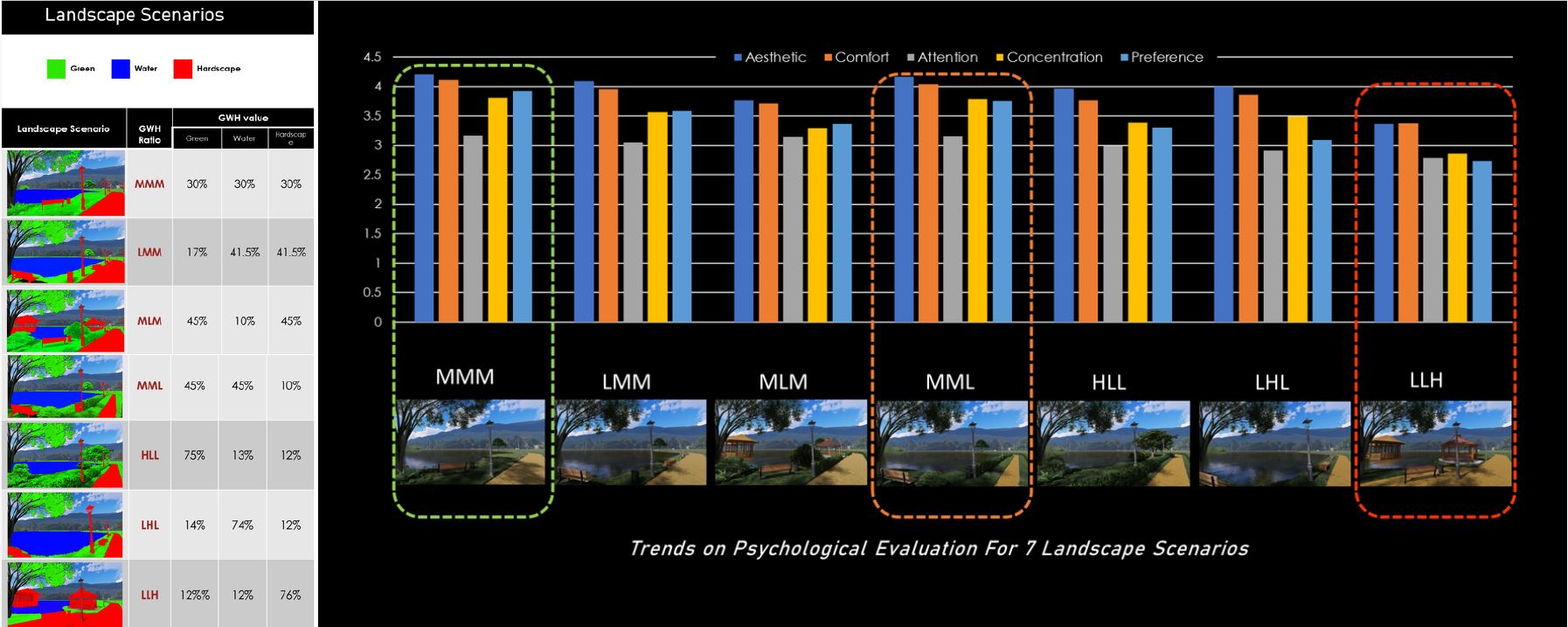
Modern life presents significant stressors that negatively impact mental well-being. While the importance of mental health is increasingly recognized, effective stress management strategies are still crucial. This study explores the potential of landscape perception as a natural intervention to enhance proximal restorative outcomes. By investigating the physiological and psychological responses of individuals to diverse landscape stimuli, we aim to understand how specific combinations of landscape elements (e.g., green spaces, water features) can promote psychological restoration. The study design intended to collect psychological and physiological (heart rate and blood pressure) responses, measured before and after stress-inducing tests and landscape exposure. Scores from self-reported questionnaires were collected from 140 participants (n = 140) exposed to seven virtual landscape scenarios with varying proportions of green (G: vegetation), water (W: blue infrastructure), and hardscape (H: pathways, seating, shelters) elements. Results revealed that balanced landscapes (e.g., MMM: 0.33/0.33/0.33) and nature-dominated landscapes with low hardscape (MML: 0.45/0.45/0.1) elicited the strongest positive responses across all psychological dimensions (aesthetic preference, comfort, concentration, and behavioral preference). In contrast, hardscape-dominated landscapes (LLH: 0.1/0.1/0.8) consistently performed the poorest. While physiological measures showed general stress reduction across all scenarios, no statistically significant differences were found between GWH compositions. This study investigates how the relative proportions of landscape elements significantly affects perceived restoration and preference, although short-term physiological differences are negligible. These results could guide the development of evidence-based interventions and design strategies utilizing the sustainable way to improve restorative experiences for individuals and communities.
Article Details

This work is licensed under a Creative Commons Attribution-NonCommercial-NoDerivatives 4.0 International License.
References
Akay, A. (2025). Perceptions of landscape quality in the historic city center of Konya, Türkiye: A multi-site user satisfaction analysis. Nakhara: Journal of Environmental Design and Planning, 24(3), Article 520. https://doi.org/10.54028/NJ202524520
Berman, M. G., Jonides, J., & Kaplan, S. (2008). The cognitive benefits of interacting with nature. Psychological Science, 19(12), 1207–1212. https://doi.org/10.1111/j.1467-9280.2008.02225.x
Bratman, G. N., Anderson, C. B., Berman, M. G., Cochran, B., de Vries, S., Flanders, J., Folke, C., Frumkin, H., Gross, J., Hartig, T., Kahn Jr., P., Kuo, M., Lawler, J., Levin, P., Lindahl, T., Meyer-Lindenberg, A., Mitchell, R., Ouyang, Z., Roe, J. … Daily, G. C. (2019). Nature and mental health: An ecosystem service perspective. Science Advances, 5(7), Article eaax0903. https://doi.org/10.1126/sciadv.aax0903
Deng, L., Luo, H., Ma, J., Huang, Z., Sun, L.-X., Jiang, M.-Y., Zhu, C. -Y, & Li, X. (2020). Effects of integration between visual stimuli and auditory stimuli on restorative potential and aesthetic preference in urban green spaces. Urban Forestry & Urban Greening, 53, Article 126702. https://doi.org/10.1016/j.ufug.2020.126702
Depledge, M. H., Stone, R. J., & Bird, W. J. (2011). Can natural and virtual environments be used to promote improved human health and wellbeing? Environmental Science & Technology, 45(11), 4660–4665. https://doi.org/10.1021/es103907m
Francis, M. (2016). The making of democratic streets. Contesti. Città, territori, progetti(1–2), 192–213. https://doi.org/10.13128/contesti-20378
Gascon, M., Triguero-Mas, M., Martínez, D., Dadvand, P., Forns, J., Plasència, A., & Nieuwenhuijsen, M. J. (2015). Mental health benefits of long-term exposure to residential green and blue spaces: A systematic review. International Journal of Environmental Research and Public Health, 12(4), 4354–4379. https://www.mdpi.com/1660-4601/12/4/4354
Hartig, T., Mitchell, R., de Vries, S., & Frumkin, H. (2014). Nature and health. Annual Review of Public Health, 35, 207–228. https://doi.org/10.1146/annurev-publhealth-032013-182443
He, H., Zhang, T., Zhang, Q., Rong, S., Jia, Y., & Dong, F. (2024). Exploring the impact of campus landscape visual elements combination on short-term stress relief among college students: A case from China. Buildings, 14(5), Article 1340. https://doi.org/10.3390/buildings14051340
Huang, Q., Yang, M., Jane, H.-a., Li, S., & Bauer, N. (2020). Trees, grass, or concrete? The effects of different types of environments on stress reduction. Landscape and Urban Planning, 193, Article 103654. https://doi.org/10.1016/j.landurbplan.2019.103654
Janpathompong, S., Tontisirin, N., & Murakami, A. (2022). How far people walk during lunchtime: Comparing actual and perceived walking distances in the Central Business District of Bangkok, Thailand. Nakhara: Journal of Environmental Design and Planning, 21(3), Article 227. https://doi.org/10.54028/NJ202221227
Jiang, B., Chang, C.-Y., & Sullivan, W. C. (2014). A dose of nature: Tree cover, stress reduction, and gender differences. Landscape and Urban Planning, 132, 26–36. https://doi.org/10.1016/j.landurbplan.2014.08.005
Kaplan, S. (1995). The restorative benefits of nature: Toward an integrative framework. Journal of Environmental Psychology, 15(3), 169–182. https://doi.org/10.1016/0272-4944(95)90001-2
Laohaviraphap, N., & Mahaek, E. (2023). Cultural revitalization of Tha Phae road: An in-depth exploration of contemporary Lanna architectural facades and urban identity. Nakhara: Journal of Environmental Design and Planning, 22(2), Article 313. https://doi.org/10.54028/NJ202322313
Lin, W., Zeng, C., Bao, Z., & Jin, H. (2023). The therapeutic look up: Stress reduction and attention restoration vary according to the sky-leaf-trunk (SLT) ratio in canopy landscapes. Landscape and Urban Planning, 234, Article 104730. https://doi.org/10.1016/j.landurbplan.2023.104730
Liu, J., Kang, J., Behm, H., & Luo, T. (2014). Effects of landscape on soundscape perception: Soundwalks in city parks. Landscape and Urban Planning, 123, 30–40. https://doi.org/10.1016/j.landurbplan.2013.12.003
Liu, Y., Hu, M., & Zhao, B. (2019). Audio-visual interactive evaluation of the forest landscape based on eye-tracking experiments. Urban Forestry & Urban Greening, 46, Article 126476. https://doi.org/10.1016/j.ufug.2019.126476
Ren, H., Wang, X., Zhang, J., Zhang, L., & Wang, Q. (2024). Evaluation of rural healing landscape design based on virtual reality and electroencephalography. Buildings, 14(6), Article 1560. https://doi.org/10.3390/buildings14061560
Shu, Y., Wu, C., & Zhai, Y. (2022). Impacts of landscape type, viewing distance, and permeability on anxiety, depression, and stress. International Journal of Environmental Research and Public Health, 19(16), Article 9867. https://doi.org/10.3390/ijerph19169867
Suppakittpaisarn, P., Wu, C.-C., Tung, Y.-H., Yeh, Y.-c., Wanitchayapaisit, C., Browning, M. H. E. M., Chang, C. -Y., & Sullivan, W. C. (2023). Durations of virtual exposure to built and natural landscapes impact self-reported stress recovery: Evidence from three countries. Landscape and Ecological Engineering, 19(1), 95–105. https://doi.org/10.1007/s11355-022-00523-9
Twohig-Bennett, C., & Jones, A. (2018). The health benefits of the great outdoors: A systematic review and meta-analysis of greenspace exposure and health outcomes. Environmental Research, 166, 628–637. https://doi.org/10.1016/j.envres.2018.06.030
Ulrich, R. S., Simons, R. F., Losito, B. D., Fiorito, E., Miles, M. A., & Zelson, M. (1991). Stress recovery during exposure to natural and urban environments. Journal of Environmental Psychology, 11(3), 201–230. https://doi.org/10.1016/S0272-4944(05)80184-7
United Nations. (2018). World urbanization prospects: The 2018 revision. https://population.un.org/wup/assets/WUP2018-Report.pdf
van den Bosch, M., & Meyer-Lindenberg, A. (2019). Environmental exposures and depression: Biological mechanisms and epidemiological evidence. Annual Review of Public Health, 40, 239–259. https://doi.org/10.1146/annurev-publhealth-040218-044106
Wang, R., Zhao, J., Meitner, M. J., Hu, Y., & Xu, X. (2019). Characteristics of urban green spaces in relation to aesthetic preference and stress recovery. Urban Forestry & Urban Greening, 41, 6–13. https://doi.org/10.1016/j.ufug.2019.03.005
Xu, Z., Marini, S., Mauro, M., Maietta Latessa, P., Grigoletto, A., & Toselli, S. (2025). Associations between urban green space quality and mental wellbeing: Systematic review. Land, 14(2), Article 381. https://doi.org/10.3390/land14020381
Yang, X., & Kang, J. (2022). The effect of visual and acoustic factors on the sound preference for waterscapes in urban public spaces. Applied Acoustics, 197, Article 108945. https://doi.org/10.1016/j.apacoust.2022.108945
Yi, K., Shi, X., Wei, M., & Zhang, Z. (2025). Benefits of various urban green spaces for public health based on landscape elements: A study of public visual perception. Forests, 16(4), Article 648. https://doi.org/10.3390/f16040648
