
“Para-Para Api”: Vernacular Architecture of Nutmeg Farmers’ Settlements in the Banda Islands, Maluku, Indonesia
Article Sidebar
Main Article Content
Abstract
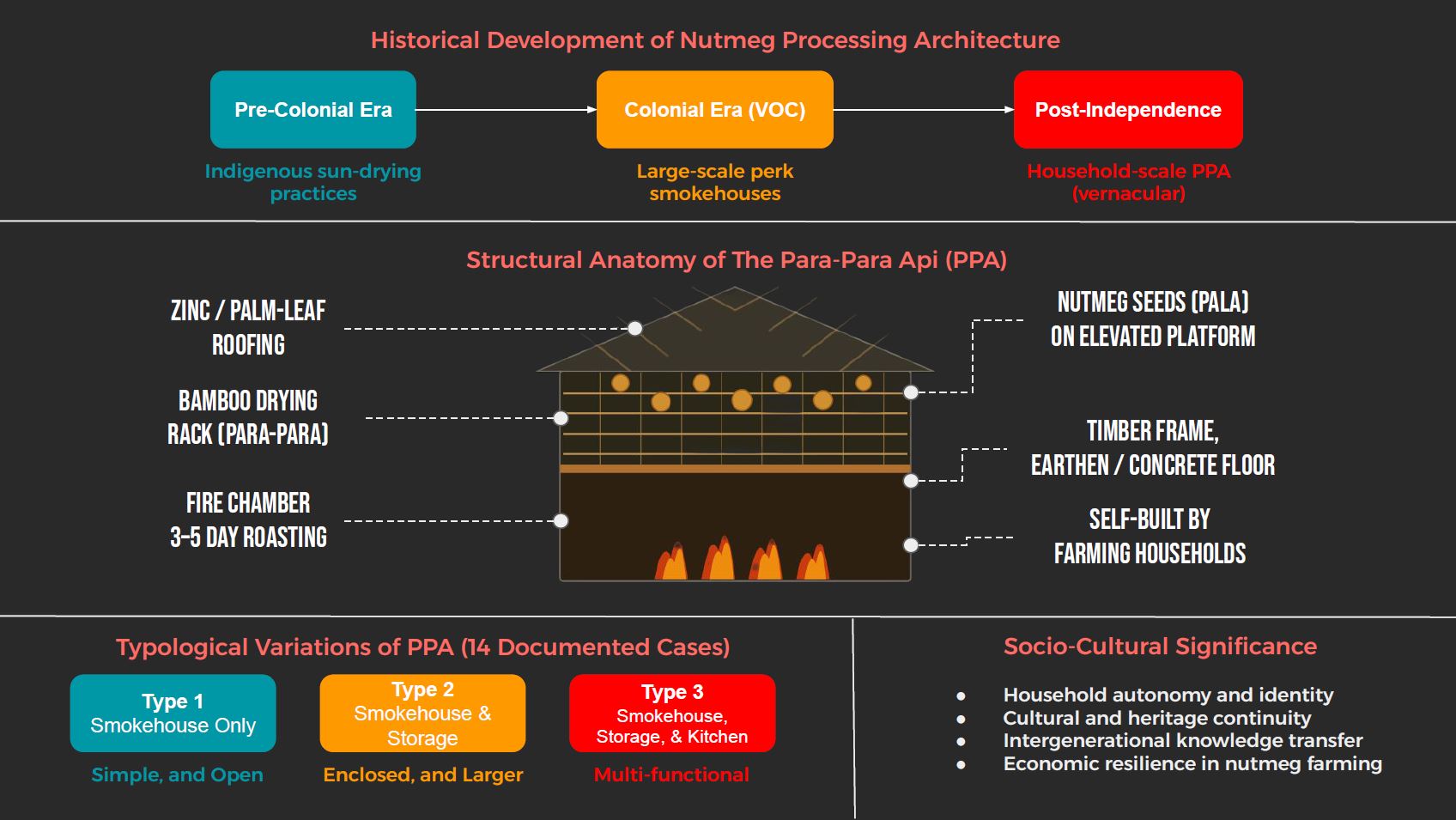
This article examines the Para-Para Api (PPA), a modest yet enduring form of vernacular architecture developed by nutmeg-farming households in the Banda Islands, Maluku. While spice-route scholarship has largely focused on palaces, forts, and trading ports, little attention has been given to the everyday structures that sustain nutmeg production. The study investigates the architectural characteristics and socio-cultural roles of the PPA, particularly how vernacular building practices adapted influences from colonial-era smokehouses within a household-scale context. Using qualitative methods that combine field surveys, architectural documentation, and semi-structured interviews with nutmeg farmers across several Bandanese settlements, the research analyzes construction techniques, spatial organization, and typological variations. The findings show that PPAs are typically small rectangular structures located beside or behind the main house, allowing smoke from nutmeg roasting to disperse while remaining integrated with domestic activity. They commonly use locally available materials such as timber frames, bamboo drying racks (para-para), earthen or concrete floors, and zinc or palm-leaf roofing. Most structures follow a two-level configuration with a fire chamber below and elevated drying platforms above, while larger examples may include wood storage or cooking spaces. Beyond their utilitarian role in nutmeg preservation, PPAs also function as spaces that express household autonomy and cultural continuity within Bandanese farming communities.
Article Details

This work is licensed under a Creative Commons Attribution-NonCommercial-NoDerivatives 4.0 International License.
References
Alalouch, C., Al Hinai, A., Al Salmi, I., & Al-Harthy, A. (2022). “Spatial DNA” of traditional houses as a catalyst for resilient and sustainable future: The case of Oman. In Proceedings of the 13th Space Syntax Symposium (13SSS) (Paper 381). Western Norway University of Applied Sciences, Bergen, Norway. https://squ.elsevierpure.com/ar/publications/spatial-dna-of-traditional-houses-as-a-catalyst-for-resilient-and/
Anuraga, J. L. Y. (2021). The Banda spice route: Between trade, conquest and mixing: The dynamics of the Banda Neira society as seen from the socio-historical spice. Jurnal Masyarakat dan Budaya, 23(3), 303–319. https://dx.doi.org/10.14203/jmb.v23i3.1483
Chiarappa, M., & Berlinger, G. (2019). Stories buildings tell, lives buildings shape: The enduring tradition of vernacular architecture research in north American folkloristics. Material Culture Review, 90–91, 1–9. https://doi.org/10.7202/1076794ar
Chinwong, D., Charaj, P., Panitsupakamol, P., Chankaew, T., Chinwong, S., & Saenjum, C. (2021). Local wisdom of Miang lifestyle and community for sustainable development in northern Thailand. Sustainability, 13(13), Article 7381. https://doi.org/10.3390/su13137381
Das, S., & Rahman, M. A. (2025). An empirical study on settlement pattern and architectural features of rural housing in Haor-basin region of Bangladesh. Journal of Architectural/Planning Research and Studies (JARS), 22(2), Article 271526. https://doi.org/10.56261/jars.v22.271526
Dayaratne, R. (2018). Toward sustainable development: Lessons from vernacular settlements of Sri Lanka. Frontiers of Architectural Research, 7(3), 334–346. https://doi.org/10.1016/j.foar.2018.04.002
Dhont, F. (2022). Of nutmeg and forts: Indonesian pride in the Banda Islands’ unique natural and cultural landscape. eTropic 21(1), 83–98. http://dx.doi.org/10.25120/etropic.21.1.2022.3864
Divekar, S. P., Thakor, N. J., Mulla, H. Y., & Sawant, M. V. (2011). Effect of drying on physical properties of nutmeg. Engineering and Technology in India, 2(1&2), 18–23. https://scholar.google.com/scholar?cluster=6991560836387753426&hl=en&oi=scholarr
Effendy, M. A. R., & Hamid A. R. (2020). Rempah Nusantara merajut dunia [Nusantara spices weaving the world]. Samarinda: Cultural Heritage Preservation Office of East Kalimantan, Ministry of Education and Culture of the Republic of Indonesia in collaboration with Ruas Media.
Fahmi, M. N. (2022). Memories of the spice route and Indonesia's future: Efforts to maintain elrigious harmony of the Lasem coastal communities. In U. Faizal & Gemala, International Forum on Spice Route Volume 2 (pp. 151–160). https://shorturl.at/zC6wm
Farid, M. (2021). Tana Banda [Banda Land]. Penerbit Prenada.
Freedman, P. (2015). Health, wellness and the allure of spices in the middle ages. Journal of Ethnopharmacology, 167, 47–53. https://doi.org/10.1016/j.jep.2014.10.065
Gil-Piqueras, T., & Rodríguez-Navarro, P. (2021). Tradition and sustainability in vernacular architecture of Southeast Morocco. Sustainability 13(2), Article 684. https://doi.org/10.3390/su13020684
Groat, L. N., & Wang, D., (2013). Architectural research methods. John Wiley & Sons.
Hamid, A. R. (2022). The role of Makassar in promoting the archipelago spice route in the XVI–XVII centuries. Buletin Al-Turas 28(2), 155–170. https://doi.org/10.15408/bat.v28i2.25037
Hanna, W. A. (1983). Kepulauan Banda: Kolonialisme dan Akibatnya di Kepulauan Pala [The Banda Islands: Colonialism and its consequences in the Nutmeg Islands]. PT Gramedia.
Hancock, J. F. (2021). Spices, scents and silk: Catalysts of world trade. CAB International.
Indonesian Statistics Bureau of Maluku. (2024). Maluku province in figures 2024. BPS Pronvisi Maluku. https://maluku.bps.go.id/id/publication/2024/02/28/96a8ee596d346811c1e602b9/provinsi-maluku-dalam-angka-2024.html
Isnaeni, H., Muafiroh, S., Ummah, Z. R., Turner, S., Lekakis, S., Adianto, J., Hermawan, R., Iriyanto, N., Kersapati, M. I., & Atqa, M. (2025). Sacred places, ritual and identity: Shaping the liminal landscape of Banda Neira, Maluku Islands. Land, 14(5), Article 1109. https://doi.org/10.3390/land14051109
Joseph, P. (2017). Process, material and method in architecture: Analysis of vernacular and current building practices. International Journal on Emerging Technologies, 8(1), 49–53. https://www.researchtrend.net/ijet/pdf/9%20Priya%20Joseph_%20Paper%20for%20research%20trend.pdf
Kaundal, G., Sharma, P., & Singh, I. (2025). Climate-resilient traditional architecture: A case of Dharamshala, India. Journal of Architectural/Planning Research and Studies (JARS), 22(2), Article 272106. https://doi.org/10.56261/jars.v22.272106
Kazimee, B. A. (2008). Learning from vernacular architecture: Sustainability and cultural conformity. WIT Transactions on Ecology and the Environment, 113, 3–13. https://www.witpress.com/elibrary/wit-transactions-on-ecology-and-the-environment/113/19192
Kiatthanawat, A., Yodsurang, P., & Krasae-in, A. (2024). Exploring Thai vernacular houses for heritage tourism along the western Bangkok canals. Nakhara: Journal of Environmental Design and Planning, 23(1), Article 407. https://doi.org/10.54028/NJ202423407
Kersapati, M. I., Faturohman, F., Sihite, B., & Purwanto, H. (2025). Banda Neira: Bandar Rempah di Timur Nusantara [Banda Neira: Spice port in the astern archipelago]. Pustaka Indis. https://scholar.google.com/citations?view_op=view_citation&hl=en&user=tHC6ZVkAAAAJ&citation_for_view=tHC6ZVkAAAAJ:d1gkVwhDpl0C
Kersapati, M. I., & Setiadi, H. (2021). Semiotic study of settlement’s spatial pattern in Kuningan Regency, West Java. Jurnal Geografi Lingkungan Tropik (Journal of Geography of Tropical Environments), 5(1), Article 1. https://doi.org/10.7454/jglitrop.v5i1.83
Khakpour, M., Ansari, M., Sheikhmehdi, A., & Tavoosi, M. (2015). Socio-cultural characteristics of the vernacular houses. Journal of Housing and Rural Environment, 34(149), 3–14. https://scholar.google.co.uk/scholar?oi=bibs&cluster=6177087060065224402&btnI=1&hl=ro
Lanier, G. M. (2009). Vernacular architecture in the twenty-first century: Theory, education and practice. Journal of Architectural Education, 63(1), 160–161. https://doi.org/10.1111/j.1531-314X.2009.01050.x
Martokusumo, W., Purwaningrum, R. D. A., Rani, M. S., Dahlan, M. Z., Faisal, B., Binta, I., Meilano, I., & Kobayashi, H. (2025). Dwelling with the fault: Cultural landscape and spatial formation in Kampung Batu Lonceng, Indonesia. Nakhara: Journal of Environmental Design and Planning, 24(3), Article 523. https://doi.org/10.54028/NJ202524523
Mendis, M. S., Abeyrathna, W., Halwatura, R. U., Amarasekara, H. S., Somadewa, R., & Jayasinghe, R. (2023). Accumulate and consolidate the traditional vernacular timber preservation technologies through a field survey. Heliyon, 10(1), Article e23907. https://doi.org/10.1016/j.heliyon.2023.e23907
Mileto, C., Vegas López-Manzanares, F., Lidón de Miguel, M., & Hueto Escobar, A. (2022). Vernacular architecture: Sustainability and risks. Journal of Cultural Heritage Management and Sustainable, 12(2), 89–91. https://doi.org/10.1108/JCHMSD-05-2022-193
Mobaraki, A., & Oktay Vehbi, B. (2022). A conceptual model for assessing the relationship between urban morphology and sustainable urban form. Sustainability, 14(5), Article 2884. https://doi.org/10.3390/su14052884
Muslimin, M. F. (2022). Konektivitas bandar-bandar di jalur rempah dalam Novel Arus Balik [The ports connectivity on the spice routes in Arus Balik novel]. Pangadereng, 8(1), 59–80. https://www.neliti.com/publications/518255/konektivitas-bandar-bandar-di-jalur-rempah-dalam-novel-arus-balik
Nasution, S., Kersapati, M. I., Lekakis, S., Geros, C. L., Aswandi, A., Farid, M., Sarah, P. N., Rais, H., Nadia, Z., Faturohman, F., Avicenna, M., Atqa, M., Sihite, B., & Taqyuddin, T. (2025). The Maluku archipelagic landscape: Exploring and evaluating the outstanding universal value towards World Heritage nomination. Journal of Tourism, Heritage & Services Marketing, 11(2), 54–71. https://doi.org/10.5281/zenodo.17609613
Noble, A. (2013). Vernacular buildings: A global survey. I.B. Tauris.
Pakpahan, A., Bermawie, N., & Wiratno. (2020). Indonesian’s nutmeg for the world, synergizing consumers need while increasing farmer’s welfare. IOP Conference Series: Earth and Environmental Science, 418, Article 012007. https://doi.org/10.1088/1755-1315/418/1/012007
Philokyprou, M., & Michael, A. (2021). Environmental sustainability in the conservation of vernacular architecture. The case of rural and urban traditional settlements in Cyprus. International Journal of Architectural Heritage, 15(11), 1741–1763. https://doi.org/10.1080/15583058.2020.1719235
Ptak, R. (1992). The northern route to the spice island: South China Sea-Sulu Zone-North Moluccas (14th to early 16th century). Archipel, 43, 27–56. https://doi.org/10.3406/arch.1992.2804
Rais, H., Kersapati, M. I., Farid, M., Aswandi, A., Faturohman, F., Avicenna, M., Nadia, Z., Atqa, M., & Sarah, P. N. (2026). Living heritage: Biocultural conservation on spice cultivation in the Maluku archipelago, the heartland of clove and nutmeg. Ethnobiology and Conservation, 15, Article 4. https://doi.org/10.15451/ec2026-02-15-04-1-27
Reid, A. (2015). A history of southeast Asia: Critical crossroads. Wiley-Blackwell.
Sarjiyanto. (2013). Kepulauan Banda, Maluku Tengah, pusat perdagangan pala abad ke-16–19 [The Banda Islands, Central Maluku, a center of nutmeg trade from the 16th to the 19th century] [PowerPoint slides]. Pusat Arkeologi Nasional.
Sato, K. (1991). Menghuni lumbung: Beberapa pertimbangan mengenai asal-usul konstruksi rumah panggung di Kepulauan Pasifik [Dwelling in the granary: Some considerations on the origins of stilt-house construction in the Pacific Islands]. Antropologi Indonesia, 49, 31–47.
Solikhah, N., & Fatimah, T. (2020). Lessons learned from vernacular architecture toward sustainable human settlements: Insights from Praigoli Village, West Sumba, Indonesia. ISVS e-journal, 7(4), 37–52. https://scholar.google.co.id/scholar?oi=bibs&cluster=18412781134040759659&btnI=1&hl=en
Song, E., Gress, D. R., & Andriesse, E. (2020). Global production networks and (distributional) regional development: The cinnamon industry in Karandeniya and Matale, Sri Lanka. Journal of South Asian Development, 15(2), 209–237. https://doi.org/10.1177/0973174120956496
Spence, C. (2024). Nutmeg and mace: The sweet and savoury spices. International Journal of Gastronomy and Food Science, 36, Article 100936. https://doi.org/10.1016/j.ijgfs.2024.100936
Straver, H. (2016). Het lot van Egeron en Adeka: Banda verhaald door Jan Fredrik Helmers [The fate of Egeron and Adeka Banda recounted by Jan Fredrik Helmers Hans Straver]. Indische Letteren, 31, 3–21. https://www.dbnl.org/tekst/_ind004201601_01/_ind004201601_01_0002.php
Takaria, D., & Pieter, C. (1998). Kamus Bahasa Melayu Ambon–Indonesia [Ambonese Malay–Indonesian dictionary]. Pusat Pembinaan dan Pengembangan Bahasa. Departemen Pendidikan dan Kebudayaan.
Tienthavorn, T. (2024). Conserving Thailand’s wooden built heritage: Developments, approaches, and current challenges. Nakhara: Journal of Environmental Design and Planning, 23(1), Article 404. https://doi.org/10.54028/NJ202423404
Tobing, R. R., & Hutabarat, G. M. (2019). The traditional settlement architecture of the Bataknese Toba Tribe and Clan Kinship in the Village of Hutaginjang, North Sumatra, Indonesia, ISVS e-journal, 6(2), 12–21. https://scholar.google.co.id/scholar?oi=bibs&cluster=14706013969005794803&btnI=1&hl=id
van Donkersgoed, J. (2019). Virtual meeting ground for colonial (re)interpretation of the Banda islands, Indonesia. Wacana, 20(2), 266–285. https://doi.org/10.17510/wacana.v20i2.731
van Ittersum, M. J. (2016). Debating natural law in the Banda Islands: A case study in Anglo–Dutch imperial competition in the east Indies, 1609–1621. History of European Ideas, 42(4), 459–501. https://doi.org/10.1080/01916599.2015.1101216
Vellinga, M. (2013). The noble vernacular. Journal of Architecture, 18(4), 570–590. https://doi.org/10.1080/13602365.2013.819813
Villiers, J. (1981). Trade and society in the Banda Islands in the sixteenth century. Modern Asian Studies, 15(4), 723–750. http://www.jstor.org/stable/312170
Waterson, R. (2009). Paths and rivers: Sa’dan Toraja society in transformation. KITLV Press. https://doi.org/10.26530/OAPEN_377535
Widana, I. N. M., Julianingsih, L. P. E. M., & Wirawan, I. W. A. (2023). The arrangement of spatial settlement for Balinese and Sasak communities at historical perspective in Cakranegara. Research Journal in Advanced Humanities, 4(1), 87–102. https://doi. org/10.58256/rjah.v4i1.1159
Widiastuti, I., & Nurhijrah. (2021). Transformations and re-domestications of Karampuang vernacular architecture from Lekeang, Rumah Besar to Bola architecture, Indonesia. ISVS e-journal, 8(3), 55–68. https://isvshome.com/pdf/ISVS_8-3/ISVS-8.3.4-Indah_Nurhijrah_Published.pdf
Winn, P. (2010). Slavery and cultural creativity in the Banda Islands. Journal of Southeast Asian Studies, 41(3), 365–389. https://doi.org/10.1017/S0022463410000238
Yin, R. K. (2018). Case study research and applications: Designs and methods (6th ed.). SAGE.
Zhang, X., Li, J., & Xu, J. (2024). Micro-scale analysis and optimization of rural settlement spatial patterns: A case study of Huanglong Town, Dayu County. Land, 13(7), Article 966. https://doi.org/10.3390/land13070966
Zumbroich, T. J. (2012). From mouth fresheners to erotic perfumes: The evolving socio-cultural significance of nutmeg, mace and cloves in south Asia. eJournal of Indian Medicine, 5(2), 37–97. https://indianmedicine.nl/article/view/24743
