
Computational Hygrothermal Analysis of External Wall Behavior in Naturally Ventilated and Air-conditioned Historical Buildings in Thailand
Article Sidebar
Main Article Content
Abstract
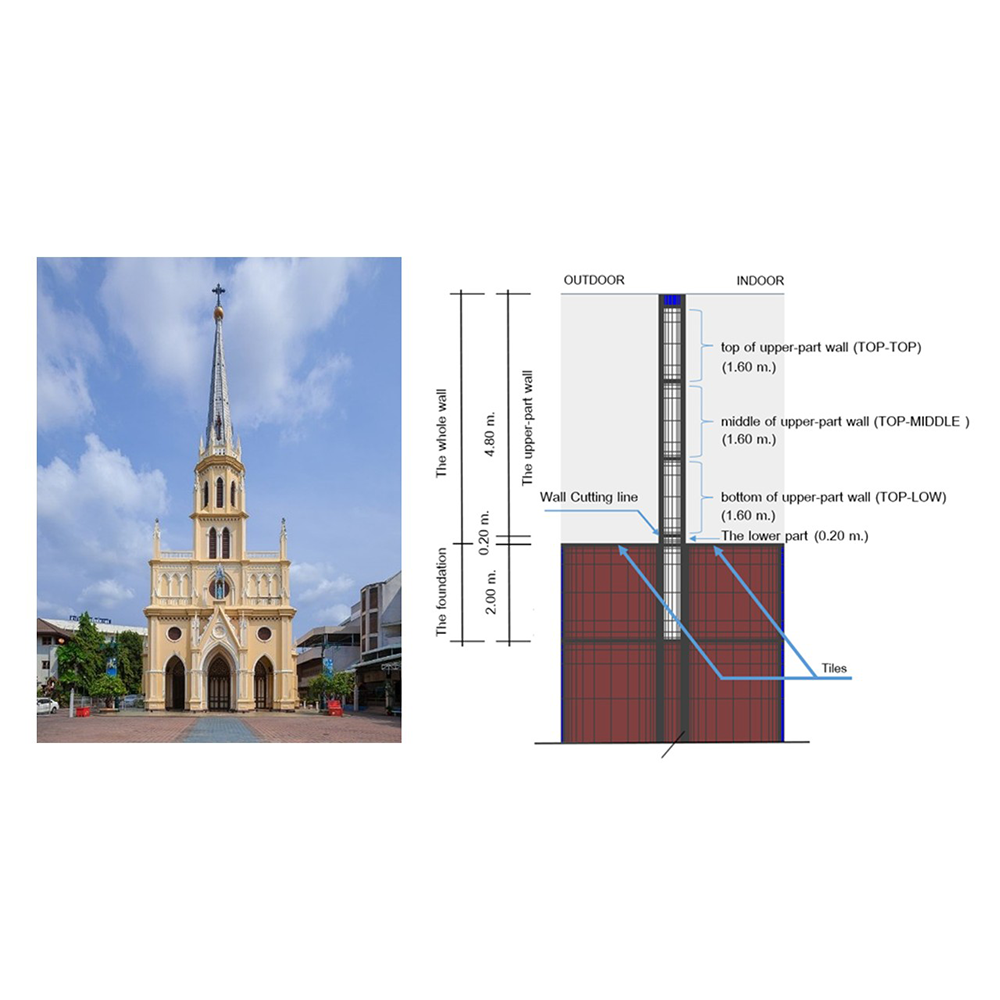
Moisture in historical buildings has long been a significant problem in Thailand, causing damage to structural elements, wall materials, and indoor air quality. While some issues are attributed to inherited structural systems, many result from changes in space use, particularly the introduction of air-conditioning, which alters hygrothermal performance. This study examines heat and moisture transfer in historical buildings using computational hygrothermal analysis (WUFI), comparing air-conditioned and naturally ventilated cases, with and without wall-cutting interventions, in Thailand’s hot-humid climate. The results present the average water content (kg/m³) in exterior walls across three upper sections and one lower section under both conditions. The findings indicate that in air-conditioned historical buildings, water content in the middle and bottom sections of the upper exterior wall is influenced by dry, lower-temperature indoor conditions. The reduced relative humidity of conditioned air promotes higher evaporation, lowering the damp rise height and reducing water content by 2.83 and 5.13 kg/m³ in the middle and bottom sections of the upper wall, respectively, compared with naturally ventilated cases. The air-conditioning system has only a slight effect on the hygrothermal behavior of retrofitted walls after wall-cutting interventions, with an approximately 2 kg/m³ higher water content across all upper sections in the conditioned case compared with the naturally ventilated case. Meanwhile, wall cutting has a greater effect in unconditioned spaces, with larger reductions in water content above the cut but increased moisture below due to redistribution.
Article Details

This work is licensed under a Creative Commons Attribution-NonCommercial-NoDerivatives 4.0 International License.
References
Alev, Ü., Uus, A., Teder, M., Miljan, M.-J., & Kalamees, T. (2014). Air leakage and hygrothermal performance of an internally insulated log house. In Proceedings of the 10th Nordic Symposium on Building Physics (NSB 2014) (pp. 55–62). Wufi. https://wufi.de/en/wp-content/uploads/sites/11/2014/12/Alev-Uus-et-al-2014-Air-leakage-and-hygrothermal-performance.pdf
Benjaporn, S. (2001). Influence of moisture penetrating through the solid walls of air conditioning buildings [Master’s thesis, Chulalongkorn University]. National Research Counsil of Thailand. https://doi.nrct.go.th//ListDoi/listDetail?Resolve_DOI=10.14457/CU.the.2000.111
Bunjerdskul, K. (2014). Changes of slaked lime formula in traditional Thai architectural conservation [Master’s thesis, Chulalongkorn University]. Chula Digital Collection. https://digital.car.chula.ac.th/chulaetd/72031/
Department of Architecture, Chulalongkorn University. (2017). Initial and planning stages in preservation process: Contributions to recommendation for appropriate conservation treatments: A case of conservation of the Our Lady of the Rosary Church project [Report]. Department of Architecture, Chulalongkorn University.
Emerisda. (2014). Existing methods against rising damp (Summary report D2.1, final version). TU Delft. https://www.emerisda.eu/wp-content/uploads/2014/07/D-2_1.pdf
Falchi, L., Slamzi, D., Balliana, E., Drussi, G., & Zendri, E. (2018). Rising damp in historical buildings: A Venetian perspective. Building and Environment, 131, 117–127. https://doi.org/10.1016/j.buildenv.2018.01.004
Franzoni, E. (2014). Rising damp removal from historical masonries: A still open challenge. Construction and Building Materials, 54, 123–136. https://doi.org/10.1016/j.conbuildmat.2013.12.054
Fraunhofer Institute for Building Physics. (2025a). WUFI – The transient coupled heat and moisture transport simulation. https://wufi.de/en/
Fraunhofer Institute for Building Physics. (2025b). WUFI® Pro 5 software online help. https://wufi.de/en/service/support/
Fraunhofer Institute for Building Physics. (2025c). WUFI-Wiki – WUFI manuals and tutorials. https://www.wufi-wiki.com/mediawiki/index.php/Hauptseite
Freitas, V. P., & Torres, M. I. M. (2003). The influence of the boundary conditions in rising damp in historical constructions. WIT Transactions on the Built Environment, 66, Article 12. https://doi.org/10.2495/STR030701
Greens Energy. (2024). Do air conditioners dry out your home? https://greensenergy.com/blog/do-air-conditioners-dry-out-home
Guimaraes, A. S., Delgado, J. M. P. Q., & Freitas, V. P. (2012a). Rising damp in walls: Evaluation of the level achieved by the damp front. Journal of Building Physics, 37(1), 6–27. https://doi.org/10.1177/1744259112453822
Guimaraes, A. S., Delgado, J. M. P. Q., & Freitas, V. P. (2012b). Numerical simulation of rising damp phenomenon. Defect and Diffusion Forum, 326–328, 48–53. https://doi.org/10.4028/www.scientific.net/DDF.326-328.48
Hagentoft, C.-E. (2001). Introduction to building physics. Studentlitteratur AB.
Hägerstedt, S. O., & Arfvidsson, J. (2010). Comparison of field measurements and calculations of relative humidity and temperature in wood framed walls. In O. Zmeškal (Ed.), Proceedings of Thermophysics 2010 (pp. 93–101). Brno University of Technology. https://lup.lub.lu.se/search/files/5974170/5212267.pdf
Holm, A., & Künzel, H. M. (2003). Two-dimensional transient heat and moisture simulations of rising damp with WUFI 2D. Fraunhofer Institute for Building Physics. https://wufi.de/literatur/Holm,%20K%C3%BCnzel%202000%20-%20Two-Dimensional%20Transient%20Heat%20and%20Moisture.pdf
Ibrahim, M., Wurtz, E., Biwole, P. H., Achard, P., & Sallee, H. (2014). Hygrothermal performance of exterior walls covered with aerogel-based insulating rendering. Energy and Buildings, 84, 241–251. https://doi.org/10.1016/j.enbuild.2014.07.039
Issarathumnoon, W. (2018). Initial and planning stages in preservation process: Contributions to recommendation for appropriate conservation treatments: A case of conservation of the Our Lady of the Rosary Church project. NAJUA: Architecture, Design and Built Environment, 33, B3–B21. https://so04.tci-thaijo.org/index.php/NAJUA-Arch/article/view/130627
Jareemit, D. (2018). Numerical simulation of moisture transfer behaviors in residential walls in hot and humid region. Journal of Architectural/Planning Research and Studies (JARS), 15(2), 153–168. https://doi.org/10.56261/jars.v15i2.167942
Jungsiriarrak, S. (1997). Conservation of structure and material of Thai historical building [Course handout]. Faculty of Architecture, Silpakorn University.
Künzel, H. M. (1995). Simultaneous heat and moisture transport in building components: One- and two-dimensional calculation using simple parameters. Fraunhofer IRB Verlag. https://www.researchgate.net/publication/41124856_Simultaneous_heat_and_moisture_transport_in_building_components_One-_and_two-dimensional_calculation_using_simple_parameters
Leerungruangpan, P., & Sreshthaputra, A. (2018). Thermal comfort of renovated historic building: Three case studies of the National Gallery, OP Place and the Ministry of Interior. In Proceedings of the 3rd BTAC Conference on Energy and Environment (BTAC 2016) (pp. 59–75). Khon Kaen University. https://btac2016.wordpress.com/wp-content/uploads/2016/07/btac2016-final-bt06.pdf
Madhury, M., & Sarker, L. (2024). Heritage values and community perception: A look into the historic ruins of Dinajpur Rajbari. Nakhara: Journal of Environmental Design and Planning, 23(1), Article 401. https://doi.org/10.54028/NJ202423401
Mason, G. (1974). Rising damp. Building Science, 9, 227–231. https://doi.org/10.1016/0007-3628(74)90021-8
Meteotest AG. (2020). Meteonorm software. https://mn8.meteonorm.com/en/product/meteonorm-software
Mundt-Petersen, S. O., & Harderup, L. (2013). Validation of a one-dimensional transient heat and moisture calculation tool under real conditions. In Proceedings of the Thermal Performance of the Exterior Envelopes of Whole Buildings XII International Conference, Clearwatre, Florida, USA, 1-5 December. Proceeding. https://www.proceedings.com/content/031/031390webtoc.pdf
Othmen, I., Poullain, P., Caucheteux, A., & Leklou, N. (2014). Sensitivity analysis of the Künzel model: Application to the study of the hygrothermal transfer in a tuffeau wall. Advanced Computational Methods and Experiments in Heat Transfer XIII, 83, 417–428. https://doi.org/10.2495/HT140361
Pinich, S. (2020). Computational hygro-thermal analysis of moisture problems in historical buildings in a tropical climate [Doctoral dissertation, Technische Universität Wien]. reposiTUm. https://doi.org/10.34726/hss.2021.90664
Pinich, S., & Mahdavi, A. (2020). Rising damp in historical buildings in tropical climate: A case study of hygro-thermal analysis. In H. Hwataik (Ed.), The 16th Conference of the International Society of Indoor Air Quality & Climate (p. 6). http://hdl.handle.net/20.500.12708/65023
Pinich, S., & Sreshthaputra, A. (2015). Relationship between moisture content and decay of walls in ancient buildings: A case of Wat Nivet Dhammaprawat, Ayutthaya. AJA: Journal of Architecture, 64, 201–216. https://so01.tci-thaijo.org/index.php/AJA/article/view/164489
Pinich, S., Taheri, M., & Mahdavi, A. (2018). Sensitivity analysis of the hygro-thermal simulation model of a historical building façade in hot-humid climate. In Proceedings of BauSIM 2018 – 7th German-Austrian IBPSA Conference (pp. 180–185). International Building Performance Simulation Association. https://publications.ibpsa.org/conference/paper/?id=bausim2018_58
Popradit, A. (2011). Variation of humidity accumulation inside the walls of some ancient remains in Phra Nakhon Si Ayutthaya Province [Master’s thesis, Thammasat University]. TU Digital Collection. https://digital.library.tu.ac.th/tu_dc/frontend/Info/item/dc:120612
Rirsch, E., & Zhang, Z. (2010). Rising damp in masonry walls and the importance of mortar properties. Construction and Building Materials, 24(10), 1815–1820. https://doi.org/10.1016/j.conbuildmat.2010.04.024
Sacho, T. (2008). Wat Niwet Thammaprawat Worawihan. Fine Arts Department.
Sirithummapiti, S. (1999). Factors affecting condensation in Buddhist ordination hall: Case study Wat Kumpang [Master’s thesis, Chulalongkorn University]. Chula DigiVerse. https://cuir.car.chula.ac.th/handle/123456789/9369
Thai Meteorological Department. (2020). Climate in Thailand. https://www.tmd.go.th/info/knowledge_weather01_n.html
Tienthavorn, T. (2024). Conserving Thailand’s wooden built heritage: Developments, approaches, and current challenges. Nakhara: Journal of Environmental Design and Planning, 23(1), Article 404. https://doi.org/10.54028/NJ202423404
Uchida, Y., Yasukawa, K., Tenma, N., Taguchi, Y., Ishii, T., Suwanlert, J., & Lorphensri, O. (2011). Subsurface temperature survey in Thailand for geothermal application. Journal of the Geothermal Research Society of Japan, 33(2), 93–98. https://doi.org/10.11367/grsj.33.93
Watsantachad, N. (2006). Salts in brick wall. NAJUA: Architecture, Design and Built Environment, 22, 237–254. https://so04.tci-thaijo.org/index.php/NAJUA-Arch/article/view/45169
Wikipedia contributors. (2025). Holy Rosary Church, Bangkok [Photograph]. https://en.wikipedia.org/wiki/Holy_Rosary_Church,_Bangkok
