
Where and Why Do Timorese Workers Migrate? Evidence from an Augmented Gravity Model and a South Korea Case Study
Article Sidebar
Main Article Content
Abstract
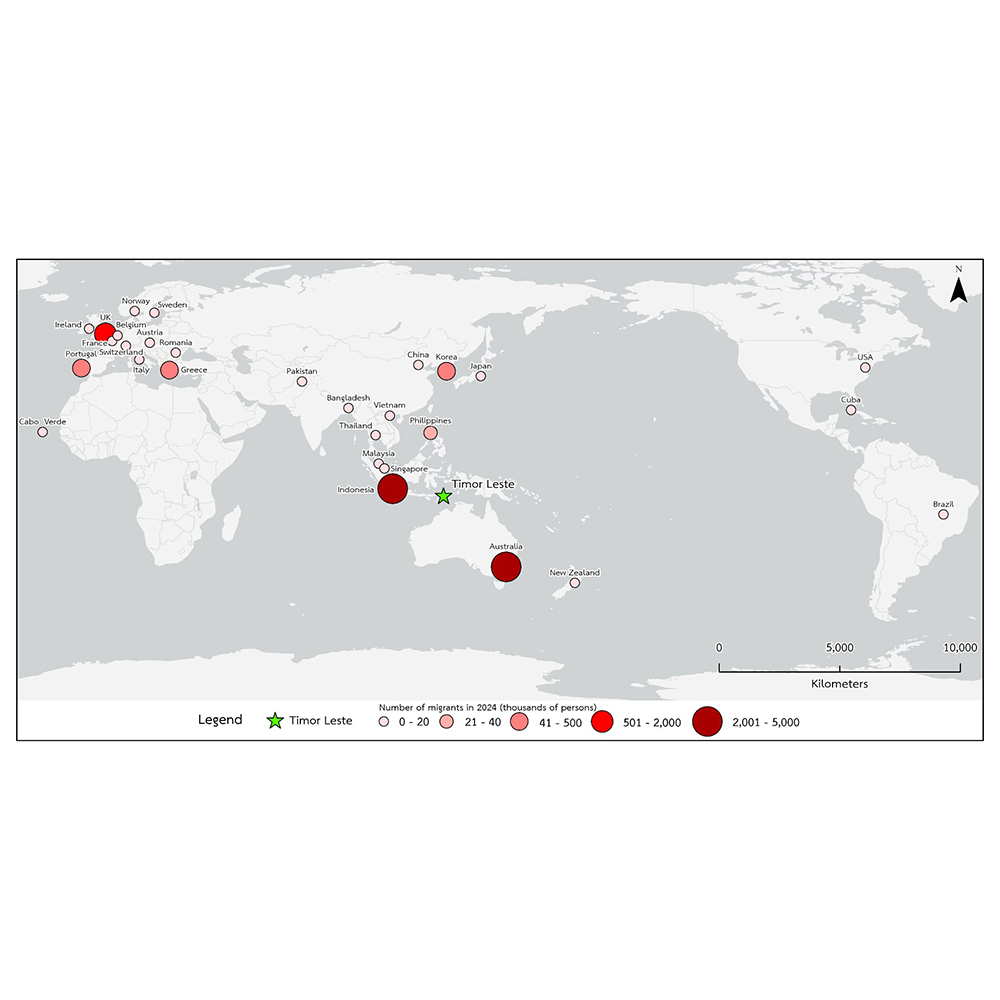
This study investigates the factors that influence international labor migration from Timor-Leste, with a focus on South Korea under the Employment Permit System. An extended gravity model was employed using bilateral migration data for 29 destination countries from 2000 to 2024 to assess the impact of economic size, geographic distance, trade relations, and migration policy regimes on migration flows. Migration is significantly influenced by political factors, such as formal recruitment channels and visa availability, and a positive correlation is observed between migration arrangements and bilateral exports. Furthermore, primary survey data of 250 Timor-Leste migrant workers in South Korea provide micro-level insights into employment outcomes, remittance patterns, and migration motivations. The findings confirm that sectoral recruitment driven by household economic demand and demand in the manufacturing and fishing sectors is a key driver, supported by Korea’s open institutional structure. The policy implications of this study highlight the need for stronger labor governance, better skill development, and diversification of migration routes to ensure safe and productive mobility.
Article Details

This work is licensed under a Creative Commons Attribution-NonCommercial-NoDerivatives 4.0 International License.
References
Acemoglu, D., Johnson, S., & Robinson, J. A. (2002). Reversal of fortune: Geography and institutions in the making of the modern world income distribution. Quarterly Journal of Economics, 117(4), 1231–1294. https://doi.org/10.1162/003355302320935025
Asian Migrant News. (2006). Malaysia, Bali sign MoU on migrant worker recruitment. https://www.gfmd.org/pfp/ppd/2658
Baek S., Lee, Y.-M., Yoon, J.-H., & Wan, J.-U. (2024) Long working hours, work-life imbalance, and poor mental health: A cross-sectional mediation analysis based on the sixth Korean working conditions survey, 2020–2021. Journal of Epidemiology, 34(11), 535–542. https://doi.org/10.2188/jea.JE20230302
Biernacki, P., & Waldorf, D. (1981). Snowball sampling: Problems and techniques of chain referral sampling. Sociological Methods & Research, 10(2), 141–163. https://doi.org/10.1177/004912418101000205
Bryman, A. (2016). Social research methods (5th ed.). Oxford University Press.
Carling, J. (2008). The determinants of migrant remittances. Oxford Review of Economic Policy, 24(3), 581–598. https://www.jstor.org/stable/23606904?seq=1
Castles, S. (2010). Understanding global migration: A social transformation perspective. Journal of Ethnic and Migration Studies, 36(10), 1565–1586. https://doi.org/10.1080/1369183X.2010.489381
Center for Global Development. (2023). Legal migration pathways: The EPS model in South Korea. Employment Permit System. https://gsp.cgdev.org/legalpathway/employment-permit-system-eps
Creswell, J. W., & Creswell, J. D. (2018). Research design: Qualitative, quantitative, and mixed methods approach (5th ed.). SAGE Publications.
Curtain, R. (2023). Timor-Leste’s labour mobility: The Korea connection. Devpolicy Blog, Development Policy Centre. https://devpolicy.org/publications/reports/Curtain-Making-Migration-Work-Pacific-and-Timor-Leste.pdf
de Haas, H. (2019). Paradoxes of migration and development (IMI Working Papers; No. 157), (MADE project paper; No. 9). International Migration Institute. https://www.migrationinstitute.org/publications/paradoxes-of-migration-and-development
DeVellis, R. F. (2017). Scale development: Theory and applications (4th ed.). SAGE Publications.
Docquier, F., Lohest, O., & Marfouk, A. (2007). Brain drain in developing countries. The World Bank Economic Review, 21(2), 193–218. https://doi.org/10.1093/wber/lhm008
Friedberg, R. M., & Hunt, J. (1995). The impact of immigrants on host country wages, employment, and growth. Journal of Economic Perspectives, 9(2), 23–44. https://doi.org/10.1257/jep.9.2.23
Gibson, J., McKenzie, D., & Rohorua, H. (2014). Impacts of temporary migration. Asia & the Pacific Policy Studies, 1(1), 18–32. https://doi.org/10.1002/app5.12
Howes, S. (2022). Submission regarding revisions to the PALM scheme rules (on the merging of SWP and PLS). Development Policy Center, Crawford School of Public Policy, Australian National University. https://devpolicy.org/publications/reports/Howes_PALM-rule-changes-submission_1Feb22.pdf
International Labour Organization. (2014). Review of labour migration policy in Korea: Employment Permit System (EPS). International Labour Organization.
International Monetary Fund. (2020). IMF data. https://www.imf.org/en/Data
Institute. (2020). International migrants by country of destination, 1960–2020. https://www.migrationpolicy.org/programs/data-hub/charts/international-migrants-country-destination-1960-2020
Instituto Nacional de Estatística Timor-Leste, IP. (2022). Thematic report on migration: Population and housing census. https://inetl-ip.gov.tl
Jang, H., Kim, J., & Oh, J. (2025). Balanced regional development in South Korea through immigration, linked with development assistance. Journal of the Asia Pacific Economy, 1–34. https://doi.org/10.1080/13547860.2025.2460851
Kang, S. (2023). Using the Gravity Model to Determine the Impact of Hallyu on International Students’ Decisions to Attend South Korean Universities [Master’s thesis, Korean Universities]. https://scholarship.claremont.edu/cgi/viewcontent.cgi?article=4456&context=cmc_theses
Kim, B., & Oh, J. (2012). A random-effects Tobit model for panel data with many zeros: An application to migration flows. Journal of Economic Development, 37(4), 1–23.
Lawton, H. (2019). The seasonal worker programme: An overview of participation trends and policy changes. Lowy Institute.
Mayda, A. M. (2010). International migration: A panel data analysis of the determinants of bilateral flows. Journal of Population Economics, 23(4), 1249–1274. https://www.jstor.org/stable/40925859
Martin, P., Abella, M., & Kuptsch, C. (2006). Managing labor migration in the twenty-first century. Yale University Press.
McCallum, J. (1995). National borders matter: Canada – U.S. regional trade patterns. American Economic Review, 85(3), 615–623. https://www.jstor.org/stable/2118191?seq=1
McWilliam, A. (2015). Rural–urban inequalities and migration in timor-leste. In S. Ingram, L. Kent, & A. McWiliam (Eds.), A new era? Timor-Leste after the UN (pp. 225–234). Australian National University Press. https://library.oapen.org/bitstream/handle/20.500.12657/32982/578881.pdf? Migration Policy
Min, A. K., Anantsuksomsri, S., & Tontisirin, N. (2023). Relationships Between Thai Language Proficiency and Livelihoods of Myanmar Urban Migrant Workers. Journal of Architectural/Planning Research and Studies, 21(1), 75–96. https://doi.org/10.56261/jars.v21.256500
Ministry of Justice, Republic of Korea. (2021). Immigration statistics. https://www.moj.go.kr
Ministry of Employment and Labor. (2022). Employment Permit System (EPS) guidelines for non-professional (E-9) workers. Ministry of Employment and Labor.
Noy, C. (2008). Sampling knowledge: The hermeneutics of snowball sampling in qualitative research. International Journal of Social Research Methodology, 11(4), 327–344. https://doi.org/10.1080/13645570701401305
Oh, J., & Prasai, L. P. (2012). Does gravity matter? Evidence from Nepal’s trade pattern. International Area Studies Review, 15(2), 161–175. https://doi.org/10.1177/2233865912447086
Organisation for Economic Co-operation and Development. (2020). OECD international development statistics. https://stats.oecd.org
Ortega, F., & Peri, G. (2013). The effect of income and immigration policies on international migration. Migration Studies, 1(1), 47–74. https://doi.org/10.1093/migration/mns004
Respicio, A. (2023). Employment Permit System requirements for work in South Korea. https://www.respicio.ph/commentaries/employment-permit-system-requirements-for-work-in-south-korea
Singleton, R. A., & Straits, B. C. (1999). Approaches to social research (3rd ed.). Oxford University Press.
Smith, J. P., & Edmonston, B. (Eds.). (1997). The new Americans: Economic, demographic, and fiscal effects of immigration. National Academy Press. https://doi.org/10.17226/5779
Taran, P. A., & Geronimi, E. (2003). Globalization, labour and migration: Protection is paramount. International Labour Office. https://elibrary.ru/item.asp?id=19747080
Tashakkori, A., & Teddlie, C. (2010). SAGE handbook of mixed methods in social and behavioral research (2nd ed.). SAGE Publications.
Wasuka, E. (2020, June 30) Plans up in the air as seasonal workers wait for Australia to re-open borders. ABC Pacific Beat https://www.abc.net.au/pacific/programs/pacificbeat/sols-workers-impact/12405058
Wigglesworth, A. (2017). The South Korea Option for Timorese Migrant Workers. Devpolicy Blog, Development Policy Centre. https://devpolicy.org/south-korea-option-timorese-migrant-workers-20171013/
