
The Felt City: Sensory–Cognitive Mapping of Urban Atmospheres in İzmir, Turkey
Article Sidebar
Main Article Content
Abstract
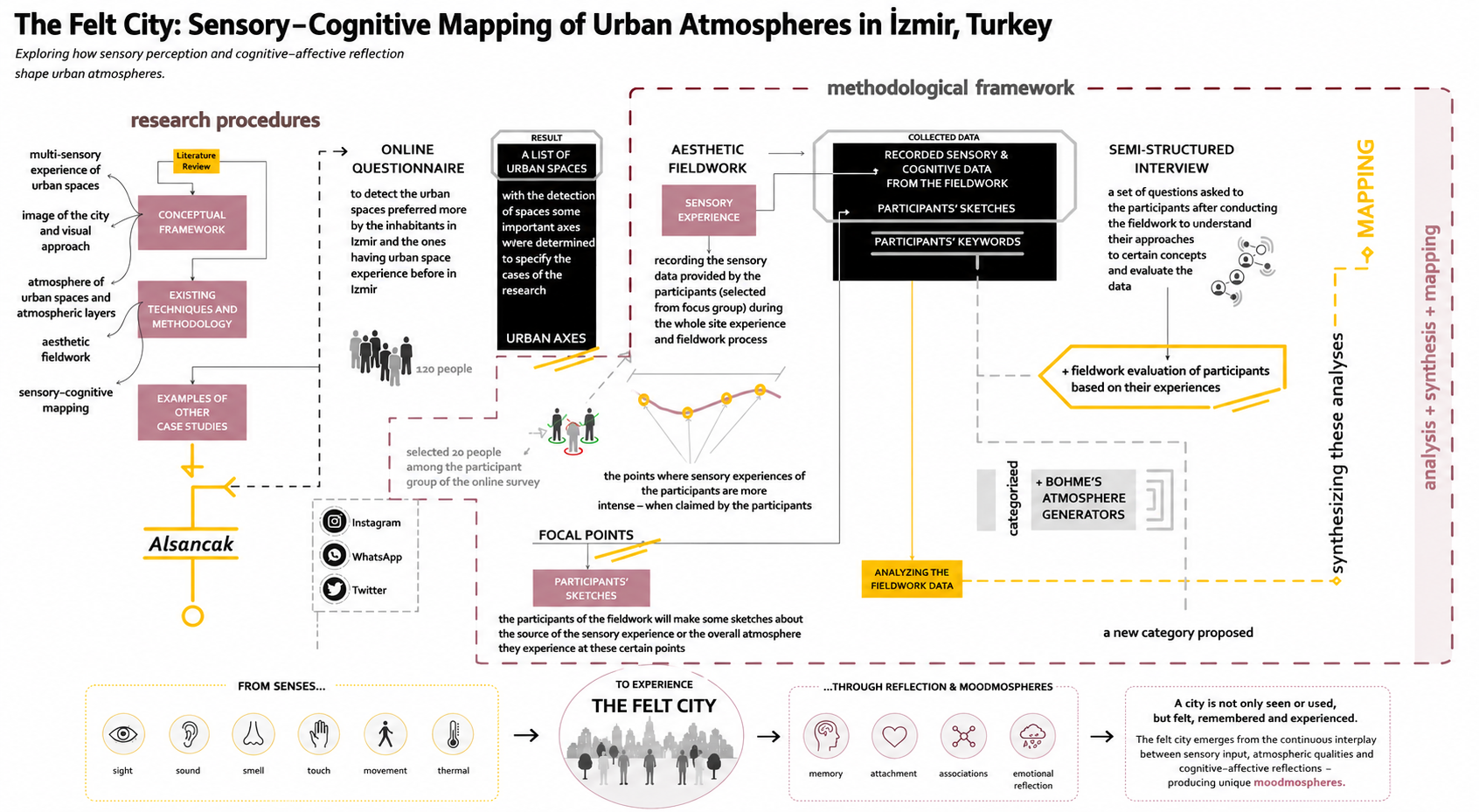
This study investigates the multi-sensory atmospheric qualities of two pedestrian corridors in İzmir, Turkey—Kıbrıs Şehitleri Avenue and Bornova Street—and examines how sensory input interacts with emotional and cognitive processes in shaping urban experience. Using a mixed-methods approach, the research combines an online questionnaire (n = 120) for case selection with in-situ aesthetic fieldwork based on guided walks and semi-structured elicitation (n = 20). The analytical framework is based on Böhme’s concept of atmosphere generators and is further extended through the notion of moodmosphere to capture cognitive–affective interpretations such as memory, attachment, and personal associations. Within this framework, the felt city is understood as an urban condition shaped through the interplay of sensory, cognitive, and affective processes.
The findings reveal a fragmented yet meaningful sensory landscape across both corridors. Visual stimuli emerge as the dominant mode of perception, while auditory and tactile inputs play a secondary role, and olfactory and gustatory cues appear more selectively. Rather than operating independently, sensory inputs are frequently mediated by memory and emotional associations, indicating that urban atmospheres are not only sensed but also cognitively and affectively constructed. Based on these findings, the study proposes a sensory–cognitive mapping approach that integrates subjective experiential data with systematically coded spatial observations. This approach contributes to expanding the understanding of the urban image beyond visually oriented models and supports the development of more integrated, multi-sensory design strategies that strengthen cognitive anchoring and place identity.
Article Details

This work is licensed under a Creative Commons Attribution-NonCommercial-NoDerivatives 4.0 International License.
References
Abusaada, H. (2020). Strengthening the affectivity of atmospheres in urban environments: The toolkit of multi-sensory experience. Archnet-IJAR: International Journal of Architectural Research, 14(3), 379–392. https://doi.org/10.1108/ARCH-03-2020-0039
Akay, A. (2025). Perceptions of landscape quality in the historic city center of Konya, Türkiye: A multi-site user satisfaction analysis. Nakhara: Journal of Environmental Design and Planning, 24(3), Article 520. https://doi.org/10.54028/NJ202524520
Albertsen, N. (2019). Urban atmospheres. Ambiances, Redécouvertes, 29(4), 5–29. http://journals.openedition.org/ambiances/2433
Bakan, Ömer C., Engin, D., & Ek, F. İpek. (2024). The mapping of sensemaking territories through physical and social media: A case of the historical bazaar of Kemeraltı, Izmir. Nakhara: Journal of Environmental Design and Planning, 23(3), Article 419. https://doi.org/10.54028/NJ202423419
Bell, D. A., & De-Shalit, A. (2011). The spirit of cities: Why the identity of a city matters in a global age. Princeton University Press. https://archive.org/details/spiritofcitieswh0000bell/page/n3/mode/2up
Benjamin, W. (2005). Little history of photography. In M. W. Jennings, H. Eiland, & G. Smith (Eds.), Walter Benjamin: Selected writings volume 2: Part 2: 1931–1934 (pp. 507–530). Belknap Press. https://monoskop.org/images/0/0e/Benjamin_Walter_1931_1999_Little_History_of_Photography.pdf
Benjamin, W. (2007). Illuminations (H. Zohn, Trans.). Schocken. https://voidnetwork.gr/wp-content/uploads/2016/08/Illuminations-Essays-and-Reflections-Walter-Benjamin-edit-by-Hannah-Arendt-Harry-Zohn.pdf
Berleant, A. (1992). The aesthetics of environment. Temple University Press. https://www.jstor.org/stable/j.ctt14bs997
Bille, M., & Simonsen, K. (2021). Atmospheric practices: On affecting and being affected. Space and Culture, 24(2), 295–309. https://doi.org/10.1177/1206331218819711
Böhme, G. (1993). Atmosphere as the fundamental concept of a new aesthetics. Thesis Eleven, 36(1), 113–126. https://doi.org/10.1177/072551369303600107
Böhme, G. (2013). Atmosphere as mindful physical presence in space. OASE, 91, 21–32. https://oasejournal.nl/en/issue/building-atmosphere/atmoshere-as-mindful-physical-presence-in-space/
Böhme, G. (2014). Urban atmospheres: Charting new directions for architecture and urban planning. In C. Borch (Ed.), Architectural atmospheres: On the experience and politics of architecture (pp. 42–59). Birkhäuser. https://doi.org/10.1515/9783038211785.42
Böhme, G. (2017). The aesthetics of atmospheres (J.-P. Thibaud, Ed.). Routledge.
Calvino, I. (1974). Invisible cities (W. Weaver, Trans.). Harcourt Brace & Company. https://tehne.com/assets/i/upload/library/italo-calvino-invisible-cities-1974.pdf
Dai, T., & Zheng, X. (2021). Understanding how multi-sensory spatial experience influences atmosphere, affective city image and behavioural intention. Environmental Impact Assessment Review, 89, Article 106595. https://doi.org/10.1016/j.eiar.2021.106595
Debord, G. (1958). Theory of the dérive. Visual Culture: Spaces of Visual Culture, 3, 77–82.
Edensor, T. (2012). Atmospheres and the matter of perception: Weather, affect and memory. In P. Simpson & B. Anderson (Eds.), Affective atmospheres (pp. 110–126). Ashgate.
Gandy, M. (2017). Urban atmospheres. Cultural Geographies, 24(3), 353–374. https://doi.org/10.1177/1474474017712995
Gehl, J. (2010). Cities for people. Island Press. https://fenix.tecnico.ulisboa.pt/downloadFile/3378318195828806/Cities_For_People_-_Jan_Gehl.pdf
Goeritz, M. (1953). Manifiesto de la arquitectura emocional [Manifesto of Emotional Architecture]. Unam. https://eleco.unam.mx/manifiesto-de-la-arquitectura-emocional-1953/
Griffero, T. (2010). Atmospheres: Aesthetics of emotional spaces. Routledge. https://www.routledge.com/Atmospheres-Aesthetics-of-Emotional-Spaces/Griffero/p/book/9781138247710
Griffero, T. (2019). Pathicity: Experiencing the world in an atmospheric way. Open Philosophy, 2(1), 414–427. https://www.degruyterbrill.com/document/doi/10.1515/opphil-2019-0031/html?srsltid=AfmBOor1LsGBY5UMAymWl5inefvgLzYNfnleXrKu3mYKAYK51oQubfrx
Hasse, J. (2019). Atmospheres and moods: Two modes of being-with. In T. Griffero & G. Moretti (Eds.), Atmosphere and aesthetics: A plural perspective (pp. 77–92). Palgrave Macmillan. https://link.springer.com/book/10.1007/978-3-030-24942-7
Hirschfeld, C. C. L. (1779–1785). Theorie der Gartenkunst [Theory of Garden Art] (Vols. 1–5). Weidmanns Erben und Reich.
İzmir Metropolitan Municipality. (2024). Re-value horizon project presentation [Project report]. https://www.izmir.bel.tr/tr/Projeler/horizon-europe---re---value-projesi/2744/4
Jhearmaneechotechai, P. (2025). A framework for ordinary urban heritage mapmaking: The case of Trok in Rattanakosin, Bangkok’s historic center. Nakhara: Journal of Environmental Design and Planning, 24(2), Article 512. https://doi.org/10.54028/NJ202524512
Johnson, M. (2007). The meaning of the body: Aesthetics of human understanding. University of Chicago Press. https://press.uchicago.edu/ucp/books/book/chicago/M/bo5417890.html
Lefebvre, H. (1991). Critique of everyday life (J. Moore, Trans.). Verso. https://chisineu.wordpress.com/wp-content/uploads/2012/08/lefebvre-henri-the-critique-of-everyday-life-vol-1.pdf
Lentini, L., & Decortis, F. (2010). Space and places: When interacting with and in physical space becomes a meaningful experience. Personal and Ubiquitous Computing, 14, 407–415. https://doi.org/10.1007/s00779-009-0267-y
Low, K. E. Y. (2015). The sensuous city: Sensory methodologies in urban ethnographic research. Ethnography, 16(3), 295–312. https://doi.org/10.1177/1466138114552938
Lynch, K. (1960). The image of the city. MIT Press. https://archive.org/details/imageofcity00lync
Merleau-Ponty, M. (2005). Phenomenology of perception (C. Smith, Trans.). Routledge. https://voidnetwork.gr/wp-content/uploads/2016/09/Phenomenology-of-Perception-by-Maurice-Merleau-Ponty.pdf
Montgomery, J. (1998). Making a city: Urbanity, vitality and urban design. Journal of urban design, 3(1), 93–116. https://doi.org/10.1080/13574809808724418
Norberg-Schulz, C. (1980). Genius loci: Towards a phenomenology of architecture. Rizzoli. https://archive.org/details/geniuslocitoward0000norb/page/4/mode/2up
Pallasmaa, J. (2012). The eyes of the skin: Architecture and the senses. John Wiley. https://archive.org/details/eyesofskinarchit0000pall
Pallasmaa, J. (2014). Space, place and atmosphere: Emotion and peripheral perception in architectural experience. Lebenswelt, 4(1), 230–245. https://doi.org/10.13130/2240-9599/4202
Pallasmaa, J. (2016). The sixth sense: The meaning of atmosphere and mood. Architectural Design, 86(6), 126–133. https://doi.org/10.1002/ad.2121
Pallasmaa, J. (2017). Touching the world: Vision, hearing, hapticity and atmospheric perception. In Proceedings of Invisible Places: Sound, Urbanism and Sense of Place (pp. 15–28). Invisible Places. http://invisibleplaces.org/2017/pdf/Pallasmaa.pdf
Peca Amaral Gomes, A. (2023). Invisible city: A multi-sensory approach to the analysis of urban space [Doctoral dissertation, University College London]. https://discovery.ucl.ac.uk/id/eprint/10164380/
Pink, S., & Sumartojo, S. (2018). Atmospheres and the experiential world: Theory and methods. Routledge. https://doi.org/10.4324/9781315281254
Rapoport, A. (1977). Human aspects of urban form. Pergamon Press. https://doi.org/10.1016/C2013-0-02616-3
Rauh, A. (2019). The atmospheric whereby: Reflections on subject and object. Open Philosophy, 2(1), 147–159. https://doi.org/10.1515/opphil-2019-0017
Schmitz, H. (1969). System der philosophie/3,2: Der gefühlsraum. Bouvier.
Schmitz, H. (2016). Atmospheric spaces. Ambiances. Environnement sensible, architecture et espace urbain, 17–30. https://doi.org/10.4000/ambiances.711
Simmel, G. (1997). Sociology of the senses. In D. Frisby & M. Featherstone (Eds.), Simmel on culture: Selected writings (pp. 109–119). Sage. https://archive.org/details/simmeloncultures0000simm/page/n5/mode/2up
Simmel, G. (2002). The metropolis and mental life. In G. Bridge & S. Watson (Eds.), The Blackwell city reader (pp. 11–19). Blackwell Publishers. https://www.blackwellpublishing.com/content/bpl_images/content_store/sample_chapter/0631225137/bridge.pdf
Thibaud, J.-P. (2001). La méthode des parcours commentés [The commented walks method]. In M. Grosjean & J.-P. Thibaud (Eds.), L’espace urbain en méthodes (pp. 79–99). Éditions Parenthèses.
Thibaud, J.-P. (2012). The city through the senses. Cadernos Proarq, 18, 1–16. https://cadernos.proarq.fau.ufrj.br/public/docs/Proarq18_TheCity_JeanThibaud.pdf
Thibaud, J.-P. (2015). The backstage of urban ambiances: When atmospheres pervade everyday experience. Emotion, Space and Society, 15, 39–46. https://doi.org/10.1016/j.emospa.2014.07.001
Urry, J. (2011). City life and the senses. In G. Bridge & S. Watson (Eds.), The new blackwell companion to the city (pp. 347–356). Wiley-Blackwell. https://doi.org/10.1002/9781444395105.ch30
Üstün, Ç. D. (2025). Mapping the multi-sensory image of urban atmospheres: Case of Alsancak [Master’s thesis, Yaşar University, İzmir, Turkey].
Wang, Z. (2023). Atmosphere and moodmospheric experience: Fusion of corporeality, spirituality and culturality. Art Style | Art & Culture International Magazine, 11(11), 59–76. https://zenodo.org/records/7647600
Zumthor, P. (2006). Atmospheres: Architectural environments – Surrounding objects. Birkhäuser. https://birkhauser.com/en/book/9783764374952
