
Outside-the-Office Environments as Innovation Enablers: Spatial Behavior and Psychological Outcomes in Thailand Science Park
Article Sidebar
Main Article Content
Abstract
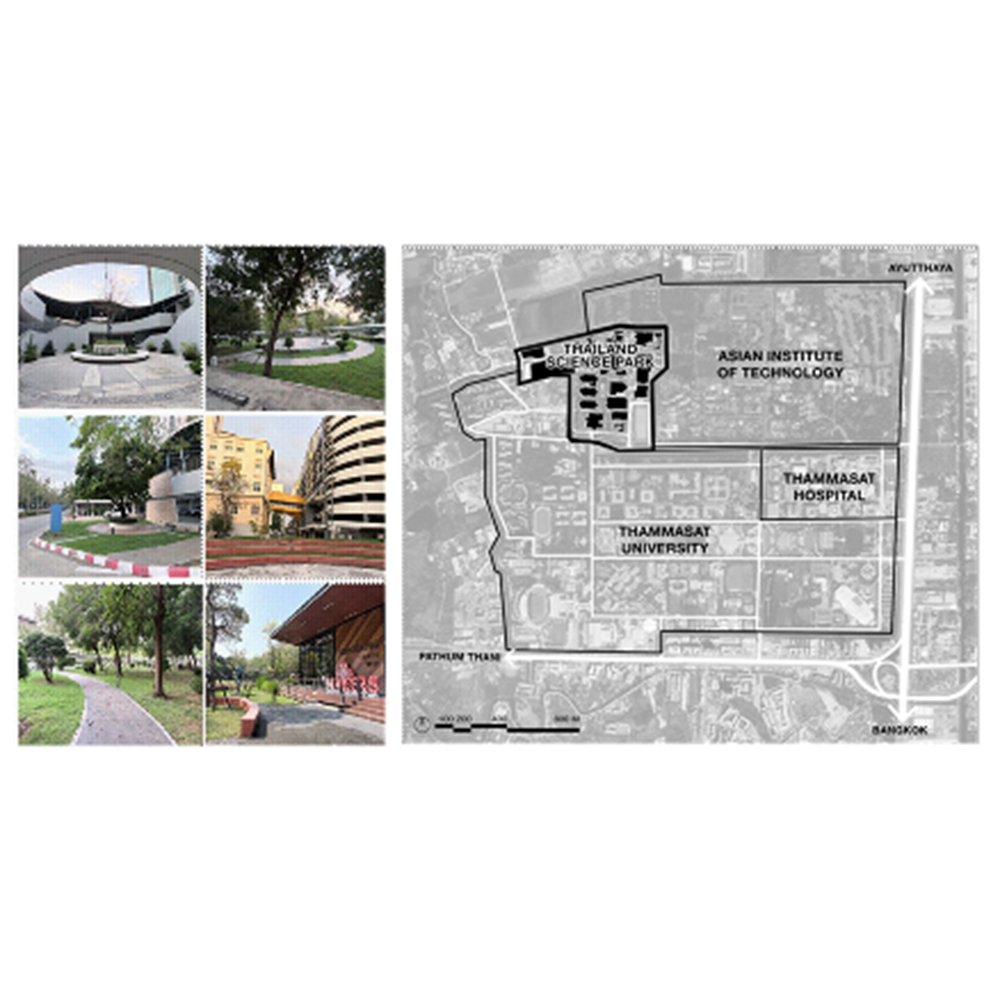
In a dynamic shift transforming modern workplaces, science parks are now embracing vibrant semi-public and outdoor spaces that spark collaboration, ignite creativity, and elevate employee well-being from the moment one steps onto the campus. However, the presence of such spaces does not automatically translate into behavioral use or innovation-related benefits. This study investigates how outside-the-office environments contribute to innovation-related psychological outcomes among knowledge workers, with particular attention to the mediating role of spatial behavior. Using Thailand Science Park as an empirical case of a campus-based innovation environment, the research examines how everyday spatial practices influence work engagement, creativity, and work well-being. A quantitative research design was employed, combining spatial case analysis with survey data from 262 knowledge workers. Data was analyzed using multivariate statistics and structural equation modeling. Results reveal that moderate daily exposure (1–2 hours) to outside-the-office spaces significantly enhanced creativity and well-being, while heavy reliance on formal offices constrained these states. Informal exchange was the only activity directly predicting creativity and engagement. Importantly, the results highlight spatial behavior as a systemic mediating mechanism through which designed environmental affordances become realized experiential outcomes. The findings suggest that semi-public and outdoor areas should be designed as functional extensions of the workplace, emphasizing climate-sensitive courtyards and socially permeable, circulation-integrated micro-restoration spaces. In hot-humid science park contexts, such strategies can unlock underutilized spaces and support innovation-oriented work environments.
Article Details

This work is licensed under a Creative Commons Attribution-NonCommercial-NoDerivatives 4.0 International License.
References
Alhusen, H., Bennat, T., Bizer, K., Cantner, U., Horstmann, E., Kalthaus, M., Proeger, T., Sternberg, R., & Töpfer, S. (2022). A new measurement conception for the ‘doing-using-interacting’ mode of innovation. Research Policy, 50(4), Article 104214. https://doi.org/10.1016/j.respol.2021.104214
Alias, Z., Mohamed Mohan, N. M., Abdol Ghani, M. R., Saad, M., & Abdullah, M. (2023). Crime prevention through environmental design for low-income residents (B40) in Sabah, Malaysia. Nakhara: Journal of Environmental Design and Planning, 22(3), Article 318. https://doi.org/10.54028/NJ202322318
Amabile, T. M., & Kramer, S. J. (2011). The progress principle: Using small wins to ignite joy, engagement, and creativity at work. Harvard Business School Press.
Amabile, T. M., & Pratt, M. G. (2016). The dynamic componential model of creativity and innovation in organizations: Making progress, making meaning. Research in Organizational Behavior, 36, 157–183. https://doi.org/10.1016/j.riob.2016.10.001
Appel-Meulenbroek, R., de Vries, B., & Weggeman, M. (2017). Knowledge sharing behavior: The role of spatial design in buildings. Environment and Behavior, 49(8), 874–903. https://doi.org/10.1177/0013916516673405
Bousbia Laiche, A., Dahlan, N. D., Shari, Z., & Zaky Jaafar, M. F. (2023). Perception of overall quality of life among occupants of green and non-green office buildings in Malaysia. Nakhara: Journal of Environmental Design and Planning, 22(1), Article 307. https://doi.org/10.54028/NJ202322307
Brown, J. (2017). Curating the “third place”? Coworking and the mediation of creativity. Geoforum, 82, 112–126. https://doi.org/10.1016/j.geoforum.2017.04.006
Cabra, J. F., & Guerrero, C. D. (2022). Regional creativity: Cultural and socio-economic differences. Journal of Creativity, 32(2). http://dx.doi.org/10.1093/acprof:oso/9780195333213.001.0001
Dul, J., Ceylan, C., & Jaspers, F. (2011). Knowledge workers’ creativity and the role of the physical work environment. Human Resource Management, 50(6), 715–734. https://doi.org/10.1002/hrm.20454
Eismann, T., Pakos, O., Rücker, M., Meinel, M., Maier, L., & Voigt, K. I. (2021). Understanding the mechanisms of activity-based workspaces: A case study. Environment and Behavior, 54(1), 170–210. https://doi.org/10.1177/00139165211008240
Esmaeilpoorarabi, N., Yigitcanlar, T., & Guaralda, M. (2018). Place quality in innovation clusters: An empirical analysis of global best practices from Singapore, Helsinki, New York, and Sydney. Cities, 74, 156–168. https://doi.org/10.1016/j.cities.2017.11.017
Gibson, J. J. (1979). The ecological approach to visual perception. Houghton Mifflin.
Granstrand, O., & Holgersson, M. (2020). Innovation ecosystems: A conceptual review and a new definition. Technovation,90–91, Article 102098. https://doi.org/10.1016/j.technovation.2019.102098
Hadavi, S., Kaplan, R., & Hunter, M. (2015). Environmental affordances: A practical approach for design of nearby outdoor settings in urban residential areas. Landscape and Urban Planning, 134, 19–32. https://doi.org/10.1016/j.landurbplan.2014.10.001
Heerwagen, J. H., Kampschroer, K., Powell, K. M., & Loftness, V. (2004). Collaborative knowledge work environments. Building Research & Information, 32(6), 510–528. https://doi.org/10.1080/09613210412331313025
Hutchins, E. (1995). Cognition in the wild. MIT Press.https://doi.org/10.7551/mitpress/1881.001.0001
Janjamlah, T., & Kaewlai, P. (2018). Spatial behavior in creative workplace: Mapping creative and innovative behavior in office environment. Journal of Architectural/Planning Research and Studies (JARS), 15(1), 97–112. https://doi.org/10.56261/jars.v15i1.156274
Janpathompong, S., & Murakami, A. (2021). Understanding Thai urban pedestrian culture during noon break: How sidewalk users experience the walking infrastructure in Bangkok, Thailand. Nakhara: Journal of Environmental Design and Planning, 20(3), Article 115. https://doi.org/10.54028/NJ202120115
Janpathompong, S., Tontisirin, N., & Murakami, A. (2022). How far people walk during lunchtime: Comparing actual and perceived walking distances in the Central Business District of Bangkok, Thailand. Nakhara: Journal of Environmental Design and Planning, 21(3), Article 227. https://doi.org/10.54028/NJ202221227
Jens, K., & Gregg, J. S. (2021). How design shapes space choice behaviors in public urban and shared indoor spaces: A review. Sustainable Cities and Society, 65, Article 102592. https://doi.org/10.1016/j.scs.2020.102592
Kaplan, S. (1995). The restorative benefits of nature: Toward an integrative framework. Journal of Environmental Psychology, 15(3), 169–182. https://doi.org/10.1016/0272-4944(95)90001-2
Lee, J. H., & Lee, S. (2023). Relationships between physical environments and creativity: A scoping review. Thinking Skills and Creativity, 48, Article 101276. https://doi.org/10.1016/j.tsc.2023.101276
Lee, K. E., Williams, K. J. H., Sargent, L. D., Williams, N. S. G., & Johnson, K. A. (2015). 40-second green roof views sustain attention: The role of micro-breaks in attention restoration. Journal of Environmental Psychology, 42, 182–189. https://doi.org/10.1016/j.jenvp.2015.04.003
Luthans, F., Avolio, B. J., Avey, J. B., & Norman, S. M. (2007). Positive psychological capital: Measurement and relationship with performance and satisfaction. Personnel Psychology, 60(3), 541–572. https://doi.org/10.1111/j.1744-6570.2007.00083.x
Mahdad, M., Minh, T. T., Bogers, M. L. A. M., & Piccaluga, A. (2020). Joint university-industry laboratories through the lens of proximity dimensions: Moving beyond geographical proximity. International Journal of Innovation Science, 12(4), 433–456. https://doi.org/10.1108/IJIS-10-2019-0096
Meijman, T. F., & Mulder, G. (1998). Psychological aspects of workload. In P. J. D. Drenth, H. Thierry, & C. J. de Wolff (Eds.), Handbook of work and organizational psychology (2nd ed., pp. 5–33). Psychology Press. https://doi.org/10.7551/mitpress/1881.001.0001
Moultrie, J., Nilsson, M., Dissel, M., Haner, U. E., Janssen, S., & van der Lugt, R. (2007). Innovation spaces: Towards a framework for understanding the role of the physical environment in innovation. Creativity and Innovation Management, 16(1), 53–65. https://doi.org/10.1111/j.1467-8691.2007.00419.x
Mäkikangas, A., Juutinen, S., Mäkiniemi, J. -P., Sjöblom, K., & Oksanen, A. (2022). Work engagement and its antecedents in remote work: A person-centered view. Work & Stress, 36(4), 392–416. https://doi.org/10.1080/02678373.2022.2080777
Nagayama, K. (2023). Does working at third places work? Multi-locational work for engagement, creativity, and well-being. Journal of Creativity, 33(3), https://doi.org/10.1016/j.yjoc.2023.100070
Oldenburg, R. (1999). The great good place: Cafés, coffee shops, bookstores, bars, hair salons and other hangouts at the heart of a community. Marlowe.
Pancholi, S., Yigitcanlar, T., & Guaralda, M. (2019). Place making for innovation and knowledge-intensive activities: The Australian experience. Technological Forecasting and Social Change, 146, 616–625. https://doi.org/10.1016/j.techfore.2017.09.014
Pancholi, S., Yigitcanlar, T., Guaralda, M., Mayere, S., Caldwell, G. A., & Medland, R. (2020). University and innovation district symbiosis in the context of placemaking: Insights from Australian cities. Land Use Policy, 99, Article 105109. https://doi.org/10.1016/j.landusepol.2020.105109
Peponis, J., Bafna, S., Bajaj, R., Bromberg, J., Congdon, C., Rashid, M., & Warmels, S. (2007). Designing space to support knowledge work. Environment and Behavior, 39(6), 815–840. https://doi.org/10.1177/0013916506297216
Qiu, X. W., Yan, X. C., & Lv, Y. L. (2015). The effect of psychological capital and knowledge sharing on innovation performance for professional technical employees. Journal of Service Science and Management, 8(4), 545–551. https://doi.org/10.4236/jssm.2015.84055
Ratcliffe, E., Gatersleben, B., Sowden, P. T., & Korpela, K. (2021). Understanding the perceived benefits of nature for creativity. Journal of Creative Behavior, 56(2), 215–231. https://doi.org/10.1002/jocb.525
Riratanaphong, C., & Narmwiset, N. (2023). Employees’ appraisal of workplace changes during COVID-19: Findings from a state-owned oil and gas company. Nakhara: Journal of Environmental Design and Planning, 22(1), Article 306. https://doi.org/10.54028/NJ202322306
Ryan, R. M., & Deci, E. L. (2001). On happiness and human potentials: A review of research on hedonic and eudaimonic well-being. Annual Review of Psychology, 52, 141–166. https://doi.org/10.1146/annurev.psych.52.1.141
Schaufeli, W. B., Salanova, M., González-Romá, V., & Bakker, A. B. (2002). The measurement of engagement and burnout: A two sample confirmatory factor analytic approach. Journal of Happiness Studies, 3, 71–92. https://doi.org/10.1023/A:1015630930326
Scott, A. J. (2010). Cultural economy and the creative field of the city. Geografiska Annaler: Series B, Human Geography, 92(2), 115–130. https://doi.org/10.1111/j.1468-0467.2010.00337.x
Soares, I., Venhorst, V., Weitkamp, G., & Yamu, C. (2022). The impact of the built environment on creativity in public spaces of Dutch university campuses and science parks. Journal of Urban Design, 27(1), 91–109. https://doi.org/10.1080/13574809.2021.1945433
Sonnentag, S., Venz, L., & Casper, A. (2017). Advances in recovery research: What have we learned? What should be done next? Journal of Occupational Health Psychology, 22(3), 365–380. https://doi.org/10.1037/ocp0000079
Spinuzzi, C. (2012). Working alone together: Coworking as emergent collaborative activity. Journal of Business and Technical Communication, 26(4), 399–441. https://doi.org/10.1177/1050651912444070
Srirahayu, D. P., Ekowati, D., & Sridadi, A. S. (2023). Innovative work behavior in public organizations: A systematic literature review. Heliyon, 9(2), Article e13557. https://doi.org/10.1016/j.heliyon.2023.e13557
Srisuwon, S., & Anantsuksomsri, S. (2025). Impacts of COVID-19 on coworking spaces in Bangkok. International Review for Spatial Planning and Sustainable Development, 13(2), 111–128. http://dx.doi.org/10.14246/irspsd.13.2_111
Weijs-Perrée, M., Appel-Meulenbroek, R., & Arentze, T. (2020). Location type choice for face-to-face interactions in business centers. Environment and Behavior, 52(7), 761–794. https://doi.org/10.1177/0013916518819715
White, M. P., Alcock, I., Grellier, J., Wheeler, B. W., Hartig, T., Warber, S. L., Bone, A., Depledge, M. H., & Fleming, L. E. (2019). Spending at least 120 minutes a week in nature is associated with good health and wellbeing. Scientific Reports, 9, Article 7730. https://doi.org/10.1038/s41598-019-44097-3
Wright, T. A., & Huang, C. -C. (2012). The many benefits of employee well-being in organizational research. Journal of Organizational Behavior, 33(8), 1188–1192. https://doi.org/10.1002/job.1828
