
From Tradition to Adaptation: Spatial Transformation of Kyoto Machiya
Article Sidebar
Main Article Content
Abstract
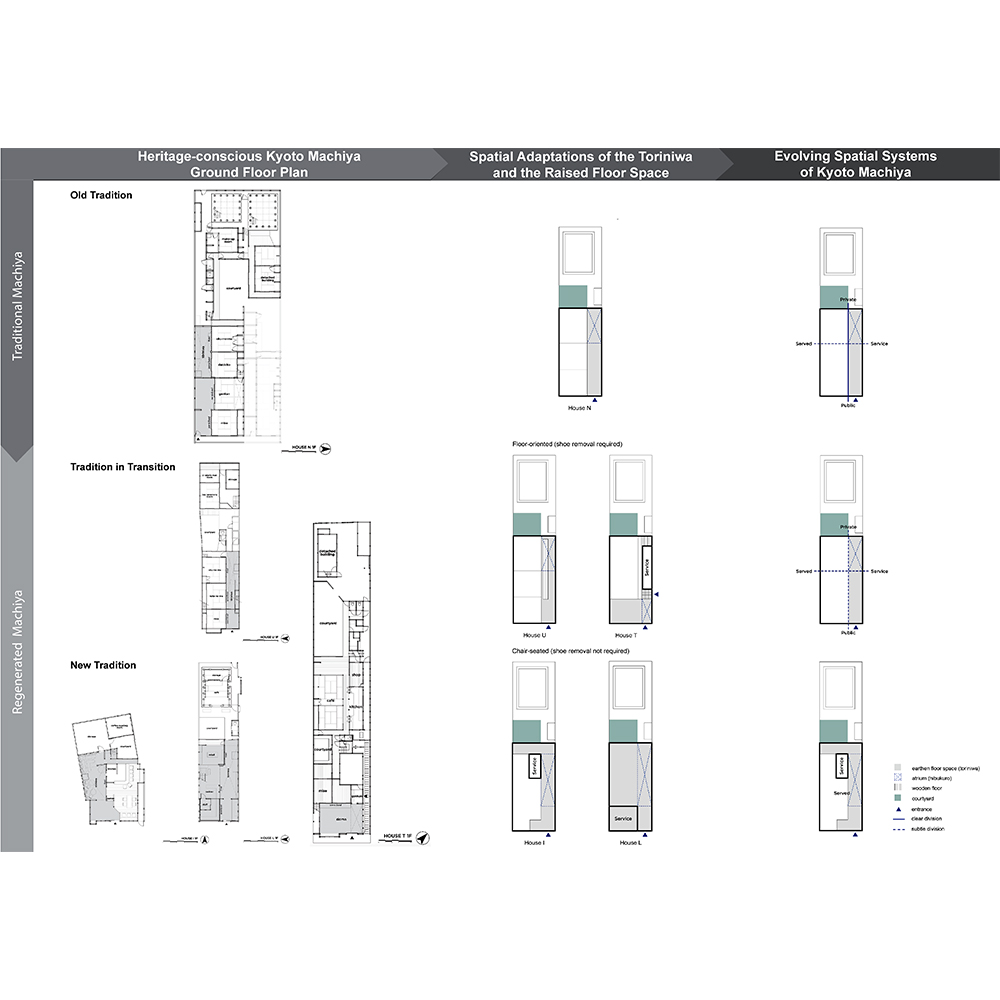
This study investigates the spatial adaptations of everyday Japanese dwellings in Kyoto, known as machiya. Employing Hall’s proxemics theory, it analyzes five heritage-conscious machiya through field surveys and comparative case analyses. The research focuses on the transformation of the earthen floor space, or tōriniwa, its relationship with the raised floor space, and the resultant spatial systems in regenerated machiya.
Findings reveal that traditional machiya are structured by a clear dichotomy between the raised floor/served space and the earthen floor/service space, reinforced by level changes, materials, spatial boundaries, and socio-cultural practices. This is complemented by a subtle spatial gradient from public working to private living quarters, articulated through linear and compartmentalized layouts. Regenerated machiya, however, demonstrate strategic adaptations: dissolving this dichotomy by lowering raised floors, expanding either floor zone, minimizing boundaries, and introducing free-flow layouts to facilitate public, guest-centric use without footwear transitions. Crucially, the nature of the program, i.e. public vs. private, proves more decisive for spatial organization than the number of functions, a significant shift from prior research emphases.
The study concludes that the tōriniwa endures as the architectural and cultural spine, enabling spatial integration. A layered approach to adaptation is key: heritage-focused interventions preserve the external skin for townscape harmony while actively modifying internal space plans and infill. This demonstrates machiya regeneration as a sustainable model of adaptable architecture, where cultural continuity is achieved through the innovative reinterpretation of spatial principles to extend building lifecycles and enhance community resilience.
Article Details

This work is licensed under a Creative Commons Attribution-NonCommercial-NoDerivatives 4.0 International License.
References
Black, A. K., Ross, B. E., & Rockow, Z. (2019). Identifying physical features that facilitate and impede building adaptation. In R.J. Howlett (Ed.), Sustainability in energy and buildings 2018: Proceedings of the 10th international conference in sustainability on energy and buildings (SEB’18) 10 (pp. 52–62). Springer International Publishing. https://doi.org/10.1007/978-3-030- 04293-6_6
Boonprasong, P. (2022). Brief for changing of use of old buildings. Salapimpakarn.
Brand, S. (1995). How buildings learn: What happens after they're built. Penguin.
Brumann, C. (2009). Outside the glass cases: The social life of urban heritage in Kyoto. American Ethnologist, 36(2), 276–299. https://www.jstor.org/stable/27667562
Dhanakoses, K., Povatong, P., Wongphyat, W., & Wiriyakraikul, C. (2023). Building adaptations and laboratory safety concerns: A case study of high-rise academic laboratories in a Thai university. Nakhara: Journal of Environmental Design and Planning, 22(2), Article 312. https://doi.org/10.54028/NJ202322312
Duffy, F. (1990). Measuring building performance. Facilities, 8(5), 17–20. https://doi.org/10.1108/eum0000000002112
Femenias, P., & Geromel, F. (2019). Adaptable housing? A quantitative study of contemporary apartment layouts that have been rearranged by end-users. Journal of Housing and the Built Environment, 35(2), 481–505. https://doi.org/10.1007/s10901-019-09693-9
Hall, E. T. (1969). The hidden dimension. Anchor Books.
Hanaoka, T. (2019). Machiya: The traditional townhouse of Kyoto. Pie International.
Huuhka, S., & Vestergaard, I. (2020). Building conservation and the circular economy: A theoretical consideration. Journal of Cultural Heritage Management and Sustainable Development, 10(1), 29–40. https://doi.org/10.1108/JCHMSD-06-2019-0081
Intaraksa, S., & Ongsavangchai, N. (2022). Urban identity represented by concept stores converted from machiya in central Kyoto. Journal of Culture Research, 25, 233–253. https://doi.org/10.14456/jucr.2022.31
Jhearmaneechotechai, P. (2022). Selection criteria of ordinary urban heritages through the case of Bangrak, a multi-cultural & old commercial district of Bangkok. Nakhara: Journal of Environmental Design and Planning, 21(2), Article 209. https://doi.org/10.54028/NJ202221209
Kawashima, C. (1986). Minka: Traditional house of rural Japan. Kodansha: International.
Khalaf, M. (2016). Urban heritages and vernacular studies parallel evolution and shared challenges. International Society for the Study of Vernacular Settlements, 4(3), 39–51. https://isvshome.com/pdf/ISVS_4-2/ISVS%20Vol4issue2paper4.pdf
Kyomachiya Sakujigumi (2019). Machiya saisei no waza to chie [Technique and wisdom for regenerating townhouses]. 2nd edition. Gakugei Publishing.
Löfgren, K. (2003). Machiya: History and architecture of the Kyoto town house. School of Architecture, KTH Royal Institute of Technology.
Luoma-Halkola, L., Kyrö, R., & Peltokorpi, A. (2019). Connecting adaptability strategies to building system lifecycles in hospital retrofits. Engineering Construction & Architectural Management, 26(6), 1–17. https://doi.org/10.1108/ECAM-10-2017-0217?urlappend=%3Futm_source%3Dresearchgate.net%26medium%3Darticle
Mizuta, S., & Kanemoto, Y. (2021). Mise in townhouses in seventeenth-century Japan: Their fittings, measurements and spatial transformation. Journal of Asian Architectural and Building Engineering, 21(3), 677–688. https://doi.org/10.1080/13467581.2021.1883030
Nakagawa, T. (2005). The Japanese house: In space, memory, and language. International House of Japan.
Nascimento, D.M. (2012). N.J. Habraken explains the potential of the Open Building approach in architectural practice. Open House International, 37(4), 5–13. https://doi.org/10.1108/OHI-04-2012-B0001?urlappend=%3Futm_source%3Dresearchgate.net%26medium%3Darticle
Orbasli, A. (2000). Tourists in historic towns: Urban conservation and heritage management. E&EN Spon.
Paramita, K., Indraprastha, A., Hariyadi, A., Yatmo, Y. A., Atmodiwirjo, P., & Suryantini, R. (2025). Tradition and modernity: The adaptation of outdoor spaces in traditional Balinese dwelling. Nakhara: Journal of Environmental Design and Planning, 24(2), Article 514. https://doi.org/10.54028/NJ202524514
Poulios, I. (2014). Discussing strategy in heritage conservation: Living heritage approach as an example of strategic innovation. Journal of Cultural Heritage Management and Sustainable Development, 4(1), 16–34. https://doi.org/10.1108/JCHMSD-10-2012-0048
Ross, B.E., Chen, D.A., Conejos, S., & Khademi, A. (2016). Enabling adaptable buildings: Results of a preliminary expert survey. Procedia Engineering, 145, 420-427. https://doi.org/10.1016/j.proeng.2016.04.009
Saarimaa, S., & Pelsmakers, S. (2020). Better living environment today, more adaptable tomorrow? Comparative analysis of Finnish apartment buildings and their adaptable scenarios. Yhdyskuntasuunnittelu, 58(2), 33–58. https://doi.org/10.33357/ys.89676
Schmidt III, R., & Austin, S. (2016). Adaptable architecture: Theory and practice. Routledge.
Schmidt III, R., Eguchi, T., Austin, S., & Gibb, A. (2010). What is the meaning of adaptability in the building industry? In J. A. Chica, P. Elguezabal, S. Meno, & A. Amundarain, Proceedings of the 16th international conference of the CIB W104 open building implementation on “Open and Sustainable Building (pp. 233–242). Labein Tecnalia. https://ris.utwente.nl/ws/portalfiles/portal/2469317 38/O_SB2010proceedings.pdf
Schneider, T., & Till, J. (2005). Flexible housing: Opportunities and limits. Architectural Research Quarterly, 9(2), 157–166. https://doi.org/10.1017/S1359135505000199
Spoormans, L. (2018). Adapting traditional machiya to a contemporary lifestyle. In M.-T. van Thoor, & S. Stroux (Eds.), Heritage, history and design between East and West: a close-up on Kyoto’s urban fabric (pp. 83–99). Delft University of Technology. https://pure.tudelft.nl/ws/portalfiles/portal/51446993/Chapter_Kyoto_book_TUD_2018_3.pdf
Statistics Bureau, Ministry of Internal Affairs and Communications. (2024). Cultural facilities and cultural properties. https://www.stat.go.jp/english/data/nenkan/73nenkan/1431-26.html
Tamura, J. (2024). Between tradition and modernity: The sociospatial dynamics of Japanese residential architecture from pre-war to present. Architecture, 4(4), 802–819. https://doi.org/10.3390/architecture4040042
Tienthavorn, T. (2024). Conserving Thailand’s wooden built heritage: Developments, approaches, and current challenges. Nakhara: Journal of Environmental Design and Planning, 23(1), Article 404. https://doi.org/10.54028/NJ202423404
Ueda, A. (1998). Nihonjin to sumai. [The inner harmony of the Japanese house]. Kodansha International.
Wongphyat, W. (2019). A proxemic study of waterfront shophouses at the Hua Takhe market, Bangkok, Thailand. Nakhara: Journal of Environmental Design and Planning, 16, 101–118. https://doi.org/10.54028/NJ201916101118
World Monument Fund. (n.d.). Machiya townhouses. www.wmf.org/projects/machiya-townhouses
