
Does One Size Fit All? Well-Being Environmental Assessment Criteria in Low- And Middle-Income Aging Communities in Thailand
Article Sidebar
Main Article Content
Abstract
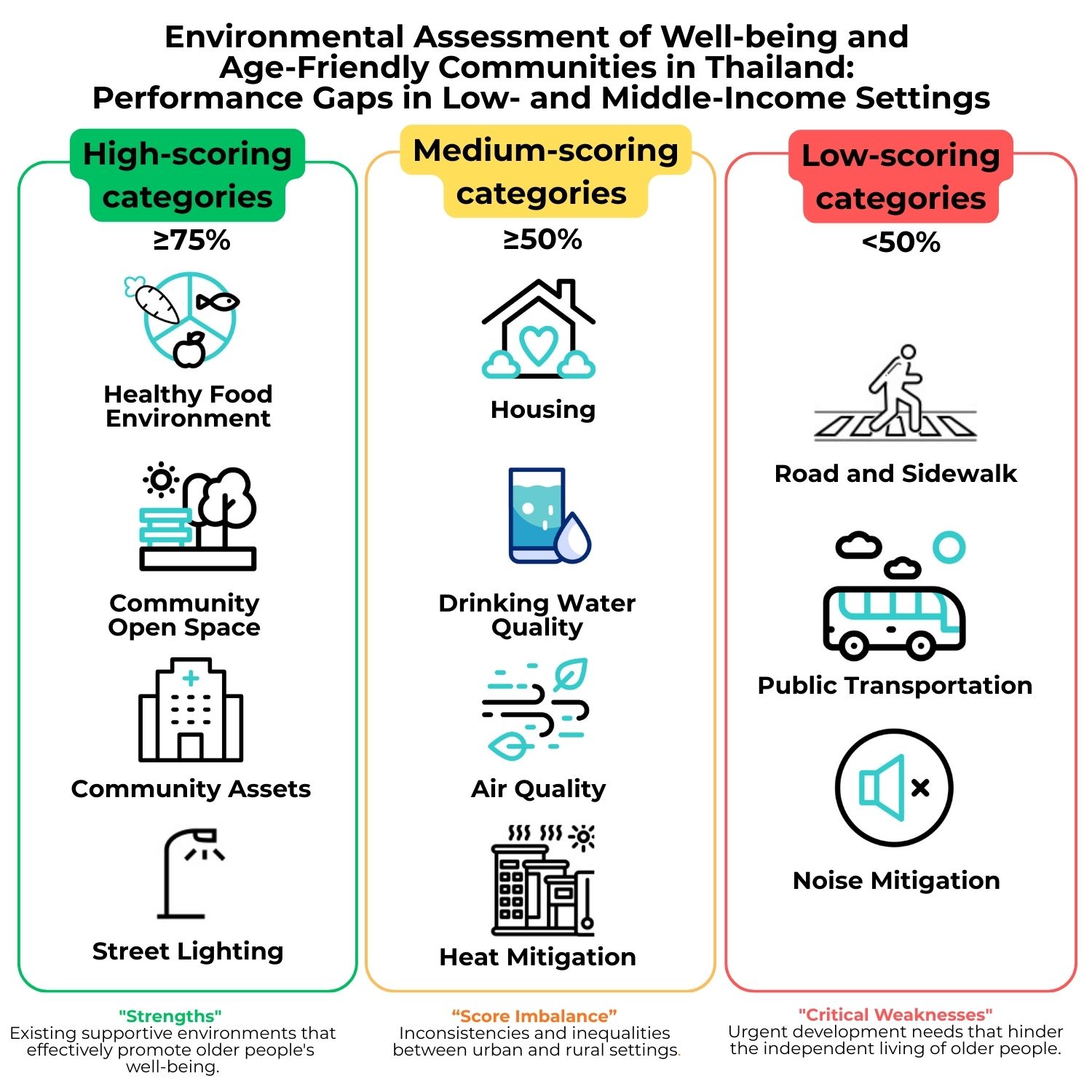
The effectiveness of well-being environment assessment criteria for aging communities in diverse contexts, particularly in developing countries, remains underexplored. This study aimed to fill this gap by employing Thailand Well-Being Environment and Age-Friendly Communities criteria to assess the living environment of 15 low- and middle-income aging communities in Thailand and determine their well-being status. The results of the overall quantitative assessment showed an average score of 60.78/100. Findings indicated high scores in categories such as healthy food environment, community open space, community asset, and street lighting, indicating a strong foundation for the well-being of low- and middle-income communities. Medium-scoring categories like housing, air quality, drinking water quality, and heat mitigation showed varied results, indicating the need for targeted interventions. Conversely, low scores were found in the categories of roads and sidewalks, public transportation, and noise mitigation, indicating to a critical gap in infrastructure for older people. Considering the scores for each main category, it was found that only the heat mitigation category showed a statistically significant difference between urban and rural areas. However, a deeper qualitative analysis by local experts revealed that 24 indicators in urban contexts, across three categories (housing, roads and sidewalks, and public transportation), were not aligned with the reality of rural contexts, underscoring the ineffectiveness of the "one size fits all" approach. This study highlights the need for context-specific criteria to guide targeted policy and resource allocation to improve the quality of life for older people.
Article Details

This work is licensed under a Creative Commons Attribution-NonCommercial-NoDerivatives 4.0 International License.
References
Abdullah, A. Z., Azizan, N., & Bohari, Z. (2024). Implementation of solar street lighting for empowering rural communities. BIO Web of Conferences, 137, Article 03001. https://doi.org/10.1051/bioconf/202413703001
Adlakha, D., Chandra, M., Krishna, M., Smith, L., & Tully, M. A. (2021). Designing age-friendly communities: Exploring qualitative perspectives on urban green spaces and ageing in two Indian megacities. International journal of environmental research and public health, 18(4), Article 1491. https://doi.org/10.3390/ijerph18041491
Agost-Felip, R., Rua, M. J., & Kouidmi, F. (2021). An inclusive model for assessing age-friendly urban environments in vulnerable areas. Sustainability, 13(15), Article 8352. https://doi.org/10.3390/su13158352
Ailshire, J., & Brown, L. L. (2021). The importance of air quality policy for older adults and diverse communities. Public Policy & Aging Report, 31(1), 33–37. https://doi.org/10.1093/ppar/prab001
Angkasith, R., Thepma, A. S., Choomket , S., Hawsutisima, K., & Tanmongkol, S. (2022). Public space for seniors activities with the local wisdom context. National Research Council of Thailand. https://cmudc.library.cmu.ac.th/frontend/Info/item/dc:165468
Ansusinha, P. (2022). The appropriate outdoor environment for age-friendly urban community in Bangkok Metropolis. NAJUA: History of Architecture and Thai Architecture, 19(1), 316–353. https://so04.tci-thaijo.org/index.php/NAJUA/article/view/259560
Ardebili, M. E., Naserbakht, M., Bernstein, C., Alazmani-Noodeh, F., Hakimi, H., & Ranjbar, H. (2021). Healthcare providers experience of working during the COVID-19 pandemic: A qualitative study. American journal of infection control, 49(5), 547–554. https://doi.org/10.1016/j.ajic.2020.10.001
BREEAM Assessment UK. (n.d.). Understanding BREEAM health and wellbeing. https://breeamassessment.co.uk/breeam-health-and-wellbeing-in-the-uk/
Brown, R. D., & Corry, R. C. (2020). Evidence-based landscape architecture for human health and well-being. Sustainability, 12(4), Article 1360. https://doi.org/10.3390/su12041360
Center for Active Design. (2020). Reference guide for the fitwel certification system: Community (beta) V2.1 https://static1.squarespace.com/static/6294f761bc48c512bfad618b/t/62f131b21bacac35940782d3/1724120681920/Fitwel+Reference+Guide_Community_Jan2022_Reduced.pdf
Chaplitskaya, A., Heijman, W., & van OPHEM, J. (2024). Exploring well-being disparities between urban and rural areas: A case study in the Stavropol Territory, Russia. Regional Sustainability, 5(1), Article 100114. https://doi.org/10.1016/j.regsus.2024.100114
Chi, Y. C., Wu, C. L., & Liu, H. T. (2022). Assessing quality of life with community dwelling elderly adults: A mass survey in Taiwan. Int J Environ Res Public Health, 19(22), Article 14621. https://doi.org/10.3390/ijerph192214621
Chindapol, S. (2025). Influence of sociocultural aspects and home modification on fall risks mitigation among the elderly in Thailand. Nakhara: Journal of Environmental Design and Planning, 24(1), Article 501. https://doi.org/10.54028/NJ202524501
Curl, A., & Mason, P. (2019). Neighbourhood perceptions and older adults’ wellbeing: Does walking explain the relationship in deprived urban communities? Transportation Research Part A: Policy and Practice, 123, 119–129. https://doi.org/10.1016/j.tra.2018.11.008
Datatab. (2022). Cohen's Kappa. https://datatab.net/tutorial/cohens-kappa
De Gea Grela, P., Sánchez-González, D., & Gallardo Peralta, L. P. (2024). Urban and rural environments and their implications for older adults’ adaptation to heat waves: A systematic review. Land, 13(9), Article 1378. https://doi.org/10.3390/land13091378
Du, Y., Zhang, A., Zhen, Q., Taleghani, M., Zheng, C., Zhu, L., Zheng, Y., & Zhang, Q. (2024). Rural heat island effect of centralized residences in China: Mitigation through localized measures. Sustainable Cities and Society, 114, Article 105782. https://doi.org/10.1016/j.scs.2024.105782
Ehsan, S., Abbas, F., Ibrahim, M., Ahmad, B., & Farooque, A. A. (2021). Thermal discomfort levels, building design concepts, and some heat mitigation strategies in low-income communities of a South Asian city. International Journal of Environmental Research and Public Health, 18(5), Article 2535. https://doi.org/10.3390/ijerph18052535
Gillam, C., & Charles, A. (2019). Community wellbeing: The impacts of inequality, racism and environment on a Brazilian coastal slum. World Development Perspectives, 13, 18–24. https://doi.org/10.1016/j.wdp.2019.02.006
Guo, N., Xia, F., & Yu, S. (2024). Enhancing elderly well-being: Exploring interactions between neighborhood-built environment and outdoor activities in old urban area. Buildings, 14(9), Article 2845. https://doi.org/10.3390/buildings14092845
Haglund, B. J., Pettersson, B., Finer, D., Tillgren, P., & World Health Organization. (1996). Creating supportive environments for health: Stories from the third International Conference on Health Promotion, Sundsvall, Sweden. World Health Organization.
Han, B., Li, D., & Chang, P.-J. (2021). The effect of place attachment and greenway attributes on well-being among older adults in Taiwan. Urban Forestry & Urban Greening, 65, Article 127306. https://doi.org/10.1016/j.ufug.2021.127306
Harden, S. R., Schuurman, N., Larson, H., & Walker, B. B. (2024). The utility of street view imagery in environmental audits for runnability. Applied Geography, 162, Article 103167. https://doi.org/10.1016/j.apgeog.2023.103167
Hasan, F., Marsia, S., Patel, K., Agrawal, P., & Razzak, J. A. (2021). Effective community-based interventions for the prevention and management of heat-related illnesses: A scoping review. International journal of environmental research and public health, 18(16), Article 8362. https://doi.org/10.3390/ijerph18168362
International Well Building Institute. (2020). The well community standard pilot. https://v2.wellcertified.com/en/community/overview
Japan Sustainable Building Consortium and Institute for Building Environment and Energy Conservation. (n.d.). CASBEE for urban development. https://www.ibecs.or.jp/CASBEE/english/toolsE_urban.htm
Jarutach, T., & Lertpradit, N. (2020). Housing conditions and improvement guidelines for the elderly living in urban areas: Case studies of four Bangkok's districts. Nakhara: Journal of Environmental Design and Planning, 18, 117–138. https://doi.org/10.54028/NJ202018117138
Jiravanichkul, S., & Jarutach, T. (2013). Behavior and living condition of the elderly in Sawangkanives [Master's thesis, Chulalongkorn University]. Chula Digital Collection.
https://digital.car.chula.ac.th/chulaetd/71921
Jiravanichkul, S., Pinich, S., Sreshthaputra, A., & Jarutach, T. (2024). The development of a well-being environment and age-friendly communities assessment criteria using the analytic hierarchy process: A case of Thailand. Nakhara: Journal of Environmental Design and Planning, 23(3), Article 416. https://doi.org/10.54028/NJ202423416
Jiravanichkul, S., Pongprasert, S., & Jarutach, T. (2020). Universal design guidelines for Pontoon Pier : Moo-7 Pier (Kru Tew Pier),Ko Kret Island and Pak Kret Pier, Nonthaburi. Journal of Architectural/Planning Research and Studies (JARS), 17(1), 173–188. https://doi.org/10.56261/jars.v17i1.205396
Kelly, D., Davern, M., Farahani, L., Higgs, C., & Maller, C. (2022). Urban greening for health and wellbeing in low-income communities: A baseline study in Melbourne, Australia. Cities, 120, Article 103442. https://doi.org/10.1016/j.cities.2021.103442
Kumar, P., Srivastava, S., Banerjee, A., & Banerjee, S. (2022). Prevalence and predictors of water-borne diseases among elderly people in India: Evidence from Longitudinal Ageing Study in India, 2017–18. BMC public health, 22(1), Article 993. https://doi.org/10.1186/s12889-022-13376-6
Larimian, T., Sadeghi, N., Erfani, G., & Palaiologou, F. (2025). Enhancing the understanding of social wellbeing among elderly populations in developing nations: A place-based approach. Cities & Health, 1–19. https://doi.org/10.1080/23748834.2025.2535245
Lee, H. S. (2022). Developing and testing the senior park environment assessment in Korea (SPEAK) audit tool. Landscape and urban planning, 227, Article 104545. https://doi.org/10.1016/j.landurbplan.2022.104545
Li, R. Y. M., Shi, M., Abankwa, D. A., Xu, Y., Richter, A., Ng, K. T. W., & Song, L. (2022). Exploring the market requirements for smart and traditional ageing housing units: A mixed methods approach. Smart Cities, 5(4), 1752–1775. https://doi.org/10.3390/smartcities5040088
Li, S.-J., Luo, Y.-F., Liu, Z.-C., Xiong, L., & Zhu, B.-W. (2021). Exploring strategies for improving green open spaces in old downtown residential communities from the perspective of public health to enhance the health and well‐being of the aged. Journal of Healthcare Engineering, 2021(1), Article 5547749. https://doi.org/10.1155/2021/5547749
Luoma-Halkola, H., & Jolanki, O. (2021). Aging well in the community: Understanding the complexities of older people's dial-a-ride bus journeys. J Aging Stud, 59, Article 100957. https://doi.org/10.1016/j.jaging.2021.100957
McHugh, M. L. (2012). Interrater reliability: The kappa statistic. Biochemia medica, 22(3), 276–282.
Mishra, H. S., Bell, S., Grellier, J., & White, M. P. (2021). Testing the reliability and effectiveness of a new tool for assessing urban blue spaces: The BlueHealth environmental assessment tool (BEAT). Health & Place, 68, Article 102526. https://doi.org/10.1016/j.healthplace.2021.102526
MOHT Office for Healthcare Transformation. (2022). Shaping age-friendly and healthy neighbourhoods with the environment audit toolkit (EAT). https://moht.com.sg/shaping-age-friendly-and-healthy-neighbourhoods-with-the-environment-audit-toolkit-eat/
Nguyen, Q. C., Chu, A. T. T., Truong, B. G., & Nguyen, D. H. T. (2025). Noise pollution in developing countries: Loopholes and recommendations for Vietnam law. City and Environment Interactions, 25, Article 100187. https://doi.org/10.1016/j.cacint.2025.100187
Osi, S. (2023). Statistics in endodontics part2: Reliability. Thai Endodontic Association, 2(2), 97–110. https://he03.tci-thaijo.org/index.php/thaiendod/article/view/1649
Parida, D., Khan, R. R., & Lavanya, K. N. (2022). Urban built environment and elderly pedestrian accessibility: Insights from South Asia. SN Social Sciences, 2(6), Article 86. https://doi.org/10.1007/s43545-022-00391-y
Park, S. J., Lee, H., & Kim, M. J. (2013). Mixed-use facility model for the welfare of the elderly based on lifestyle. Journal of Asian Architecture and Building Engineering, 12(2), 245–252. https://doi.org/10.3130/jaabe.12.245
Pineda, E., Atanasova, P., Wellappuli, N. T., Kusuma, D., Herath, H., Segal, A. B., Vandevijvere, S., Anjana, R. M., Shamim, A. A., & Afzal, S. (2024). Policy implementation and recommended actions to create healthy food environments using the Healthy Food Environment Policy Index (Food-EPI): A comparative analysis in South Asia. The Lancet Regional Health-Southeast Asia, 26, Article 100428. https://doi.org/10.1016/j.lansea.2024.100428
Qazimirsaeed, A., Khosravi, H., Rafieian, M., Mirzahossein, H., & Forciniti, C. (2022). Walkability policies in developing countries: What do people need and prefer in Iran? Sustainability, 14(17), Article 10808. https://doi.org/10.3390/su141710808
Ren, K., Sun, X., Cenci, J., & Zhang, J. (2023). Assessment of public open space research hotspots, vitalities, and outlook using CiteSpace. Journal of Asian Architecture and Building Engineering, 22(6), 3799–3817. https://doi.org/10.1080/13467581.2023.2208200
Rivas, M. E., & Serebrisky, T. (2021). The role of active transport modes in enhancing the mobility of low-income people in Latin America and the Caribbean. Inter-American Development Bank. http://dx.doi.org/10.18235/0003216
Rugel, E. J., Chow, C. K., Corsi, D. J., Hystad, P., Rangarajan, S., Yusuf, S., & Lear, S. A. (2022). Developing indicators of age-friendly neighbourhood environments for urban and rural communities across 20 low-, middle-, and high-income countries. BMC public health, 22(1), Article 87. https://doi.org/10.1186/s12889-021-12438-5
Sacchetti, R., De Luca, G., Guberti, E., & Zanetti, F. (2015). Quality of drinking water treated at point of use in residential healthcare facilities for the elderly. Int J Environ Res Public Health, 12(9), 11163–11177. https://doi.org/10.3390/ijerph120911163
Sajjad, M., Rajapaksha, I., Rijal, H. B., & Siriwardana, C. (2025). Ageing in place in low-income communities in tropics: A field investigation on overheating, thermal comfort, and well-being of young elders. Building and Environment, 270, Article 112480. https://doi.org/10.1016/j.buildenv.2024.112480
Saneinejad, S., Moonen, P., & Carmeliet, J. (2014). Comparative assessment of various heat island mitigation measures. Building and Environment, 73, 162–170. https://doi.org/10.1016/j.buildenv.2013.12.013
Schwela, D. (2023). Guidelines for environmental noise management in developing countries. In J. K. Summers (Ed.), Management of noise pollution. IntechOpen. https://doi.org/10.5772/intechopen.109952
Somsopon, W., Kim, S. M., Nitivattananon, V., Kusakabe, K., & Nguyen, T. P. L. (2022). Issues and needs of elderly in community facilities and services: A case study of urban housing projects in Bangkok, Thailand. Sustainability, 14(14), Article 8388. https://doi.org/10.3390/su14148388
Song, Y., Deziel, N. C., & Bell, M. L. (2024). Delineating urbanicity and rurality: Impact on environmental exposure assessment. Environmental science & technology, 58(43), 19178–19188. https://doi.org/10.1021/acs.est.4c06942
Sreshthaputra, A. (2013). Ecovillage evaluation manual: NHA. Papermate (Thailand).
Sun, J., & Fleming, R. (2021). The development and reliability of the Singaporean environmental assessment tool (SEAT) for facilities providing high levels of care for people living with dementia. HERD, 14(2), 289–300. https://doi.org/10.1177/1937586720980175
Sun, R., & Gu, D. (2008). Air pollution, economic development of communities, and health status among the elderly in urban China. American journal of epidemiology, 168(11), 1311–1318. https://doi.org/10.1093/aje/kwn260
Suwanprasop, N., & Tontisirin, N. (2020). Assessing the appropriateness of and development guidelines for an age-friendlyc ommunity in physical aspect: A case study of Rangsit municipality. Journal of Architectural/Planning Research and Studies (JARS), 17(1), 157–172. https://doi.org/10.56261/jars.v17i1.175203
Thomas, F. B. (2022). The role of purposive sampling technique as a tool for informal choices in a social Sciences in research methods. Just Agriculture, 2(5), 1–8. https://justagriculture.in/files/newsletter/2022/january/47.%20The%20Role%20of%20Purposive%20Sampling%20Technique%20as%20a%20Tool%20for%20Informal%20Choices%20in%20a%20Social%20Sciences%20in%20Research%20Methods.pdf
Thongsawang, S., & Kaewkumkong, A. (2025). The sociopolitical manifestation of built environment in rural Thailand: Holistic development for an aging society? Nakhara: Journal of Environmental Design and Planning, 24(2), Article 510. https://doi.org/10.54028/NJ202524510
Tiraphat, S., Kasemsup, V., Buntup, D., Munisamy, M., Nguyen, T. H., & Hpone Myint, A. (2021). Active aging in ASEAN countries: Influences from age-friendly environments, lifestyles, and socio-demographic factors. International journal of environmental research and public health, 18(16), Article 8290. https://doi.org/10.3390/ijerph18168290
Tontisirin, N., Anantsuksomsri, S., & Laovakul, D. (2024). Spatial-temporal distribution of debt and delinquency of the elderly in Thailand: Perspectives from the National Credit Bureau data. Plos one, 19(7), Article e0306626. https://doi.org/10.1371/journal.pone.0306626
Tuicomepee, A., Sirisuk, K.-o., Wiwattanapantuwong, J., Gulsatitporn, S., & Jarutach, T. (2025). The impact of home environmental hazards on subjective health among healthy elderly adults in Thailand. Nakhara: Journal of Environmental Design and Planning, 24(1), Article 507. https://doi.org/10.54028/NJ202524507
Turner, C., Aggarwal, A., Walls, H., Herforth, A., Drewnowski, A., Coates, J., Kalamatianou, S., & Kadiyala, S. (2018). Concepts and critical perspectives for food environment research: A global framework with implications for action in low-and middle-income countries. Global food security, 18, 93–101. https://doi.org/10.1016/j.gfs.2018.08.003
Vasconcelos, L., Langemeyer, J., Cole, H. V., & Baró, F. (2024). Nature-based climate shelters? Exploring urban green spaces as cooling solutions for older adults in a warming city. Urban Forestry & Urban Greening, 98, Article 128408. https://doi.org/10.1016/j.ufug.2024.128408
Wang, Y.-F. (2015). Assessing age-friendly features and needs of elderly toward age-friendly city in Muang district, Ratchaburi province, Thailand. Journal of Health Research, 29, 159–167. https://he01.tci-thaijo.org/index.php/jhealthres/article/view/78009
World Health Organization. (2023). National programmes for age-friendly cities and communities: A guide. https://www.who.int/publications/i/item/9789240068698
Wu, C., Zhang, Z., Elahi, E., Mu, G., & Zhao, P. (2022). Urban-rural income disparities and atmospheric contamination: Aggravating or restraining? Frontiers in Environmental Science, 10, Article 1015857. https://doi.org/10.3389/fenvs.2022.1015857
Yu, T., Ren, B., & Li, M. (2024). Regard to assessing agreement between two raters with kappa statistics. International Journal of Cardiology, 15(403), Article 131896. https://doi.org/ 10.1016/j.ijcard.2024.131896
