
The First Home: A Pedagogical Exploration of Architecture’s Mythical Origins
Article Sidebar
Main Article Content
Abstract
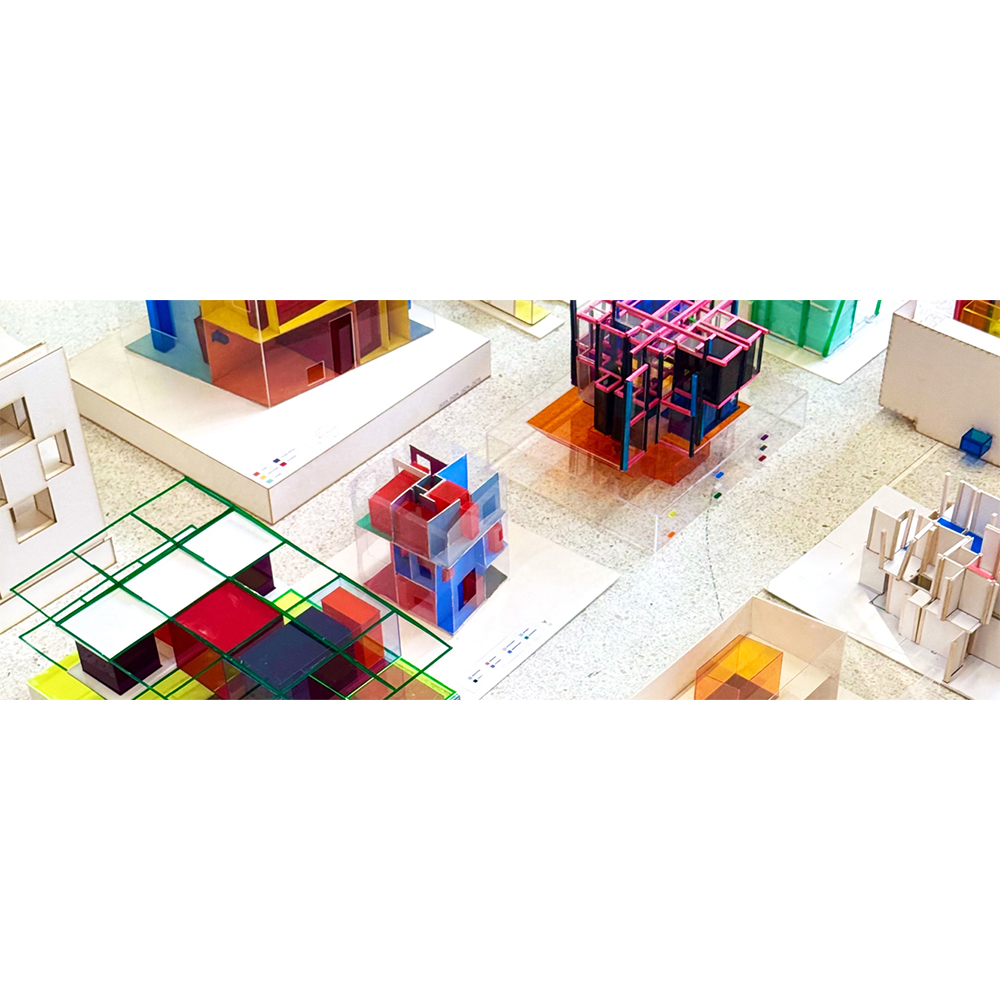
This research article proposes the idea of the "First Home" as a pedagogical model for architectural design studios in Thailand. The objective is to foster a more humanistic approach to the foundation of architecture education by integrating histories and theories of architecture, architectural representation, and architectural design studio courses. The "First Home" investigates the mythical origins of architecture—the cave, post-and-lintel structure, and tent—as well as the roles of language and art, framed as the processes of “remembering” and “forgetting.” The literature review for this study is based on architectural texts and diagrams focusing on spatial composition, written by architects who are also educators. These were articulated through a project-based teaching and learning process in two architectural design projects: an analytical case study inspired by the mythical origins of architecture and a shared house design. In these projects, students analyzed the spatial organization of case studies and developed their understanding of three-dimensional architectural composition through diagrammatic drawings and model-making. The teaching method reinforced the historical beginnings and core principles of architecture while allowing students to overlook conventional residential typologies (e.g., a standard two-story house with a ground-floor living room, kitchen, and dining area, and first-floor bedrooms, all separated by standard walls and doors). By directing students beyond aesthetic concerns, the pedagogical model encouraged engagement with enduring architectural archetypes and the attainment of spatial qualities informed by fundamental living conditions, thereby cultivating a reflective and imaginative foundation essential for architecture.
Article Details

This work is licensed under a Creative Commons Attribution-NonCommercial-NoDerivatives 4.0 International License.
References
Andri Yatmo, Y., & Atmodiwirjo, P. (2023). Revisiting Vitruvius’ town planning method in architectural education. Nakhara: Journal of Environmental Design and Planning, 22(3), Article 321. https://doi.org/10.54028/NJ202322321
Ansari, I. (2020, July 20). Interview: Peter Eisenman. Architectural Review. https://www.architectural-review.com/essays/interview-peter-eisenman
Atelier Bow-Wow. (2002). Pet architecture guide book vol 2. World Photo Press.
Balmer, J., & Swisher, M. T. (2019). Diagramming the big idea: Methods for architectural composition. Routledge.
Bandeirinha, J. A., & Lebre, R. A. (2020). The need for shelter Laugier, Ledoux, and enlightenment’s shadows. Sophia, 5(1), 54–71. https://doi.org/10.24840/2183-8976_2019-0005_0001_05
Botton, A., & Armstrong, J. (2015). Art as therapy. Phaidon Press.
Chitrabongs, C. (2022). Curartistry: Curating everyday artistry in Bangkok. Nakhara: Journal of Environmental Design and Planning, 21(1), Article 208. https://doi.org/10.54028/NJ202221208
Chitranukroh, J., & Buranakarn, V. (2006). Sentiment in traditional Thai achitecture. Nakhara: Journal of Environmental Design and Planning, 1(1), Article 8. https://digital.car.chula.ac.th/nakhara/vol1/iss1/8
Colomina, B., Galán, I. G., Kotsioris, E., & Meister, A. (2022). Radical pedagogies. MIT Press.
Corbusier, L. (1986). Towards a new architecture. Courier Corporation.
Dripps, R. D. (1999). The first house: Myth, paradigm, and the task of architecture. MIT Press.
Eisenman, P. (1999). Diagram diaries. Thames and Hudson.
Eisenman, P. (2006). The formal basis of modern architecture. Lars Müller Publishers.
Forty, A. (2004). Words and buildings: A vocabulary of modern architecture. Thames & Hudson.
Fujimoto, S. (2014). Primitive future. Inax.
Fusinpaiboon, C., Coomans, T., & Povatong, P. (2021). Nationalism and the modernisation of Thai architectural education at Chulalongkorn University in the 1920s and 1930s. Nakhara: Journal of Environmental Design and Planning, 20(2), Article 112. https://doi.org/10.54028/NJ202120112
Genov, A. (2017). The symbolism of caves as a border between worlds in the conceptions of ancient societies. Knowledge International Journal, 20(6), 2859–2864. https://ojs.ikm.mk/index.php/kij/article/view/3979/3978
Hearn, M. F. (2003). Ideas that shaped buildings. MIT Press.
Hertzberger, H. (2005). Lessons for students in architecture. 010 Publishers.
Hertzberger, H. (2010). Space and the Architect Lessons in architecture 2. 010 Publishers.
Ishigami, J. (2010). Another scale of architecture. Seigensha.
Koolhaas, R., Avermaete, T., Inaba, J., Clouette, B., Easterling, K., Feng, J., Maak, N., Marot, S., McLeod, K., Zaera-Polo, A., Zhenning, F., Davis, B., Lenz, B., MacWillie, E., Potts, N., Reisz, T., Wang, A., & Williams, E. (2018). Elements of architecture. Taschen.
Laugier, M. (2009). An essay on architecture. Hennessey & Ingalls, Inc.
Nishimaki, A. (2014). JA spring, 2014: Kazuo Shinohara. Nobuyuki Yoshida.
Paramita, K., Indraprastha, A., Hariyadi, A., Yatmo, Y. A., Atmodiwirjo, P., & Suryantini, R. (2025). Tradition and modernity: The adaptation of outdoor spaces in traditional Balinese dwelling. Nakhara: Journal of Environmental Design and Planning, 24(2), Article 514. https://doi.org/10.54028/NJ202524514
Pollio, V., & Morgan, M. H. (1960). Vitruvius: The ten books on architecture. Dover Publications.
Prasertsuk, S., & Ardrugsa, W. (2023). Postmodern architecture in Thailand 1982–1997: Key concepts and case studies. Nakhara: Journal of Environmental Design and Planning, 22(2), Article 314. https://doi.org/10.54028/NJ202322314
Rykwert, J. (1981). On Adam’s house in paradise: The idea of the primitive hut in architectural history. The MIT Press.
Seeumpornroj, P. (2021). Globality in teaching art and architectural history: A case study of the glossary assignment. Nakhara: Journal of Environmental Design and Planning, 20(2), Article 109. https://doi.org/10.54028/NJ202120109
Sejima, K., & Nishizawa, R. (2007). Architectural topology. El Croquis Editorial.
