
Localized Ks Assessment for Bioretention in Thailand: Improving SWMM Accuracy
Article Sidebar
Main Article Content
Abstract
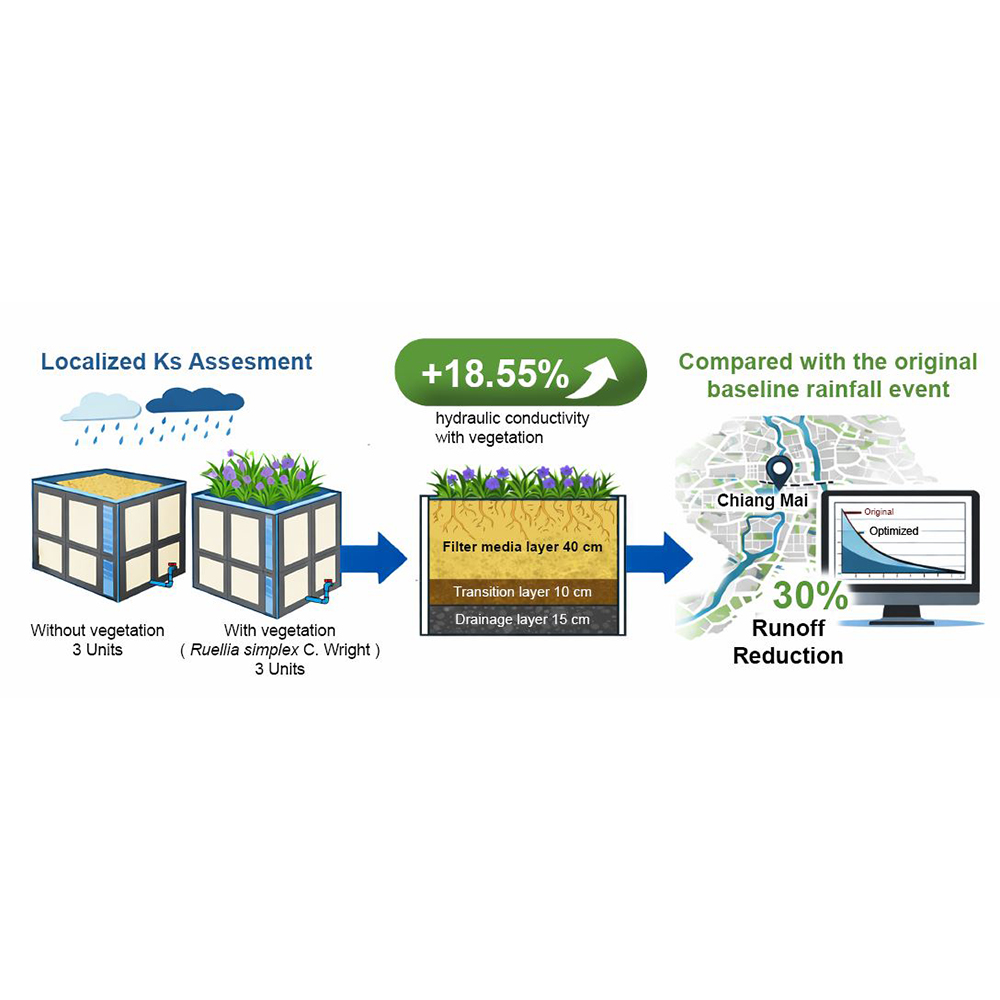
Urbanization in Thailand has significantly reduced natural infiltration surfaces, intensified stormwater runoff, and increased the demand for effective urban drainage solutions. Bioretention systems, guided by water-sensitive urban design (WSUD) principles, offer a promising approach for enhancing infiltration and mitigating urban flooding. However, the effectiveness of bioretention depends critically on the accurate estimation of saturated hydraulic conductivity (Ks), a key input parameter in hydrological models such as the Storm Water Management Model (SWMM). Despite international guidelines, local Ks values for tropical soils and vegetation remain scarce, limiting model reliability. This study aims to determine its suitability as a filter media layer in bioretention systems developed specifically for the Thai context. Two surface conditions, vegetated and unvegetated, were tested using coarse construction sand as filter media. The results showed a significantly higher Ks (an 18.55% increase, p<0.001) in the vegetated system (306.57 ± 4.58 mm h-1) compared to the unvegetated system (258.61 ± 4.98 mm h-1), confirming a significant influence of vegetation on infiltration capacity. The localized Ks data produced in this study fall within international bioretention design standards and offer a practical alternative to SWMM’s default parameters. A sensitivity analysis using SWMM and actual Chiang Mai rainfall data demonstrated the critical impact of these localized Ks values, showing that integrating them can reduce simulated runoff volumes by up to 30% for high-frequency storms, thereby enhancing the predictive accuracy of urban stormwater models. This research contributes to bridging the gap between hydrological modeling and site-specific environmental conditions in Southeast Asia.
Article Details

This work is licensed under a Creative Commons Attribution-NonCommercial-NoDerivatives 4.0 International License.
References
Agyare, W. A., Park, S., & Vlek, P. (2007). Artificial neural network estimation of saturated hydraulic conductivity. Vadose Zone Journal, 6(2), 423–431. https://doi.org/10.2136/vzj2006.0131
Ahammed, F., Rohita Sara, G., Paul Kai, H., & Yan, L. (2021). Optimum numbering and sizing of infiltration-based water sensitive urban design technologies in South Australia. International Journal of Sustainable Engineering, 14(1), 79–86. https://doi.org/10.1080/19397038.2020.1733131
Akay, A. (2025). Perceptions of landscape quality in the historic city center of Konya, Türkiye: A multi-site user satisfaction analysis. Nakhara: Journal of Environmental Design and Planning, 24(3), Article 520. https://doi.org/10.54028/NJ202524520
Amerinia, S. (2023). Assessment of low-impact development practices on stormwater management using SWMM 5.2: a case study of Shiraz, Iran [Master’ thesis, Memorial University of Newfoundland]. https://hdl.handle.net/20.500.14783/10070
Bibi, T. S., & Kara, K. G. (2023). Evaluation of climate change, urbanization, and low-impact development practices on urban flooding. Heliyon, 9(1), Article e12955. https://doi.org/10.1016/j.heliyon.2023.e12955
Cescon, A., & Jiang, J.-Q. (2020). Filtration process and alternative filter media material in water treatment. Water, 12(12), Article 3377. https://doi.org/10.3390/w12123377
Chen, X., van der Werf, J. A., Droste, A., Coenders-Gerrits, M., & Uijlenhoet, R. (2025). Barriers of urban hydro-meteorological simulation: A review [Preprint]. The EGU Interactive Community Platform. https://doi.org/10.5194/egusphere-2024-3988
Farina, A., Di Nardo, A., Gargano, R., van der Werf, J. A., & Greco, R. (2023). A simplified approach for the hydrological simulation of urban drainage systems with SWMM. Journal of Hydrology, 623, Article 129757. https://doi.org/10.1016/j.jhydrol.2023.129757
Fassman-Beck, E., & Saleh, F. (2021). Sources and impacts of uncertainty in uncalibrated bioretention models using SWMM 5.1. 012. Journal of Sustainable Water in the Built Environment, 7(3), Article 04021006. https://doi.org/10.1061/JSWBAY.0000944
Funai, J. T., & Kupec, P. (2017). Exploring planting and filter media in stormwater bioremediating landscapes: A review. Water, Air, & Soil Pollution, 228, Article 340. https://doi.org/10.1007/s11270-017-3524-0
Garshasbi, D., Kitiphaisannon, J., Wongbumru, T., & Thanvisitthpon, N. T. (2025). Assessment of future urban flood risk of Thailand's bangkok metropolis using geoprocessing and machine learning algorithm. Environmental and Sustainability Indicators, 25, Article 100559. https://doi.org/https://doi.org/10.1016/j.indic.2024.100559
Goh, H. W., Lem, K. S., Azizan, N. A., Chang, C. K., Talei, A., Leow, C. S., & Zakaria, N. A. (2019). A review of bioretention components and nutrient removal under different climates—future directions for tropics. Environmental Science and Pollution Research, 26, 14904–14919. https://doi.org/10.1007/s11356-019-05041-0
Goh, H. W., Zakaria, N. A., Lau, T. L., Foo, K. Y., Chang, C. K., & Leow, C. S. (2017). Mesocosm study of enhanced bioretention media in treating nutrient rich stormwater for mixed development area. Urban Water Journal, 14(2), 134–142. https://doi.org/10.1080/1573062X.2015.1076861
Hao, M., Zhang, J., Meng, M., Chen, H. Y., Guo, X., Liu, S., & Ye, L. (2019). Impacts of changes in vegetation on saturated hydraulic conductivity of soil in subtropical forests. Scientific reports, 9(1), Article 8372. https://doi.org/10.1038/s41598-019-44921-w
Hatt, B. E., Fletcher, T. D., and Deletic, A. (2009). Hydrologic and pollutant removal performance of stormwater biofiltration systems at the field scale. Journal of Hydrology, 365(3–4), 310–321. https://doi.org/10.1016/j.jhydrol.2008.12.001
Hermawan, A. A., Talei, A., Leong, J. Y. C., Jayatharan, M., Goh, H. W., & Alaghmand, S. (2019). Performance assessment of a laboratory scale prototype biofiltration system in tropical region. Sustainability, 11(7), Article 1947. https://doi.org/10.3390/su11071947
Kanso, T., Tedoldi, D., Gromaire, M.-C., Ramier, D., Saad, M., & Chebbo, G. (2018). Horizontal and vertical variability of soil hydraulic properties in roadside sustainable drainage systems (SuDS)—nature and implications for hydrological performance evaluation. Water, 10(8), Article 987. https://doi.org/10.3390/w10080987
Kiguchi, M., Takata, K., Hanasaki, N., Archevarahuprok, B., Champathong, A., Ikoma, E., Jaikaeo, C., Kaewrueng, S., Kanae, S., & Kazama, S. (2021). A review of climate-change impact and adaptation studies for the water sector in Thailand. Environmental Research Letters, 16(2), Article 023004. https://doi.org/10.1088/1748-9326/abce80
Knighton, J., Lennon, E., Bastidas, L., & White, E. (2016). Stormwater detention system parameter sensitivity and uncertainty analysis using SWMM. Journal of Hydrologic Engineering, 21(8), Article 05016014. https://doi.org/doi:10.1061/(ASCE)HE.1943-5584.0001382
Kritsanaphan, B., Wongsa, S., & Limsakul, A. (2021). Diurnal variation of rainfall and convective activity over northern Thailand. Thai Meteorological Journal, 73(1), 15–26.
Lechner, A. M., Gomes, R. L., Rodrigues, L., Ashfold, M. J., Selvam, S. B., Wong, E. P., Raymond, C. M., Zieritz, A., Sing, K. W., Moug, P., Billa, L., Sagala, S., Cheshmehzangi, A., Lourdes, K., Azhar, B., Sanusi, R., Ives, C. D., Tang, Y.-T., Tan, D. T., . . . Gibbins, C. (2020). Challenges and considerations of applying nature-based solutions in low- and middle-income countries in Southeast and East Asia. Blue-Green Systems, 2(1), 331–351. https://doi.org/10.2166/bgs.2020.014
Li, C., Peng, C., Chiang, P.-C., Cai, Y., Wang, X., & Yang, Z. (2019). Mechanisms and applications of green infrastructure practices for stormwater control: A review. Journal of Hydrology, 568, 626–637. https://doi.org/10.1016/j.jhydrol.2018.10.074
Li, G., Xiong, J., Zhu, J., Liu, Y., & Dzakpasu, M. (2021). Design influence and evaluation model of bioretention in rainwater treatment: A review. Science of the Total Environment, 787, Article 147592. https://doi.org/10.1016/j.scitotenv.2021.147592
Li, J., Liu, Z., Jiang, C., Li, Y., Li, H., & Xia, J. (2021). Optimization design of key parameters for bioretention cells with mixed filter media via HYDRUS-1D model and regression analysis. Ecological Engineering, 164, Article 106206. https://doi.org/10.1016/j.ecoleng.2021.106206
Liu, J., Sample, D. J., Bell, C., & Guan, Y. (2014). Review and research needs of bioretention used for the treatment of urban stormwater. Water, 6(4), 1069–1099. https://doi.org/10.3390/w6041069
Lu, J., Zhang, Q., Werner, A. D., Li, Y., Jiang, S., & Tan, Z. (2020). Root-induced changes of soil hydraulic properties–A review. Journal of Hydrology, 589, Article 125203. https://doi.org/10.1016/j.jhydrol.2020.125203
Melbourne Water. (2020). Biofiltration systems in development services schemes guideline (Vol. 3). https://www.melbournewater.com.au/building-and-works/developer-guides-and-resources/standards-and-specifications/biofiltration
Nasr, T., Jafarpour Ghalehteimouri, K., Khedmatzadeh, A., Najaf Mousavi, M., & Rajabi, A. (2024). Predicting urban green infrastructures of ecosystem services in Tehran Metropolitan area sprawl with landsat satellite time series data. Journal of Architectural/Planning Research and Studies (JARS), 22(1), Article 268554. https://doi.org/10.56261/jars.v22.268554
Neuman, S. P. (1977). Theoretical derivation of Darcy's law. Acta mechanica, 25(3), 153–170. https://doi.org/10.1007/BF01376989
Niazi, M., Nietch, C., Maghrebi, M., Jackson, N., Bennett, B. R., Tryby, M., & Massoudieh, A. (2017). Storm water management model: Performance review and gap analysis. Journal of Sustainable Water in the Built Environment, 3(2), Article 04017002. https://doi.org/10.1061/JSWBAY.0000817
Numsuk, W. (2025). Dynamics of landscape transformation and governance of Bangkok’s urban waterways. Nakhara : Journal of Environmental Design and Planning, 24(2), Article 511. https://doi.org/10.54028/NJ202524511
Nur Hannah Ismail, S., Stovin, V., & Cameron, R. W. (2023). Functional urban ground-cover plants: Identifying traits that promote rainwater retention and dissipation. Urban Ecosystems, 26, 1709–1724. https://doi.org/10.1007/s11252-023-01417-w
Pan, R., Martinez, A., Brito, T., & Seidel, E. (2018). Processes of soil infiltration and water retention and strategies to increase their capacity. Journal of Experimental Agriculture International, 20(2), 1–14. https://doi.org/10.9734/JEAI/2018/39132
Payne, E., Hatt, B., Deletic, A., Dobbie, M., McCarthy, D., & Chandrasena, G. (2015). Adoption guidelines for stormwater biofiltration systems—summary report. Cooperative Research Centre for Water Sensitive Cities. https://watersensitivecities.org.au/wp-content/uploads/2015/10/TMR_C1-1_AdoptionGuidelinesStormwaterBiofiltrationSystems_2.pdf
Radinja, M., Vidmar, I., Atanasova, N., Mikos, M., & raj, M. (2019). Determination of spatial and temporal variability of soil hydraulic conductivity for urban runoff modelling. Water, 11(5), Article 941. https://doi.org/10.3390/w11050941
Reyes, N. J. D. G., Geronimo, F. K. F., Choi, H., Jeon, M., & Kim, L.-H. (2024). Comprehensive evaluation of soil characteristics and carbon stocks variability in different urban land use types. Environmental Engineering Research, 29(5), Article 230568. https://doi.org/10.4491/eer.2023.568
Rinchumphu, D., Suriyanon, N., Phichetkunbodee, N., Munlikawong, S., Wanitchayapaisit, C., & Sitthikankun, S. (2024). Economics and cost effectiveness of a rain garden for flood-resistant urban design. Global Journal of Environmental Science and Management, 10(1), 1–12. https://doi.org/10.22034/gjesm.2024.01.01
Ristianti, N. S., Paulla Dewi, S., Susanti, R., Kurniati, R., & Syafira Zain, N. (2024). Using biophilic design to enhance resilience of urban parks in Semarang city, Indonesia. Nakhara: Journal of Environmental Design and Planning, 23(1), Article 402. https://doi.org/10.54028/NJ202423402
Rossman, L. A., & Huber, W. C. (2016). Storm water management model user’s manual, version 5.1 (Report No. EPA/600/R-14/413). U.S.. Environmental Protection Agency. https://www.epa.gov/sites/default/files/2019-02/documents/epaswmm5_1_manual_master_8-2-15.pdf
Royal Botanic Gardens, Kew. (1870). Ruellia Simplex C.Wright [Photo]. Plants of the World Online. https://powo.science.kew.org/taxon/urn:lsid:ipni.org:names:54585-1
Shrestha, S., Khatiwada, M., Babel, M. S., & Parajuli, K. (2014). Impact of climate change on river flows in the Upper Ping River Basin, Thailand. Journal of Water and Climate Change, 5(1), 67–81.
https://doi.org/10.2166/wcc.2014.108
Sagrelius, P. O., Blecken, G., Hedström, A., Ashley, R., & Viklander, M. (2023). Sustainability performance of bioretention systems with various designs. Journal of Environmental Management, 340, Article 117949. https://doi.org/10.1016/j.jenvman.2023.117949
Shi, X., Qin, T., Yan, D., Tian, F., & Wang, H. (2021). A meta-analysis on effects of root development on soil hydraulic properties. Geoderma, 403, Article 115363. https://doi.org/10.1016/j.geoderma.2021.115363
Sihag, P., Mohsenzadeh Karimi, S., & Angelaki, A. (2019). Random forest, M5P and regression analysis to estimate the field unsaturated hydraulic conductivity. Applied Water Science, 9(5), Article 129. https://doi.org/10.1007/s13201-019-1007-8
Singh, V. K., Panda, K. C., Sagar, A., Al-Ansari, N., Duan, H.-F., Paramaguru, P. K., Vishwakarma, D. K., Kumar, A., Kumar, D., & Kashyap, P. (2022). Novel genetic algorithm (GA) based hybrid machine learning-pedotransfer function (ML-PTF) for prediction of spatial pattern of saturated hydraulic conductivity. Engineering Applications of Computational Fluid Mechanics, 16(1), 1082–1099. https://doi.org/10.1080/19942060.2022.2071994
Sinsabvarodom, C., Rinchumphu, D., & Chai, W. (2025). Enhancing SWMM hydrological accuracy and bioretention design in Thailand through local Ks assessment for sustainable urban green infrastructure [Manuscript in preparation]. Faculty of Engineering, Chiang Mai University.
Sittisom, P., Tangsongsuwan, R., Munlikawong, S., Wongsapai, W., Sitthikankun, S., & Rinchumphu, D. (2022). The determination of soil Infiltration rate of urban bioretention design process in Chiang Mai, Thailand. Nakhara: Journal of Environmental Design and Planning, 21(3), Article 228. https://doi.org/10.54028/NJ202221228
Skorobogatov, A., He, J., Chu, A., Valeo, C., & van Duin, B. (2020). The impact of media, plants and their interactions on bioretention performance: A review. Science of the Total Environment, 715, Article 136918. https://doi.org/10.1016/j.scitotenv.2020.136918
Sornubol, N., & Lekagul, A. (2024). Restorative interior design to renew attention and reduce stress in small residential units. Journal of Architectural/Planning Research and Studies (JARS), 22(1), Article 269283. https://doi.org/10.56261/jars.v22.269283
Suppakittpaisarn, P., Jiang, X., & Sullivan, W.C. (2017). Green infrastructure, green stormwater infrastructure, and human health: A review. Curr Landscape Ecol Rep, 2, 96–110. https://doi.org/10.1007/s40823-017-0028-y
Thai Meteorological Department. (2024). Annual meteorological data report – Chiang Mai station. TMD Publication. https://www.tmd.go.th/
Tirpak, R. A., Afrooz, A. N., Winston, R. J., Valenca, R., Schiff, K., & Mohanty, S. K. (2021). Conventional and amended bioretention soil media for targeted pollutant treatment: A critical review to guide the state of the practice. Water research, 189, Article 116648. https://doi.org/10.1016/j.watres.2020.116648
Tresch, S., Moretti, M., Le Bayon, R.-C., Mäder, P., Zanetta, A., Frey, D., Stehle, B., Kuhn, A., Munyangabe, A., & Fliessbach, A. (2018). Urban soil quality assessment—a comprehensive case study dataset of urban garden soils. Frontiers in Environmental Science, 6, Article 136. https://doi.org/10.3389/fenvs.2018.00136
Veloso, M. F., Rodrigues, L. N., & Fernandes Filho, E. I. (2022). Evaluation of machine learning algorithms in the prediction of hydraulic conductivity and soil moisture at the Brazilian Savannah. Geoderma Regional, 30, Article e00569. https://doi.org/10.1016/j.geodrs.2022.e00569
Vijayaraghavan, K., Biswal, B. K., Adam, M. G., Soh, S. H., Tsen-Tieng, D. L., Davis, A. P., Chew, S. H., Tan, P. Y., Babovic, V., & Balasubramanian, R. (2021). Bioretention systems for stormwater management: Recent advances and future prospects. Journal of Environmental Management, 292, Article 112766. https://doi.org/10.1016/j.jenvman.2021.112766
Wang, J., Liu, J., Wang, H., & Mei, C. (2020). Approaches to multi-objective optimization and assessment of green infrastructure and their multi-functional effectiveness: A review. Water, 12(10), Article 2714. https://www.mdpi.com/2073-4441/12/10/2714
Wanitchayapaisit, C., Rinchumphu, D., & Suppakittpaisarn, P. (2022). Design factors towards water retention ability of water-sensitive urban design (WSUD) in tropical and subtropical climates: An exploratory literature review. In International conference on Climate Change and Environmental Sustainability (pp. 61–72). Springer Nature Switzerland. https://doi.org/10.1007/978-3-031-65088-8_6
Wanitchayapaisit, C., Suppakittpaisarn, P., Charoenlertthanakit, N., Surinseng, V., Yaipimol, E., & Rinchumphu, D. (2022). Rain garden design for stormwater management in Chiang Mai, Thailand: A Research-through-Design Study. Nakhara: Journal of Environmental Design and Planning, 21(3), Article 222. https://doi.org/10.54028/NJ202221222
Weiss, P. T., & Gulliver, J. S. (2015). Effective saturated hydraulic conductivity of an infiltration-based stormwater control measure. Journal of Sustainable Water in the Built Environment, 1(4), Article 04015005. https://doi.org/10.1061/JSWBAY.0000801
Wilby, R. L. (2019). A global hydrology research agenda fit for the 2030s. Hydrology Research, 50(6), 1464–1480. https://doi.org/10.2166/nh.2019.100
Wu, W., Jamali, B., Zhang, K., Marshall, L., & Deletic, A. (2023). Water sensitive urban design (WSUD) spatial prioritisation through global sensitivity analysis for effective urban pluvial flood mitigation. Water research, 235, Article 119888. https://doi.org/10.1016/j.watres.2023.119888
Wuepper, D., Borrelli, P., & Finger, R. (2020). Countries and the global rate of soil erosion. Nature Sustainability, 3, 51–55. https://doi.org/10.1038/s41893-019-0438-4
Wunderlin, R. P., Hansen, B. F., Franck, A. R., & Essig, F. B. (2025). Ruellia Simplex. Atlas of Florida Plants. https://florida.plantatlas.usf.edu/plant/species/1302
Yang, N., Du, W., Chen, L., Shen, Z., Chang, C.-C., & Ma, Y. (2021). Prioritizing the soil and filler layers of a bioretention system by considering multiple hydrological effects. Journal of Hydrology, 603, Article 127008. https://doi.org/10.1016/j.jhydrol.2021.127008
Yue, M., & Gao, X. (2025). A comparative study of infiltration methods based on the SWMM model: Application of Horton and Green-Ampt models in drainage system design in northeast China. International Journal of Engineering Advances, 2(1), 25–31. https://doi.org/10.71222/rry5ks79
Zhang, H., Li, J., & Zhou, Y. (2021). Evaluating the potential hydrological performance of a bioretention media with 100% recycled waste components. Water, 13(15), Article 2014. https://doi.org/10.3390/w13152014
Zhang, X., Qiao, W., Huang, J., Li, H., & Wang, X. (2023). Impact and analysis of urban water system connectivity project on regional water environment based on Storm Water Management Model (SWMM). Journal of Cleaner Production, 423, Article 138840. https://doi.org/10.1016/j.jclepro.2023.138840
Zhang, Y., & Schaap, M. G. (2019). Estimation of saturated hydraulic conductivity with pedotransfer functions: A review. Journal of Hydrology, 575, 1011–1030. https://doi.org/10.1016/j.jhydrol.2019.05.058
Zhang, Z., Hu, W., Wang, W., Zhou, J., Liu, D., Qi, X., & Zhao, X. (2022). The hydrological effect and uncertainty assessment by runoff indicators based on SWMM for various LID facilities. Journal of Hydrology, 613, Article 128418. https://doi.org/https://doi.org/10.1016/j.jhydrol.2022.128418
Zhou, P., Luukkanen, O., Tokola, T., & Nieminen, J. (2008). Effect of vegetation cover on soil erosion in a mountainous watershed. Catena, 75(3), 319–325. https://doi.org/10.1016/j.catena.2008.07.010
