
Fiction of Form: Beaux-Arts as Projective Grammar in Yang Tingbao’S Architecture (1930–1981)
Article Sidebar
Main Article Content
Abstract
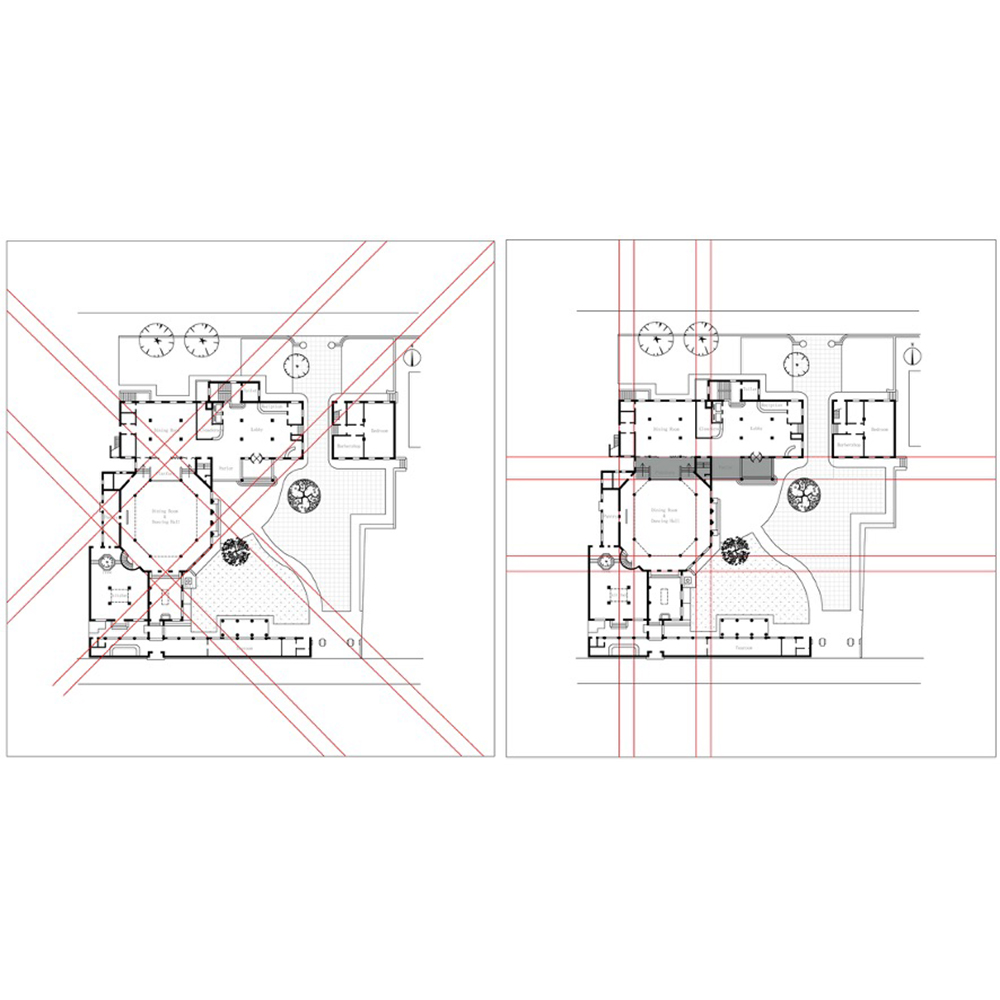
This article proposes “fiction of form” to examine how architectural form mediates ideological pressures from institutional mandates, state imperatives, and professional discourse while sustaining cultural resonance in China (1930–1981). Through a comparative reading of plans, elevations, and spatial sequences, the article traces how Yang’s Beaux-Arts–inspired design principles were adapted across three Chinese political regimes, as evidenced by Tsinghua University Library Extension (1930), Peace Hotel (Beijing, 1951), and Wuyi Hotel (Fujian, 1981). Respectively, these cases demonstrate institutional legibility achieved through axial order and hierarchical sequencing in the Republican Period (1912–1949); functional alignment via compositional neutrality and façade discipline under early PRC state imperatives (1950s–1960s); and cultural resonance achieved through courtyard sequencing and calibrated thresholds in the Reform era (after 1978). The study situates Yang’s work within debates on non-Western modernism and reframes formalism as rhetorical instrumentation rather than aesthetic autonomy. It argues for further research into how architectural form—particularly when derived from Beaux-Arts traditions—can function rhetorically in shaping meaning across diverse geopolitical contexts.
Article Details

This work is licensed under a Creative Commons Attribution-NonCommercial-NoDerivatives 4.0 International License.
References
Bahga, S., & Raheja, G. (2018). An account of critical regionalism in diverse building types in postcolonial Indian architecture. Frontiers of Architectural Research, 7(4), 473–496. https://doi.org/10.1016/j.foar.2018.09.001
Bourdieu, P. (1984). Distinction: A social critique of the judgement of taste (R. Nice, Trans.). Harvard University Press. (Original work published 1979)
de Bary, W. T., & Tu, W. (Eds.) (1999). Confucianism and human rights. Columbia University Press.
Deng, X. (2000). 邓小平论旅游 [Deng Xiaoping talking about tourism], Party Documents Research Office of the Cpc Central Committee and National Tourism Administration, (Ed.). Central Party Literature Press.
Denison, E. (2017). Architecture and the landscape of modernity in China before 1949. Routledge.
Denison, E., & Ren, G. (2016). Ultra-modernism: Architecture and modernity in Manchuria. Hong Kong University Press.
Durand, J.-N.-L. (2000). Précis of the lectures on architecture: With graphic portion of the lectures on architecture (D. Britt, Trans.) Getty Research Institute. (Original work published 1802)
Eisenberg, E. M. (1984). Ambiguity as strategy in organisational communication. Communication Monographs, 51(3), 227–242. https://doi.org/10.1080/03637758409390197
Elman, B. A. (2000). A cultural history of civil examinations in late imperial China. University of California Press.
Evans, R. (1978). Figures, doors and passages. Architectural Design, 48(4), 267–278.
Fang, X., & Li, H. (2023). 中国语境里“建筑理论”的构建(20世纪50–60年代) [Architectural theory within the framework of Chinese architecture during the 1950s and 1960s]. Journal of Architectural History, 2023(4), 102–111. https://dx.doi.org/10.12329/20969368.2023.04011
Foucault, M. (1995). Discipline and punish: The birth of the prison (A. Sheridan, Trans.). Vintage Books. (Original work published 1975)
Hays, K. M. (2009). Architecture’s desire: Reading the late avant-garde. The MIT Press.
He, K. (2018). 武夷风格 [Wuyi Fengge; Wuyi style]. Southeast University Press. https://special.rhky.com/mobile/mooc/tocourse/222578820?utm_source=chatgpt.com&user_token=123&DSSTASH_LOG=&UID=&_uid=&fid=&vc3=&_d=&uf=&_industry=
Hernandez, F. M. (2002). Dynamic identities and the consideration of transcultural architecture [Unpublished doctoral dissertation]. The University of Nottingham.
Huang, Y. P., & Seeumpornroj, P. (2024). Comparative analysis of form and compass Schools in Feng Shui architecture. Nakhara: Journal of Environmental Design and Planning, 23 (3), Article 420. https://doi.org/10.54028/NJ202423420
Lai, D. (2007). 中国近代建筑史研究 [Studies in modern Chinese architecture history]. Tsinghua University Press.
Li, Z. (Ed.). (2020). 杨廷宝全集 [The complete works of Yang Tingbao]. China Architecture & Building Press.
Lu, D. (2006). Remaking Chinese urban form: Modernity, scarcity and space, 1949–2005. Routledge.
Lu, D. (2007). Architecture and global imaginations in China. Journal of Architecture, 12(2), 123–145. https://doi.org/10.1080/13602360701363411
Middleton, R. (1982). The Beaux-Arts and nineteenth-century French architecture. MIT Press.
Oakes, T. (1998). Tourism and modernity in China. Routledge.
Paperny, V. (2002). Architecture in the age of Stalin: Culture two. Cambridge University Press.
Qian, F., & Wu, J. (2008). 中国现代建筑教育史 (1920–1980) [Education of modern architecture in China (1920–1980)]. China Architecture & Building Press.
Qi, K. (1991). 杨廷宝谈建筑 [Yang Tingbao’s discourse on architecture]. China Architecture & Building Press.
Research Group on the Present and Future Architectural Design in Contemporary China. (2014). 当代中国建筑设计现状与发展 [The present and future architectural design in contemporary China]. Southeast University Press.
Rowe, P. G. & Kuan, S. (2002). Architectural encounters with essence and form in modern China. The MIT Press.
Tsinghua University Library. (n.d.). History. https://lib.tsinghua.edu.cn/en/About_the_Library/History.htm
Tzonis, A., & Lefaivre, L. (1986). Classical architecture: The poetics of order. The MIT Press.
Weber, M. (2019). Economy and society (K. Tribe, Ed. & Trans.). Harvard University Press. (Original work published 1922)
Xu, S. (2010). 近代中国建筑学的诞生 [The beginning of Chinese modern architecture]. Tianjin University Press.
Xu, Y. (2018). The universal and the local: Some new features in the built environment of contemporary China. The Journal of Architecture, 23(2), 310–338. https://doi.org/10.1080/13602365.2018.1443344
Yang, B. (2002). 中国近代中西建筑文化交融史 [The combination history of Sino-West architecture culture in modern times of China]. Hubei Education Press.
Yang, Z., & Lai, J. (1985). 返璞归真 蹊辟新径: 武夷山庄建筑创作回顾 [Fanpuguizhen Qipixinjing: Wuyi Shanzhuang Jianzhu Chuangzuo Huigu; Wuyi mountain resort, Fujian]. Architectural Journal, 1985(01), 16–24.
Zeng, D. Z. (Ed.). (2010). Building engines for growth and competitiveness in China: Experience with special economic zones and industrial clusters. World Bank Publications.
Zhao, Q. (2014). 从流水别墅和武夷山庄透视不同的建筑环境观 [Different natural views through fallingwater house and Wuyi hotel case studies]. Architecture & Culture, 12, 148–150. https://chn.oversea.cnki.net/KCMS/detail/detail.aspx?dbcode=CJFD&dbname=CJFDLAST2015&filename=JZYW201412048&uniplatform=OVERSEA&v=LcDdQi95wxDXLYTpMOAd0GdFT7C7eYH60U1DhgcNSN0xYyLnWWFe4YQiBpSgTRs
Zhou, F., & Buranaut, I. (2025). Study on the interaction between agricultural practices, religious activities, and cultural relics. Nakhara: Journal of Environmental Design and Planning, 24(1), Article 506. https://doi.org/10.54028/NJ202524506
