
Sustainable Architecture Practice in Indonesia: Navigating Global Standards and Local Knowledge
Article Sidebar
Main Article Content
Abstract
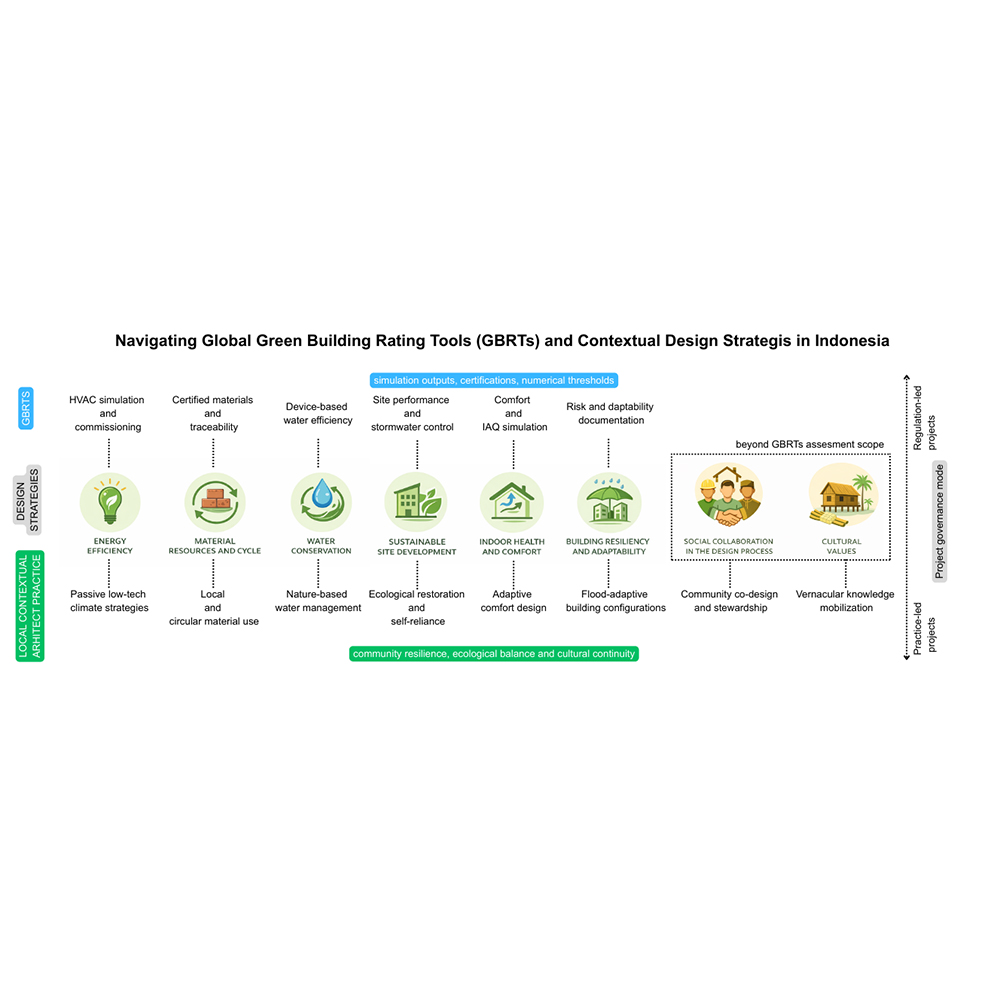
This study investigates how Indonesian architects navigate between global green building rating tools (GBRTs) and context-specific design strategies across different project types and scales. Using a comparative analysis of sixteen award-winning projects by six Indonesian architects, the research combines semi-structured interviews with document review and inductive coding to map design logics against core GBRT categories. The analysis is around six themes used by GBRTs—energy efficiency, material resources and cycles, water conservation, sustainable site development, indoor health and comfort, and building resilience and adaptability—and identifies two additional themes central to Indonesian practice yet largely absent from GBRT assessment—social collaboration in the design process and cultural values. Findings reveal that in small- to medium-scale private and CSR projects, architects exercise greater autonomy to implement low-tech, community-based strategies, including passive cooling, proximate and recycled materials, hydrological restoration, and collaborative building processes. By contrast, large, regulation-led government projects tend to limit sustainability to compliance requirements, resource accounting, and site-level mitigation, often marginalizing socio-cultural dimensions and constraining contextual innovation. Across all design themes, recurring misalignments appear between GBRTs’ measurable proxies and architects’ context-driven values. These frictions show that what counts as sustainability in GBRTs—simulation outputs, certifications, and prescriptive thresholds—does not consistently capture what sustains practice on the ground: community resilience, ecological balance, and cultural continuity. In Indonesia, a context-aligned recalibration that recognizes adaptive comfort, vernacular material cycles, and participatory processes can keep GBRTs rigorous while making them more responsive to climatic logics, cultural values, and long-term stewardship norms.
Article Details

This work is licensed under a Creative Commons Attribution-NonCommercial-NoDerivatives 4.0 International License.
References
Ahuja, S., & Weatherall, R. (2023). “This boys club world is finally getting to me”: Developing our glass consciousness to understand women’s experiences in elite architecture firms. Gender, Work & Organization, 30(3), 826–841. https://doi.org/10.1111/gwao.12921
Andracana, I. G. N. (2023). Green thinking of indonesian architects. Iop Conference Series Earth and Environmental Science, 1169, Article 012070. https://doi.org/10.1088/1755-1315/1169/1/012070
Awadh, O. (2017). Sustainability and green building rating systems: LEED, BREEAM, GSAS and Estidama critical analysis. Journal of Building Engineering, 11(10), 25–29. https://doi.org/10.1016/j.jobe.2017.03.010
Berardi, U. (2015). Sustainability assessments of buildings, communities, and cities. In J. J. Klemes (Ed.), Assessing and measuring environmental impact and sustainability (pp. 497–545). Butterworth-Heinemann. https://doi.org/10.1016/B978-0-12-799968-5.00015-4
Bryman, A. (2016). Social research methods. Oxford university press.
Building Research Establishment. (2021). Technical manual: BREEAM international new construction, version 6.0. https://breeam.com/breeam-infrastructure/technical-manuals/version-6
Chapman, A., Hadfield, M., & Chapman, C. (2015). Qualitative research in healthcare: An introduction to grounded theory using thematic analysis. Journal of the Royal College of Physicians of Edinburgh, 45(3), 201–205. https://doi.org/10.4997/jrcpe.2015.305
Chokor, A., El Asmar, M., Tilton, C., & Srour, I. (2016). Dual assessment framework to evaluate LEED-certified facilities’ occupant satisfaction and energy performance: Macro and micro approaches. Journal of Architectural Engineering, 22(4). https://doi.org/10.1061/(ASCE)AE.1943-5568.0000186
Correia, M., Juvanec, B., Mileto, C., Vegas, F., Gomes, F., Alcindor, M., & Lima, A. (2023). Socio-economic sustainability in vernacular architecture. In M. Correia, L. Dipasquale, & S. Mecca (Eds.), VerSus: Heritage for tomorrow. Vernacular knowledge for sustainable architecture (pp. 56–63). Firenze University Press. https://media.fupress.com/files/pdf/24/2920/2920_7032
Cross, N. (2023). Design thinking: Understanding how designers think and work. Bloomsbury Publishing.
Daly, S. R., Yilmaz, S., Christian, J. L., Seifert, C. M., & Gonzalez, R. (2012). Design heuristics in engineering. Journal of Engineering Education, 101(4), 601–629. https://doi.org/10.1002/j.2168-9830.2012.tb01121.x
De Castro, D., & Kim, A. (2021). Adaptive or absent: A critical review of building system resilience in the LEED rating system. Sustainability, 13(12), Article 6697. https://doi.org/10.3390/su13126697
Dear, R. de. (2020). A review of adaptive thermal comfort research since 1998. Energy and Buildings, 214, Article 109893. https://doi.org/10.1016/j.enbuild.2020.109893
Devos, K., Devlieger, L., & Steeman, M. (2024). Reclaimed or new? Life cycle assessment of ceramic bricks. Journal of Cleaner Production, 476, Article 143764. https://doi.org/10.1016/j.jclepro.2024.143764
Diaz-Sarachaga, J. M., Jato-Espino, D., & Castro-Fresno, D. (2017). Methodology for the development of a new sustainable infrastructure rating system for developing countries (SIRSDEC). Environmental Science & Policy, 69, 65–72. https://doi.org/10.1016/j.envsci.2016.12.010
Gan, J., Chen, M., Semple, K., Liu, X., Dai, C., & Tu, Q. (2022). Life cycle assessment of bamboo products: Review and harmonization. Science of The Total Environment, 849, Article 157937. https://doi.org/10.1016/j.scitotenv.2022.157937
Ge, J., Wang, Y., Zhou, D., Gu, Z., & Meng, X. (2024). Effects of urban vegetation on microclimate and building energy demand in winter: An evaluation using coupled simulations. Sustainable Cities and Society, 102, Article 105199. https://doi.org/10.1016/j.scs.2024.105199
Gramkow, M. C., Merit, M. T., & Stigsdotter, U. K. (2022). A qualitative study on how Danish landscape architectural firms understand and work with accessibility. Archnet-IJAR: International Journal of Architectural Research, 16(3), 536–553. https://doi.org/10.1108/ARCH-08-2021-0233
Green Building Council Indonesia. (2024). GREENSHIP new building v1.2 (Green building rating tool). https://gbcindonesia.org/files/resource/9b552832-b500-4b73-8c0e-acfaa1434731/Summary%20GREENSHIP%20New%20Building%20V1.2.pdf
Griffiths, K., Boyle, C., & Henning, T. F. P. (2018). Beyond the certification badge—how infrastructure sustainability rating tools impact on individual, organizational, and industry practice. Sustainability, 10(4), Article 1038. https://doi.org/10.3390/su10041038
Hanan, H., & Wonorahardjo, S. (2012). The architecture of Batak Toba: An expression of living harmoniously. Nakhara: Journal of Environmental Design and Planning, 8, 11–21. https://ph01.tci-thaijo.org/index.php/nakhara/article/view/104899
Hartley, K. (2020). The epistemics of policymaking: From technocracy to critical pragmatism in the UN sustainable development goals. International Review of Public Policy, 2(2), 233–244. https://doi.org/10.4000/irpp.1242
Illankoon, I. M. C. S., Tam, V. W. Y., Le, K. N., Tran, C. N. N., & Ma, M. (2019). Review on green building rating tools worldwide: recommendations for Australia. Journal of Civil Engineering and Management, 25(8), 831–847. https://doi.org/10.3846/jcem.2019.10928
Isaksson, R., Rosvall, M., Espuny, M., Nunhes, T. V., & de Oliveira, O. J. (2022). How is building sustainability understood? A study of research papers and sustainability reports. Sustainability, 14(19), Article 12430. https://doi.org/10.3390/su141912430
Iwuanyanwu, O., Gil-Ozoudeh, I., Okwandu, A. C., & Ike, C. S. (2024). Cultural and social dimensions of green architecture: Designing for sustainability and community well-being. International Journal of Applied Research in Social Sciences, 6(8), 1951–1968. https://doi.org/10.51594/ijarss.v6i8.1477
Jeannotte, M. S., & Duxbury, N. (2015). Advancing knowledge through grassroots experiments: Connecting culture and sustainability. The Journal of Arts Management, Law, and Society, 45(2), 84–99. https://doi.org/10.1080/10632921.2015.1039739
Jiang, Z., Kobayashi, T., Yamanaka, T., & Sandberg, M. (2023). A literature review of cross ventilation in buildings. Energy and Buildings, 291, Article 113143. https://doi.org/10.1016/j.enbuild.2023.113143
Junaidy, D. W., & Nagai, Y. (2017). The characteristic of thought of digital architects. International Journal of Creative Future and Heritage (TENIAT), 5(1), 41–73. https://doi.org/10.47252/teniat.v5i1.210
Khan, J. S., Zakaria, R., Shamsudin, S. M., Abidin, N. I. A., Sahamir, S. R., Abbas, D. N., & Aminudin, E. (2019). Evolution to emergence of green buildings: A review. Administrative Sciences, 9(1), Article 6. https://doi.org/10.3390/admsci9010006
Kusno, A. (2010a). The appearances of memory: Mnemonic practices of architecture and urban form in Indonesia. Duke University Press.
Kusno, A. (2010b). Tropics of discourse: Notes on the re-invention of architectural regionalism in Southeast Asia in the 1980s. Fabrications, 19(2), 58–81. https://doi.org/10.1080/10331867.2010.10539658
Lam, W. H., Wong, C. F., Tan, O. K., & Yap, B. H. (2024). Study on the benefits of the implementation of green building rating in Malaysia. The Journal of The Institution of Engineers Malaysia, 85(1), 17–24. https://doi.org/10.54552/v85i1.226
Lee, J. W., Daly, S. R., Huang-Saad, A., Rodriguez, G., & Seifert, C. M. (2020). Cognitive strategies in solution mapping: How engineering designers identify problems for technological solutions. Design Studies, 71, Article 100967. https://doi.org/10.1016/j.destud.2020.100967
Li, S., & Qu, F. (2022). Preserving authenticity in urban regeneration: A framework for the new definition from the perspective of multi-subject stakeholders—a case study of Nantou in Shenzhen, China. International Journal of Environmental Research and Public Health, 19(15), Article 9135. https://doi.org/10.3390/ijerph19159135
Liu, F., & Kang, J. (2016). A grounded theory approach to the subjective understanding of urban soundscape in Sheffield. Cities, 50, 28–39. https://doi.org/10.1016/j.cities.2015.08.002
Makwaney, D. (2021). The Pritzker Prize for architects: A critical analysis of gender and identity [Master’s thesis, Deakin University]. ResearchGate. https://www.researchgate.net/publication/350371544.
Marshall, B., Cardon, P., Poddar, A., & Fontenot, R. (2013). Does sample size matter in qualitative research? A review of qualitative interviews in is research. Journal of Computer Information Systems, 54(1), 11–22. https://doi.org/10.1080/08874417.2013.11645667
Mastrucci, A. (2019). Improving the SDG energy poverty targets: Residential cooling needs in the Global South. Energy and Buildings, 186, 405–415. https://doi.org/10.1016/j.enbuild.2019.01.015
Memmott, P., & Keys, C. (2015). Redefining architecture to accommodate cultural difference: Designing for cultural sustainability. Architectural Science Review, 58(4), 278–289. https://doi.org/10.1080/00038628.2015.1032210
Memmott, P., Vellinga, M., O’Rourke, T., & Ting, J. (2023). Design and the vernacular: Interpretations for contemporary architectural practice and theory. Bloomsbury Visual Arts
Ministry of Public Works and Housing of the Republic of Indonesia. (2021). Regulation of the Minister of Public Works and Housing of the Republic of Indonesia No. 21 of 2021 on green building performance assessment. Ministry of Public Works and Housing of the Republic of Indonesia.
Ministry of Public Works and Housing of the Republic of Indonesia. (2024). Roadmap for the implementation and guidance of green building (GB) development. https://ciptakarya.pu.go.id/admin/assets/upload/file/laporan/2024/10/10/205512_PETA%20JALAN%20PENYELENGGARAAN%20PEMBINAAN%20BGH_OKT%202024.pdf
Musa, C., & Burgess, G. (2022). Beyond policy change: The complexity of transitioning to alternative building materials in informal settlements. Reginal Studies Association. https://doi.org/10.1080/13673882.2023.00001002
Nabilunnuha, M. B., Hervanda, S., Xian, G. E., Tjong, A., Indarti, F. R., Nuffida, N. E., Ardhyanto, A., & Novianto, D. (2022). Sustainability principle in Nusantara architecture: Case study of the Tongkonan House, the Betawi Stage House, the Gadang House, and Lamin House. IOP Conference Series: Earth and Environmental Science, 1007, Article 012015. https://doi.org/10.1088/1755-1315/1007/1/012015
Nielsen, S. D. (2022). Architectural sustainability as a cultural practice. In A. E. Toft & M. Rönn (Eds.), Northernness Proceedings Series 2022–1 (pp. 139–161). Nordic Academic Press of Architectural Research. https://research.chalmers.se/publication/534388/file/534388_Fulltext.pdf
Olukoya, O. A. P., & Atanda, J. O. (2020). Assessing the social sustainability indicators in vernacular architecture—application of a green building assessment approach. Environments, 7(9), Article 67. https://doi.org/10.3390/environments7090067
Paramita, K. D., Atmodiwirjo, P., & Sinuraibhan, S. (2022). Learning from contextual material practices in architecture: Exploring nature-based materials in Indonesia and Thailand. IOP Conference Series: Earth and Environmental Science, 1098(1), Article 012040. https://doi.org/10.1088/1755-1315/1098/1/012040
Pareti, S., Valdebenito, V., Rudolph, L., & Bustamante, C. (2022). Green energy and environmental sustainability on vernacular architecture. The case of Ayllus of Atacama Desert and stilt houses of Chiloe. IOP Conference Series: Earth and Environmental Science, 1094, Article 012003. https://doi.org/10.1088/1755-1315/1094/1/012003
Park, J.-W. (2024). From physics to environmental policy: Exploring Boltzmann distribution for carbon trading permit allocation. Nakhara: Journal of Environmental Design and Planning, 23(1), Article 405. https://doi.org/10.54028/NJ202423405
Peltason, R., & Ong-Yan, G. (2017). Architect: The pritzker prize laureates in their own words. Hachette UK.
Peters, T. (2015). Sustaining the local: An alternative approach to sustainable design. Architectural Design, 85(2), 136–141. https://doi.org/10.1002/ad.1889
Purwaningrum, D. A. (2019). Perplexing discourse of Indonesian architectural identity: An understanding of contemporary Nusantaran architecture. International Journal of Architecture and Urban Studies, 4(2), 5–17. https://www.researchgate.net/publication/338710499_PERPLEXING_DISCOURSE_OF_INDONESIAN_ARCHITECTURAL_IDENTITY_AN_UNDERSTANDING_OF_CONTEMPORARY_NUSANTARAN_ARCHITECTURE
Purwaningrum, D. A. (2021). Indonesian architecture and being Indonesian: Contemporary context of Nusantaran architecture in architectural design and theory [Doctoral dissertation, The University of Melbourne]. https://minerva-access.unimelb.edu.au/bitstream/handle/11343/277047/236a5c5d-e139-eb11-94cd-0050568d0279_PURWANINGRUM-DissertationFinal-29June2021.pdf
Rashid, M., & Ara, D. R. (2015). Modernity in tradition: Reflections on building design and technology in the Asian vernacular. Frontiers of Architectural Research, 4(1), 46–55. https://doi.org/10.1016/j.foar.2014.11.001
Ray, S., Haque, M., Sakib, Md. N., Mita, A. F., Rahman, M. D. M., & Tanmoy, B. B. (2021). Use of ceramic wastes as aggregates in concrete production: A review. Journal of Building Engineering, 43, Article 102567. https://doi.org/10.1016/j.jobe.2021.102567
Razman, R., Khaw, S. T., Md Noh, N. I. F., Ng, J. L., Abd Wahid, A. Z., & Yasin, M. N. (2023). Readiness of Malaysia’s construction industry in adopting green building rating tools. IOP Conference Series: Earth and Environmental Science, 1205, Article 012031. https://doi.org/10.1088/1755-1315/1205/1/012031
Reid, J., & Rout, M. (2020). Developing sustainability indicators–the need for radical transparency. Ecological Indicators, 110, Article 105941. https://doi.org/10.1016/j.ecolind.2019.105941
Riaubiene, E., Navickeinė, E., & Dijokienė, D. (2023). The profile of Lithuanian architects in relation to the professional generations active today. Landscape Architecture and Art, 22(22), 69–80. https://doi.org/10.22616/j.landarchart.2023.22.07
Robati, M., Oldfield, P., Nezhad, A. A., Carmichael, D. G., & Kuru, A. (2021). Carbon value engineering: A framework for integrating embodied carbon and cost reduction strategies in building design. Building and Environment, 192, Article 107620. https://doi.org/10.1016/j.buildenv.2021.107620
Roostaie, S., Kouhirostami, M., Sam, M., & Kibert, C. J. (2021). Resilience coverage of global sustainability assessment framework: A systematic review. Journal of Green Building, 16(2), 23–53. https://doi.org/10.3992/jgb.16.2.23
Saleh, A., Saleh, N., Ali, O., Hasan, R., Ahmed, O., Alias, A., & Yassin, K. (2024). Green building techniques: Under the umbrella of the climate framework agreement. Babylonian Journal of Machine Learning, 2024, 1–14. https://doi.org/10.58496/BJML/2024/001
Salman, M. (2019). Sustainability and vernacular architecture: Rethinking what identity is. In Urban and architectural heritage conservation within sustainability (pp. 1–16). IntechOpen. https://doi.org/10.5772/intechopen.82025
Shan, M., & Hwang, B. (2018). Green building rating systems: Global reviews of practices and research efforts. Sustainable Cities and Society, 39, 172–180. https://doi.org/10.1016/j.scs.2018.02.034
Shaw, I. (2008). Ethics and the practice of qualitative research. Qualitative Social Work, 7(4), 400–414. https://doi.org/10.1177/1473325008097137
Sirror, H. (2024). Lessons learned from the past: Tracing sustainable strategies in the architecture of Al-Ula heritage village. Sustainability, 16(13), Article 5463. https://doi.org/10.3390/su16135463
Stierand, M., & Dörfler, V. (2016). The role of intuition in the creative process of expert chefs. The Journal of Creative Behavior, 50(3), 178–185. https://doi.org/10.1002/jocb.100
Styhre, A., & Brorström, S. (2023). Awards and prizes as control devices: The case of urban development project awards. Organization, 30(5), 1094–1112. https://doi.org/10.1177/13505084211061245
Sujanová, P., Rychtáriková, M., Mayor, T. S., & Hyder, A. (2019). A healthy, energy-efficient and comfortable indoor environment: A review. Energies, 12(8), Article 1414. https://doi.org/10.3390/en12081414
Tienthavorn, T. (2024). Conserving Thailand’s wooden built heritage: Developments, approaches, and current challenges. Nakhara: Journal of Environmental Design and Planning, 23(1), Article 404. https://doi.org/10.54028/NJ202423404
Tuhkanen, H., Cinderby, S., Bruin, A. de, Wikman, A., Adelina, C., Archer, D., & Muhoza, C. (2022). Health and wellbeing in cities–cultural contributions from urban form in the Global South context. Wellbeing, Space and Society, 3, Article 100071. https://doi.org/10.1016/j.wss.2021.100071
United Nations Environment Programme. (2022). 2022 global status report for buildings and construction. https://wedocs.unep.org/items/c22095a1-fbcc-4378-8a42-b87ef3ec724
U.S. Green Building Council. (2025). LEED v4.1: Building design and construction. https://www.usgbc.org/leed/v41
Utami, L. A., Lechner, A. M., Permanasari, E., Purwandaru, P., & Ardianto, D. T. (2022). Participatory learning and co-design for sustainable rural living, supporting the revival of indigenous values and community resiliency in Sabrang village, Indonesia. Land, 11(9), Article 1597. https://doi.org/10.3390/land11091597
Uzunkaya, A., & Paker Kahvecioğlu, N. (2022). Architectural design research through reflection: A sub-approach under “research by design.” Open House International, 47(4), 688–709. https://doi.org/10.1108/OHI-07-2021-0155
Varma, C. R. S., & Palaniappan, S. (2019). Comparision of green building rating schemes used in North America, Europe and Asia. Habitat International, 89, Article 101989. https://doi.org/10.1016/j.habitatint.2019.05.008
Vyas, G. S., & Jha, K. N. (2016). Identification of green building attributes for the development of an assessment tool: A case study in India. Civil Engineering and Environmental Systems, 33(4), 313–334. https://doi.org/10.1080/10286608.2016.1247832
Wali, A., Alvira, D., Tallman, P. S., Ravikumar, A., & Macedo, M. O. (2017). A new approach to conservation: Using community empowerment for sustainable well-being. Ecology and Society, 22(4), Article 6. https://doi.org/10.5751/ES-09598-220406
Wang, M. (2020). The role of local knowledge for rural revitalization in China: Social-ecological lessons learned through disasters, architecture, and education. In D. Fanfani, & A. Matarán Ruiz (Eds.), Bioregional Planning and Design: Volume II: Issues and Practices for a Bioregional Regeneration (pp. 259–278). Springer, Cham. https://doi.org/10.1007/978-3-030-46083-9_15
Walker, E., Jowett, T., Whaanga, H., & Wehi, P. M. (2024). Cultural stewardship in urban spaces: Reviving Indigenous knowledge for the restoration of nature. People and Nature, 6(4), 1696–1712. https://doi.org/10.1002/pan3.10683
Wardhani, D. K., & Susan. (2019). Greenship assessment of indoor health comfort in adaptive reused buildings. In Proceedings of the Annual International Conference on Architecture and Civil Engineering (pp. 236–244). https://dspace.uc.ac.id/bitstream/handle/123456789/2584/Paper2584.pdf?sequence=4
Wasilah, W. (2023). Understanding local architectural forms as a sustainable design transformation. In A. Almusaed, A. Almssad, I. Yitmen, M. Wallhagen, & Y.-F. Yang (Eds.), Integrative approaches in urban sustainability: Architectural design, technological innovations and social dynamics in global contexts. IntechOpen. https://doi.org/10.5772/intechopen.109560
Widiarso, T. (2022). The role of architects’ rationality in the conceptual design creative process [Doctoral dissertation, Institut Teknologi Bandung].
Widiarso, T., Hanan, H., & Tedjo, B. (2021). Rationality as the driver of the creative process in architectural design. Advances in Social Science, Education and Humanities Research, 602, 1–10. https://doi.org/10.2991/assehr.k.211126.001
Widodo, J. (2019). Human, nature, and architecture. ARTEKS, Jurnal Teknik Arsitektur, 4(1), 127–130. https://doi.org/10.30822/arteks.v4i1
Wiles, R., Crow, G., Heath, S., & Charles, V. (2008). The management of confidentiality and anonymity in social research. International Journal of Social Research Methodology, 11(5), 417–428. https://doi.org/10.1080/13645570701622231
Wirjawan, G. (2024). The paradox of sustainability definitions (Shorenstein Asia-Pacific Research Center working paper). Stanford University. https://aparc.fsi.stanford.edu/publication/paradox-sustainability
Wu, S. R., Fan, P., & Chen, J. (2016). Incorporating culture into sustainable development: A cultural sustainability index framework for green buildings. Sustainable Development, 24(1), 64–76. https://doi.org/10.1002/sd.1608
Yakoub, W. A., Eleinen, O. M. A., Mahmoud, M. F., & Elrayies, G. M. (2021). Developing a holistic green urban meter: An analytical study of global assessment tools for urban sustainability. International Journal of Sustainable Development and Planning, 16(2), 263–275. https://doi.org/10.18280/ijsdp.160206
Zainul Abidin, N., & Powmya, A. (2025). Identifying barriers in constructing green buildings in Oman: A study on project contractors’ experience. Built Environment Project and Asset Management, 15(1), 67–84. https://doi.org/10.1108/BEPAM-02-2024-0044
Zhukovskiy, Y. L., Batueva, D. E., Buldysko, A. D., Gil, B., & Starshaia, V. V. (2021). Fossil energy in the framework of sustainable development: Analysis of prospects and development of forecast scenarios. Energies, 14(17), Article 5268. https://doi.org/10.3390/en14175268
